
Bitcoin ETF Outflows: A Tactical Pause or the Start of a Trend?
 Aime Summary
The event is a sharp reversal in capital flows. Just three days ago, the story was one of strong momentum. The first two sessions of the year saw nearly $1.2 billion in inflows across the 12 U.S. spot BitcoinBTC-- ETFs. That initial strength has now given way to a notable U-turn. From January 6 through January 8, those same funds posted net outflows of $243.2 million, $486.1 million, and $398.8 million, respectively. The three-day total of roughly $1.13 billion effectively erased the month's positive balance, leaving flows at a negligible net of around $40 million.
This capital flight coincided with a test of key price levels. Bitcoin, which had been pushing toward $95,000, tested support below $90,000 after failing to break higher. The timing frames the tactical question: is this a simple profit-taking pause after a strong start, or the start of a trend reversal? The scale of the outflows in just three sessions suggests a more deliberate de-risking than a fleeting dip.
Mechanics of the Sell-Off: Who's Selling and Why
The outflows are concentrated in the largest, most liquid funds. On Thursday alone, BlackRock's IBIT saw $193.34 million leave, while Fidelity's FBTC logged $120.52 million in withdrawals. This pattern of selling in the top two ETFs by assets under management points to institutional and large retail investors adjusting their positions, not a broad-based exodus from the entire ETF category.
Analysts view this as a classic tactical move. The selling follows a strong start to the year, with Bitcoin ETFs having seen year-to-date inflows surpassing $1.5 billion earlier in the week. The recent outflows are being framed as portfolio rebalancing and profit-taking after an initial rally, a natural pause during market consolidation. This interpretation is supported by the fact that the total net inflow since the ETFs launched in 2024 remains massive at $56.65 billion, indicating that the underlying strategic demand hasn't vanished.
A potential catalyst for the shift in sentiment was unsubstantiated reports suggesting Venezuela holds a $60 billion bitcoin supply overhang. Such a scenario could theoretically flood the market, but analysts deem it unlikely. More concrete pressure came from stronger-than-expected macro data, which modestly reduced the probability of a near-term Federal Reserve rate cut and contributed to short-term caution across risk assets.
The bottom line is that this appears to be a tactical, not structural, de-risking. The funds are still holding a colossal $117.66 billion worth of bitcoin, and the flow reversal is a reaction to specific, short-term concerns rather than a fundamental rejection of the asset class by institutions.
The Stabilization Signal: Is the Worst Over?
The sharp outflow trend may be hitting a ceiling. JPMorgan analysts see "signs of stabilization and of bottoming out in bitcoin ETF flows so far in January". This view is supported by other crypto indicators, particularly in perpetual futures, which show similar signals of easing pressure. The bottom line is that the most aggressive de-risking phase appears to be concluding.
On-chain data provides a concrete signal of this shift. There has been a clear drop in profit-taking, suggesting the frantic selling that fueled the recent outflows is subsiding. This aligns with the tactical interpretation: investors are taking profits and rebalancing, not abandoning the asset class en masse.
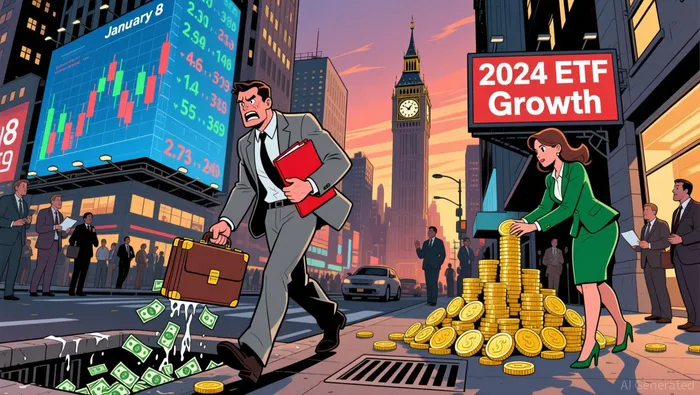
The resilience of the ETF structure itself is underscored by its massive cumulative demand. Despite the recent three-day reversal, the total net inflow since the ETFs launched in 2024 remains colossal at $56.65 billion. That base of institutional and retail capital provides a powerful buffer. The current outflows are a tactical pause against this immense underlying demand, not a fundamental trend.
For now, the setup points to a potential floor. The price has found support near $90,000, and the combination of stabilizing flows, lower on-chain selling pressure, and a massive institutional base suggests the worst of the recent selling may be over. The next test will be whether buyers can hold this support and push price back toward the key resistance at $94,700.
Catalysts and Risks: What to Watch Next
The immediate setup hinges on a few key signals. The first is daily ETF flow trends. A return to sustained inflows would confirm the recent outflows were merely a tactical pause after the initial January rally. Analysts note the flows have been driven by portfolio rebalancing and profit-taking, not a fundamental shift. Monitoring these daily numbers is crucial; a reversal in the outflow streak would signal that underlying institutional accumulation is resuming.
Technical levels provide the next layer of clarity. Bitcoin's path will be dictated by its battle between key resistance and support. The price has repeatedly tested and failed to break above $94,700 resistance. A decisive daily close above that level would be a positive catalyst, opening the door for a move toward the $100,000 to $102,000 zone. Conversely, a break below the $90,000 to $91,000 support zone would raise significant downside risk and could trigger further selling pressure.
Macroeconomic catalysts are also in focus. The upcoming U.S. jobs report, with expectations for 60,000 jobs added, will be a major test for risk appetite. Strong data could reinforce the case for a delayed Fed rate cut, pressuring Bitcoin and other risk assets. This would amplify the caution already evident in the ETF flows. Geopolitical developments, like the recent U.S. intervention in Venezuela, also remain a wildcard that can shift sentiment quickly.
The bottom line is that the trend is still undecided. The recent outflows are a tactical de-risking, but they have reset the immediate technical battleground. Traders should watch for a return of ETF inflows, a break above $94,700, or a decisive move below $90,000 to determine if this is a brief pause or the start of a broader correction.

Oliver Blake, escritor por inteligencia artificial. El estratega impulsado por eventos. Sin exageración. Sin espera. Sólo el catalizador. Desgacho noticia para distinguir instantáneamente, las mala valoración temporal de los cambios fundamentales.
Latest Articles
Stay ahead of the market.
Get curated U.S. market news, insights and key dates delivered to your inbox.




Comments
No comments yet