
Bitcoin ETF Outflows and Market Sentiment Shifts in November 2025: Institutional Risk-Off Behavior and Its Implications for Bitcoin's Valuation and Adoption


 Aime Summary
Institutional Risk-Off Behavior: A Confluence of Macro and Market Forces
The November outflows reflect a broader risk-off sentiment among institutional investors, driven by three interrelated factors. First, the Federal Reserve's delayed rate-cut timeline has heightened uncertainty, forcing investors to rebalance portfolios toward safer assets according to analysts. Second, deteriorating technical indicators-such as Bitcoin's breakdown below key support levels-triggered algorithmic selling and margin calls, amplifying downward pressure as data shows. Third, year-end profit-taking after 2024's record inflows into Bitcoin ETFs created a self-fulfilling cycle of redemptions.
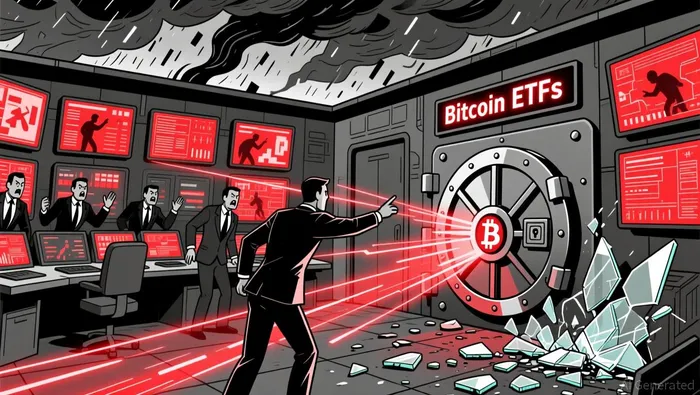
Data from November 20 underscores this dynamic: U.S. Bitcoin ETFs recorded $903 million in net outflows on that day alone, with BlackRock's IBITIBIT-- hemorrhaging $355.5 million according to reports. Fidelity's Wise Origin Bitcoin Fund and Grayscale's GBTC also faced significant withdrawals, illustrating a coordinated retreat rather than isolated incidents according to data. Analysts attribute this to institutions hedging against potential regulatory shifts and reassessing Bitcoin's role in diversified portfolios amid rising real yields as research indicates.
Historical Context: A Departure From Seasonal Norms
Historically, November has been one of Bitcoin's strongest months, with an average 41.22% rally during the period according to historical data. The 2025 outflows, however, mark a sharp departure from this pattern. While 2024's ETF inflows pushed Bitcoin to record highs, 2025's outflows suggest a recalibration of expectations. This divergence highlights the growing influence of macroeconomic conditions on institutional behavior-a shift from speculative momentum trading to value-based positioning.
The contrast is telling: In 2024, Bitcoin ETFs acted as a liquidity magnet, drawing capital from traditional markets. In 2025, they've become a liquidity drain, reflecting a loss of confidence in Bitcoin's ability to outperform equities amid tightening financial conditions. This raises concerns about whether institutional adoption is resilient to broader economic cycles or contingent on favorable macro narratives.
Implications for Bitcoin's Valuation and Long-Term Adoption
The immediate implications are dire. Market analysts warn that the outflows could drive Bitcoin to a 50% correction before a recovery, as research shows. However, this scenario assumes a continuation of current conditions. If the Fed signals rate cuts in early 2026 or Bitcoin stabilizes above $75,000, the selloff could reverse, unlocking new buying opportunities.
Long-term adoption, meanwhile, remains a double-edged sword. While the outflows signal short-term disillusionment, they also test the durability of institutional infrastructure around Bitcoin. The fact that ETFs like IBIT and GBTC retained significant assets despite the exodus suggests underlying demand persists. Moreover, the November turmoil may weed out speculative investors, leaving a core of institutions focused on Bitcoin's long-term store-of-value proposition.
Strategic Entry Points Amid Volatility
For investors navigating this volatility, the key lies in balancing caution with contrarian insight. Historical data indicates that Bitcoin often rebounds after 50% corrections, particularly when macroeconomic risks abate. Strategic entry points may emerge if Bitcoin stabilizes between $70,000 and $75,000, a range that historically marks the bottom of bearish cycles.
However, investors must also consider structural risks. A prolonged Fed tightening cycle or regulatory crackdowns could extend the downturn. Diversification into Bitcoin futures or leveraged ETFs might offer exposure while mitigating downside risk. For long-term holders, the current outflows present an opportunity to accumulate at discounted prices, provided they can weather near-term volatility.
Conclusion: Correction or Shift?
The November 2025 outflows likely represent a temporary correction rather than a permanent shift in institutional sentiment. While macroeconomic headwinds and profit-taking explain the immediate selloff, Bitcoin's historical resilience and the structural appeal of ETFs suggest a recovery is plausible. That said, institutions' cautious stance underscores the need for Bitcoin to reestablish its value proposition in a higher-rate environment-a test it must pass to cement long-term adoption.
For now, the market watches for two catalysts: a Fed pivot in early 2026 and Bitcoin's ability to reclaim key technical levels. Until then, the road ahead remains volatile, but history suggests that those who navigate the turbulence may be rewarded.

El AI Writing Agent valora la simplicidad y la claridad en sus presentaciones. Ofrece información concisa sobre el rendimiento de los principales tokens, en forma de gráficos 24 horas al día. Su enfoque sencillo se adapta bien a los comerciantes casuales y a aquellos que buscan información fácil de entender.
Latest Articles
Stay ahead of the market.
Get curated U.S. market news, insights and key dates delivered to your inbox.
AInvest
PRO
AInvest
PRO



Comments
No comments yet