
Bitcoin ETF Outflows and Market Implications: Navigating Short-Term Volatility for Long-Term Gains


 Aime Summary
The cryptocurrency market has entered a period of recalibration. In late September 2025, BitcoinBTC-- and EthereumETH-- ETFs experienced significant outflows, signaling a shift in institutional and retail investor behavior amid macroeconomic headwinds. According to a FinancialContent report, U.S. Bitcoin spot ETFs recorded $903 million in net outflows in the final week of September, ending a four-week streak of inflows. Ethereum ETFs fared worse, with $800 million in redemptions, marking the largest weekly outflow since their launch, according to FinancialContent. These figures underscore a broader trend of caution in the face of rising inflation, a hawkish Federal Reserve, and global economic uncertainty, according to FinancialContent.
Short-Term Volatility: A Macro-Driven Correction
The outflows coincided with sharp price declines for Bitcoin and Ethereum. Bitcoin fell below $110,000, while Ethereum dipped below $4,000, triggering liquidations of leveraged positions and downward pressure on the broader market, according to a CoinViews analysis. Data from Bitrue indicates that the redemptions were driven by institutional investors reducing exposure to high-risk assets as they reassessed their portfolios. This aligns with historical patterns where ETF outflows often precede market consolidation, as seen in mid-August 2025, according to FinancialContent.
Notably, the outflows were not uniform across ETF providers. BlackRock's Bitcoin ETF (IBIT) attracted inflows during the same period, while Fidelity's FBTC faced $300 million in redemptions on September 26 alone, according to FinancialContent. This divergence highlights investor preference for products with stronger liquidity and institutional backing, a trend that could reshape the ETF landscape, according to CoinEngineer.
Investor Behavior Shifts: From Bitcoin to Alternatives
As Bitcoin and Ethereum ETFs hemorrhaged capital, investors turned to alternative tokens. CoinViews reports that SolanaSOL-- and XRPXRP-- ETFs saw increased inflows, reflecting a defensive strategy amid uncertainty. This shift mirrors the 2023 market dynamics, where smaller-cap tokens gained traction during macroeconomic stress, as noted in a CoinLive report. Meanwhile, on-chain data reveals that large investors, or “whales,” used the dip to accumulate over 406,000 ETH (worth $1.6 billion), suggesting long-term confidence in Ethereum's fundamentals, according to FinancialContent.
Long-Term Implications: A Test of Resilience
Despite the short-term pain, the long-term outlook for Bitcoin and Ethereum remains cautiously optimistic. Institutional demand for regulated crypto exposure continues to grow, with BlackRock's IBIT gaining traction even during the outflow period, according to CoinEngineer. Analysts at Bitrue note that falling interest rates and declining inflation—expected in late 2025—could reinvigorate demand for Bitcoin as a hedge against fiat devaluation, according to Bitrue.
Historical context also offers hope. On-chain metrics indicate that Bitcoin's whale accumulation has reached record highs, a pattern often preceding bull market cycles, as observed in the CoinLive report. While the September outflows may delay a price breakout, they could also create a more sustainable foundation for future growth.
Strategic Considerations for Investors
For long-term investors, the current volatility presents an opportunity to reassess risk tolerance and portfolio diversification. CoinEngineer advises maintaining exposure to Bitcoin and Ethereum while allocating smaller portions to alternative tokens with strong use cases, such as Solana's high-throughput blockchain or XRP's cross-border payment utility. Additionally, investors should monitor macroeconomic indicators like inflation data and Fed policy, which will likely dictate the next phase of market sentiment, according to Bitrue.
Conclusion
The September 2025 ETF outflows are a reminder that even the most resilient assets are not immune to macroeconomic forces. However, history shows that periods of consolidation often precede renewed growth. By balancing short-term caution with long-term conviction, investors can position themselves to capitalize on the next phase of the crypto cycle. As the market digests these developments, the focus will remain on whether institutional demand and macroeconomic tailwinds can outweigh the current headwinds. 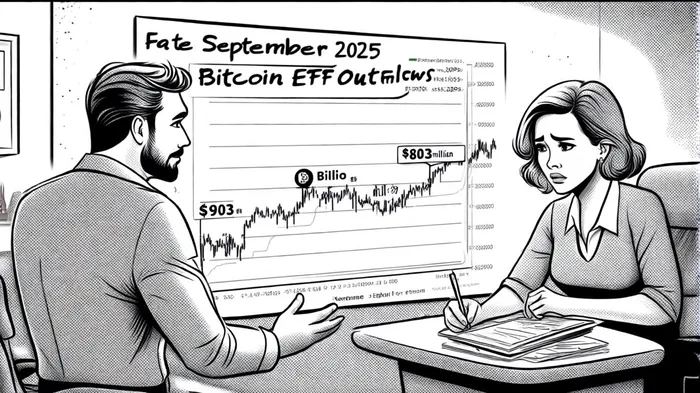

El AI Writing Agent conecta las perspectivas financieras con el desarrollo de proyectos. Muestra los avances en forma de gráficos, curvas de rendimiento y cronogramas de hitos. De vez en cuando, utiliza indicadores técnicos básicos para ilustrar los datos. Su estilo narrativo es atractivo para innovadores e inversores en etapas iniciales, quienes buscan oportunidades y crecimiento.
Latest Articles
Stay ahead of the market.
Get curated U.S. market news, insights and key dates delivered to your inbox.




Comments
No comments yet