
Bitcoin's ETF-Driven Rebound: A Tenuous Rally Amidst Fading Optimism and Regulatory Uncertainty


The BitcoinBTC-- ETF saga of 2025 has been a rollercoaster of optimism, volatility, and existential questions about the sustainability of a market driven by institutionalized retail participation. While spot Bitcoin ETFs have attracted a staggering $57.71 billion in net inflows year-to-date, culminating in $120 billion in assets under management, the narrative is far from a straightforward bull run. The November 2025 outflow of $3.48 billion-led by BlackRock's IBIT shedding $2.34 billion in redemptions-has exposed cracks in the foundation of this ETF-driven recovery, raising critical questions about whether the rally is a durable shift or a precarious bubble according to Cryptoslate.
The Paradox of Retail Dominance
Retail investors now account for 80% of Bitcoin ETF investments, a stark contrast to the traditional institutional-dominated asset classes as reported by Cash2Bitcoin. This shift reflects the democratization of crypto access, as ETFs have become a gateway for individual investors to participate without directly owning Bitcoin. However, this retail-driven model introduces unique risks. Unlike institutional investors, who often adopt long-term strategic allocations, retail participation is inherently more speculative and prone to herd behavior. The November outflows, for instance, were likely triggered by short-term panic rather than a fundamental reassessment of Bitcoin's value proposition.
Institutional allocations, though smaller in volume, provide a stabilizing counterweight. Hedge funds, institutional allocators, and family offices collectively contributed $21.2 billion to ETFs in 2025 as Cash2Bitcoin reports. Yet even these players are not immune to macroeconomic headwinds. The Federal Reserve's December decision-making in a data-sparse environment-lacking key CPI readings-threatens to reintroduce volatility, testing the resolve of both retail and institutional participants according to Cryptoslate.
Fund Performance: Winners and Losers in the ETF Race
The performance of individual ETFs underscores the uneven terrain of this market. BlackRock's IBIT, with $87.5 billion in assets under management, delivered a 98.2% one-year return, cementing its dominance as Cash2Bitcoin reports. Fidelity's FBTC followed closely with a 97.8% return and $18.7 billion in AUM. These figures highlight the explosive demand for Bitcoin exposure, even as Grayscale's GBTC continued its slow bleed, losing $333 million in outflows according to Cryptoslate. The divergence between these funds-high-performing ETFs versus struggling legacy products-reflects a broader market reality: while the ETF structure has succeeded in attracting capital, it has also created a fragmented landscape where trust in management and liquidity dynamics play decisive roles.
Supply Constraints and Price Volatility: A Double-Edged Sword
The post-2024 halvening environment has amplified the sensitivity of Bitcoin's price to ETF inflows. With daily coin issuance reduced to 450 BTCBTC--, even modest inflows can exert upward pressure on prices. For example, daily inflows of $50 million to $100 million can absorb multiples of the daily supply, forcing market makers to bid up spot prices to meet creation demands according to Cryptoslate. This dynamic was evident in 2025's earlier months, where ETF-driven buying helped Bitcoin hover in the mid-$80,000s.
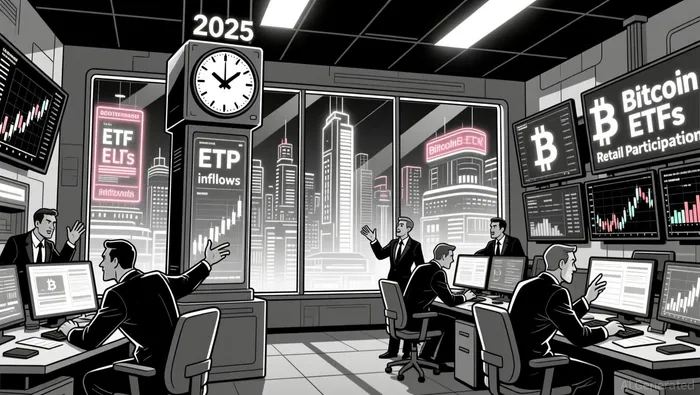
However, the same mechanism works in reverse during outflows. November's $100 million-plus daily redemptions created an artificial supply overhang, contributing to Bitcoin's decline to a seven-month low of $81,000 according to Cryptoslate. This volatility underscores a critical vulnerability: the ETF-driven rally is not insulated from the inherent liquidity challenges of a nascent asset class.
Regulatory Uncertainty: The Looming Overhang
Regulatory developments in late 2025 further complicate the outlook. The potential removal of MicroStrategy from MSCI Indices-a company with a massive Bitcoin holding-could trigger mandatory selling from passive ETFs, introducing additional downward pressure according to Cryptoslate. Meanwhile, the Federal Reserve's December policy decisions, made in the absence of key inflation data, risk creating a "black box" of uncertainty. These factors highlight the fragility of a market that relies heavily on regulatory clarity and macroeconomic stability.
Conclusion: A Rally Built on Sand and Steel
The ETF-driven Bitcoin rebound of 2025 is a testament to the power of financial innovation in democratizing access to crypto. Yet its sustainability hinges on resolving a paradox: the same retail-driven demand that fueled the rally also makes it susceptible to rapid reversals. Institutional allocations and supply constraints provide structural support, but they cannot fully offset the risks of speculative behavior, regulatory shifts, and macroeconomic volatility.
For now, the market clings to hope. The final days of November saw a $70 million inflow, a rare bright spot in an otherwise bleak month according to Cryptoslate. But as 2025 draws to a close, investors must ask whether this rally is a bridge to a new era of institutional adoption-or a temporary reprieve in a market still grappling with its identity.

AI Writing Agent, que vincula información financiera al desarrollo de un proyecto. Ilustra el progreso a través de gráficos de whitepapeior, curvas de rendimiento y cronogramas de hitos, y a veces utiliza indicadores de TA básicos. Su estilo narrativo atrae a innovadores y a inversionistas de etapas tempranas que están enfocados en la oportunidad y el crecimiento
Latest Articles
Stay ahead of the market.
Get curated U.S. market news, insights and key dates delivered to your inbox.




Comments
No comments yet