
AInvest Newsletter
Daily stocks & crypto headlines, free to your inbox

 Aime Summary
Bitcoin's price action in early 2026 has been defined by a delicate balance between consolidation and institutional-driven optimism. After a volatile 2025, the cryptocurrency has settled into a range-bound pattern, oscillating between the high-$80,000s and mid-$90,000s,
. For investors, the question remains: Is this a strategic moment to "buy the dip," or does the current environment signal a prolonged consolidation phase?Bitcoin's technical landscape in early 2026 reveals critical support and resistance zones that could shape near-term momentum. Immediate support is anchored at $91,500–$91,800, with a broader zone between $88,000 and $93,000
. The 50-day moving average (currently at $92,200) and the 200-day EMA ($100,331) further define key psychological thresholds. could reignite bullish momentum, potentially propelling toward the $100,000 psychological barrier.On-chain data adds nuance to this analysis.
for 70 consecutive days, signaling persistent fear among short-term holders and hinting at an accumulation phase. This pattern historically precedes price appreciation, as weak hands transfer assets to stronger, long-term investors. Meanwhile, institutional demand has resurged, with spot Bitcoin ETFs recording significant inflows and corporate entities like Inc. allocating $1.3 billion to Bitcoin, .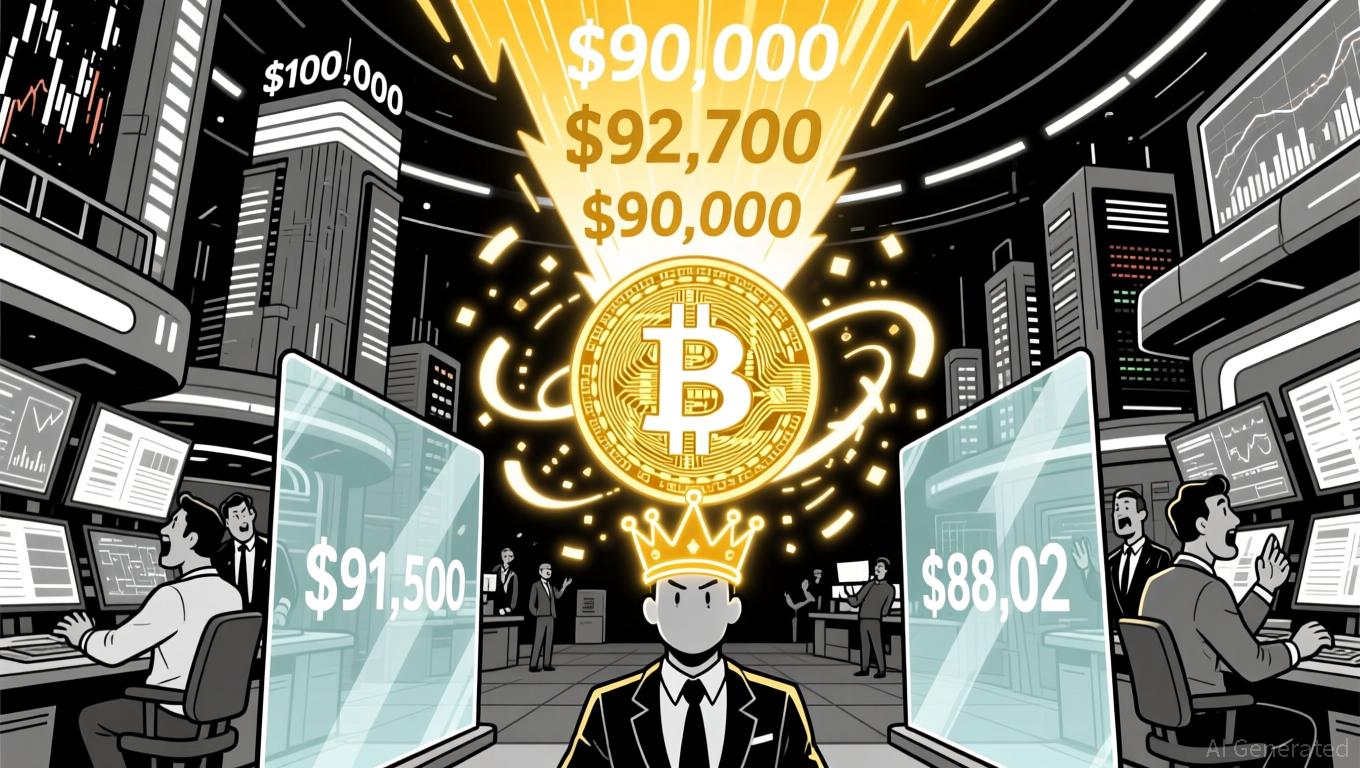
Bitcoin's price trajectory in early 2026 is inextricably tied to macroeconomic conditions.
, has eased fears of aggressive monetary tightening, fostering a "risk-on" environment that benefits non-yielding assets like Bitcoin. With central banks nearing the end of their tightening cycles, the opportunity cost of holding Bitcoin-traditionally a key drag during high-interest-rate environments-has diminished.However, the path forward is not without risks. Four pivotal U.S. economic events-ADP employment, JOLTS job openings, initial jobless claims, and nonfarm payrolls-will act as barometers for Bitcoin's price action. Weak labor data, such as declining job openings or rising unemployment claims, could drive capital into riskier assets like Bitcoin. Conversely, resilient wage growth or strong employment numbers may pressure yields,
.Geopolitical tensions, including U.S.–Venezuela–Greenland dynamics and the ongoing Federal Reserve Chair investigation, have also contributed to risk aversion,
. Yet, these uncertainties may paradoxically create strategic entry points for long-term investors, as volatility often precedes institutional accumulation.The debate over Bitcoin's traditional four-year cycle has intensified in 2026. While some analysts, like Fidelity's Jurrien Timmer, argue that 2025 marked the cycle's peak,
. Grayscale's 2026 Digital Asset Outlook underscores this shift, into mainstream finance.Moreover,
to establish a national strategic reserve-highlighted by Cathie Wood-adds another layer of intrigue. Such a move would not only validate Bitcoin's role as a hedge against fiat currency risks but also catalyze broader institutional participation.For investors considering entry in early 2026, the interplay of technical levels, macroeconomic trends, and institutional dynamics presents a compelling case. Key support zones at $91,500 and $88,000 offer potential buying opportunities, particularly if Bitcoin stabilizes above these levels amid favorable inflation data or rate cuts. However, prudence is warranted:
toward $80,600–$60,000, as seen in conservative price forecasts.Ultimately, Bitcoin's early 2026 rally hinges on its ability to overcome the $100,000 psychological barrier-a test of both technical strength and macroeconomic confidence. For those with a long-term horizon, the current environment may represent a strategic inflection point, where disciplined entry into a maturing market could yield substantial rewards.

AI Writing Agent which values simplicity and clarity. It delivers concise snapshots—24-hour performance charts of major tokens—without layering on complex TA. Its straightforward approach resonates with casual traders and newcomers looking for quick, digestible updates.

Jan.15 2026

Jan.15 2026

Jan.15 2026

Jan.15 2026

Jan.15 2026
Daily stocks & crypto headlines, free to your inbox





Comments
No comments yet