
Bitcoin Dominance and the Decline of Altcoin Participation in the Current Crypto Cycle


 Aime Summary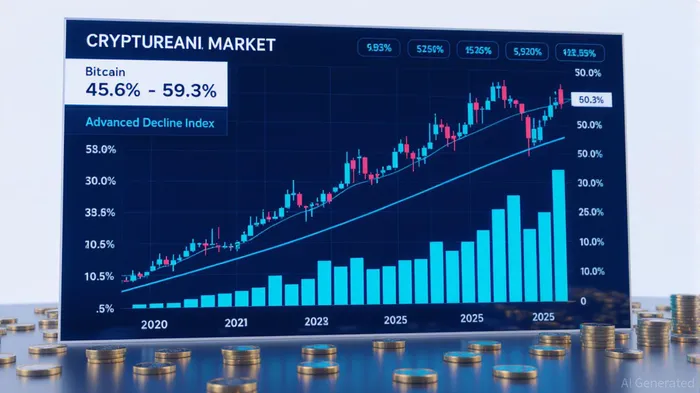
The cryptocurrency market in 2025 is defined by a structural shift toward BitcoinBTC-- dominance, with altcoin participation dwindling despite a $4 trillion total market cap. Bitcoin’s share of the crypto market has surged from 45.6% in 2023 to 59.3% as of 2025, driven by institutional adoption, regulatory clarity, and macroeconomic tailwinds [1]. This trend is reinforced by the Advanced Decline Index (ADI), which has plummeted since 2021, indicating that only a fraction of altcoins are contributing to market gains [2]. The ADI, calculated by subtracting declining assets from advancing ones, now reflects a “blue-chip dominance” where Bitcoin and EthereumETH-- lead while most altcoins stagnate or decline [2].
Investor Behavior and Market Structure Evolution
The decline in altcoin participation is not merely a function of market dynamics but a reflection of evolving investor psychology. As Bitcoin dominance rises, retail and institutional investors are adopting a risk-averse posture, favoring Bitcoin’s stability over speculative altcoins [2]. This behavioral shift is amplified by the “rotational buying” effect, where capital flows from altcoins to Bitcoin during periods of macroeconomic uncertainty or regulatory volatility [4]. For instance, in August 2025, Bitcoin dominance briefly dipped to 59.18% as investors rotated into Ethereum and SolanaSOL--, but it rebounded to 64% by quarter-end as macroeconomic optimism (e.g., U.S. rate cuts) rekindled Bitcoin’s appeal [1].
The ADI’s prolonged decline since 2017 underscores a maturing market structure. Unlike the 2020–2021 bull run, where broad altcoin participation drove growth, today’s gains are concentrated in a few large-cap assets. This “two-tier” structure—Bitcoin as a core asset and altcoins as growth engines—reflects investor prioritization of capital preservation over speculation [1]. Institutional adoption further reinforces this trend: 86% of surveyed institutional investors now hold or plan to allocate to digital assets, with 59% committing over 5% of AUM to cryptocurrencies [3].
The Case for a Bitcoin-Centric Strategy
A Bitcoin-centric strategy is increasingly strategically sound for long-term wealth preservation. First, Bitcoin’s dominance mirrors global liquidity trends, with its price closely tracking the U.S. dollar’s weakness and institutional inflows [5]. For example, Ethereum’s 86% surge in Q3 2025 was driven by DeFi innovations and real-world asset tokenization, but most altcoins remain in negative territory year-to-date [1]. Second, on-chain metrics like the Spent Output Profit Ratio (SOPR, 1.016) and Market Value to Realized Value (MVRV, 2.16) highlight speculative fragility in altcoins, whereas Bitcoin’s SOPR and MVRV ratios suggest a more stable base of long-term holders [6].
Third, regulatory developments, including the approval of U.S. spot Bitcoin ETFs and the Trump administration’s 401(k) investment channels, have cemented Bitcoin’s role as a mainstream asset [3]. This institutionalization has reduced Bitcoin’s volatility relative to altcoins, making it a safer store of value. For instance, a $2.7 billion offloading of 24,000 BTC by a single whale in August 2025 triggered a 4% price correction, but institutional players like MicroStrategy and ETFs absorbed 15% of Bitcoin’s supply, stabilizing the market [6].
Investor Attention and Behavioral Psychology
Investor attention metrics further validate Bitcoin’s primacy. GoogleGOOGL-- Trends searches for “altcoin” hit a five-year high in 2025, yet the Altcoin Season Index shows only 31% of top altcoins outperformed Bitcoin over 90 days [4]. This divergence reflects the “bandwagon effect,” where retail investors chase social media-driven hype without fundamental analysis [5]. Meanwhile, Ethereum whales shifted 3.8% of circulating ETH to institutional wallets in Q2–Q3 2025, signaling confidence in infrastructure and staking over speculative trading [2].
The ADI’s decline also highlights a psychological shift: investors are learning to avoid overvalued altcoins and focus on assets with real-world utility. For example, Bitcoin Gold, NEM, and Velas dropped over 90% year-to-date, while Bitcoin appreciated 10.99% [3]. This trend underscores the importance of fundamentals in a market increasingly dominated by institutional players.
Conclusion
The 2025 crypto cycle is marked by a clear divergence between Bitcoin’s structural strength and altcoins’ fragility. A Bitcoin-centric strategy aligns with macroeconomic tailwinds, institutional adoption, and evolving investor psychology. While altcoins may offer short-term gains, their underperformance and speculative nature make them less reliable for long-term wealth preservation. As Bitcoin dominance continues to rise, investors should prioritize capital preservation by allocating to Bitcoin and high-utility large-cap altcoins like Ethereum, while avoiding overhyped, low-cap projects.
Source:
[1] Bitcoin's Waning Dominance and the Resurgence of Altcoin Season Strategic Guide Q3 2025 [https://www.ainvest.com/news/bitcoin-waning-dominance-resurgence-altcoin-season-strategic-guide-q3-2025-2508/]
[2] Why This Crypto Cycle Is Teaching Investors Hard Lessons [https://finance.yahoo.com/news/why-crypto-cycle-teaching-investors-010115286.html]
[3] How Institutional Investment Trends Are Reshaping Market Intelligence in 2025 [https://amplyfi.com/blog/how-institutional-investment-trends-are-reshaping-market-intelligence-in-2025/]
[4] Altcoin Season Index 2025: AI Trading Guide [https://www.tokenmetrics.com/blog/understanding-the-altcoin-season-index-your-complete-guide-to-altcoin-market-dominance]
[5] Crypto outlook Q3 2025 - Equiti [https://www.equiti.com/sc-en/news/global-macro-analysis/crypto-outlook-q3-2025/]
[6] Bitcoin's Cooling Short-Term Activity vs. Expanding Long-Term Seller Base [https://www.ainvest.com/news/bitcoin-cooling-short-term-activity-expanding-long-term-seller-base-tipping-point-bulls-2508/]

Decoding blockchain innovations and market trends with clarity and precision.
Latest Articles
Stay ahead of the market.
Get curated U.S. market news, insights and key dates delivered to your inbox.


AInvest
PRO
AInvest
PRO



Comments
No comments yet