
Bitcoin Dominance and the Altcoin Season: Strategic Allocation in a Shifting Crypto Landscape
 Aime Summary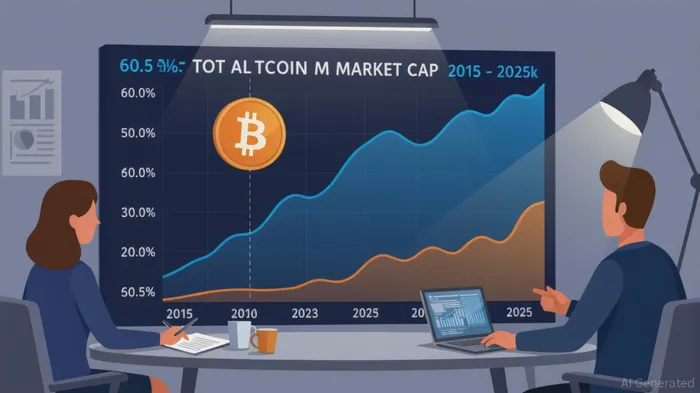
The cryptocurrency market has long been defined by cycles of capital reallocation, with Bitcoin's dominance serving as both a barometer and a harbinger of these shifts. From 2015 to 2025, Bitcoin's market share has oscillated between 31.1% and 64.0%, reflecting broader investor sentiment, technological innovation, and macroeconomic forces. Today, as BitcoinBTC-- dominance stands at 59% in August 2025—down from 64% in early 2025—the market is signaling a potential inflection pointIPCX--. For investors, understanding this metric is not merely academic; it is a strategic imperative for navigating the next phase of the crypto cycle.
The Historical Pattern: Bitcoin Dominance as a Leading Indicator
Bitcoin dominance, calculated as Bitcoin's market capitalization divided by the total crypto market cap, has historically exhibited an inverse relationship with altcoin performance. During bull markets, Bitcoin often leads the initial rally, drawing capital as a “safe haven” asset. As the cycle matures, however, investors tend to rotate into altcoins, seeking higher returns in speculative or innovation-driven projects. This pattern has repeated with uncanny regularity:
- 2017–2018: Bitcoin dominance fell from 87.2% to 31.1% as the ICO boom attracted capital to altcoins like EthereumETH-- and Ripple.
- 2021: Dominance dropped from 70% to 38% during the DeFi and NFT booms, with Ethereum and meme coins surging.
- 2025: After a post-halving rebound to 62.7% in 2024, dominance has now dipped to 59%, suggesting a similar reallocation is underway.
These shifts are not random. They reflect a fundamental truth: Bitcoin acts as a proxy for risk-off sentiment, while altcoins thrive in risk-on environments. When macroeconomic conditions improve (e.g., lower interest rates, regulatory clarity), investors tolerate higher risk, favoring altcoins with growth potential. Conversely, during uncertainty (e.g., Terra-Luna collapse, FTX insolvency), capital flows back to Bitcoin.
The 2025 Context: A New Altcoin Season?
The current decline in Bitcoin dominance—from 64% to 59% in six months—aligns with historical patterns of an emerging altcoin season. Several factors amplify this signal:
- Institutional Adoption of Ethereum: Ethereum's price has surged 54% in the past month, outpacing Bitcoin's 10% gain. Institutional inflows into Ethereum-based ETFs and the approval of yen-pegged stablecoins in Japan and South Korea are fueling demand for altcoins with strong fundamentals.
- Regulatory Tailwinds: Asia's regulatory trials (e.g., South Korea's spot Bitcoin ETF plans) are creating new liquidity pools for altcoins, particularly those tied to decentralized finance (DeFi) and blockchain infrastructure.
- Macroeconomic Drivers: The Federal Reserve's anticipated rate cuts in September and October are likely to reduce the cost of capital, incentivizing investors to seek higher returns in riskier assets like altcoins.
Strategic Allocation: Timing the Cycle with Bitcoin Dominance
For investors, the key lies in leveraging Bitcoin dominance as a predictive tool. Here's how to position a portfolio for the next phase:
- Monitor Bitcoin Dominance Breakdowns: A sustained drop below 55% (a key historical threshold) could signal a full-blown altcoin season. Investors should increase exposure to high-conviction altcoins with strong fundamentals, such as Ethereum-based tokens (e.g., LDO, ARB) or layer-1 blockchains (e.g., SolanaSOL--, Cardano).
- Use the ETH/BTC Ratio as a Proxy: The ETH/BTC ratio has risen from 0.03 to 0.05 in 2025, indicating Ethereum's growing strength relative to Bitcoin. A further rise above 0.06 would reinforce the case for altcoin allocation.
- Diversify Across Beta Levels: While large-cap altcoins (e.g., Ethereum, Solana) offer relative stability, mid- and small-cap tokens (e.g., ENAENTA--, OP) carry higher beta and volatility. A balanced approach—allocating 60% to large-cap altcoins and 40% to high-beta plays—can optimize risk-adjusted returns.
Risk Management: Navigating Volatility
An altcoin season is not without risks. The 2021–2022 collapse of Terra-Luna and FTX serves as a stark reminder of the sector's fragility. To mitigate downside risk:
- Cap Exposure to High-Beta Altcoins: Limit allocations to 10–15% of a crypto portfolio for speculative plays.
- Leverage Options and Derivatives: Platforms like PowerTrade offer altcoin options, enabling investors to hedge against downside risk while maintaining upside potential.
- Rebalance Dynamically: As Bitcoin dominance stabilizes or rebounds, gradually shift capital back to Bitcoin to lock in gains.
Conclusion: A Cyclical Opportunity
Bitcoin dominance is more than a metric—it is a lens through which to view the crypto market's evolving dynamics. In 2025, as the market transitions from a Bitcoin-led recovery to an altcoin-driven phase, investors who recognize the signals will be best positioned to capitalize. By aligning allocations with the rhythm of the cycle, leveraging institutional-grade tools, and maintaining disciplined risk management, strategic investors can navigate the volatility and harness the potential of a maturing crypto ecosystem.
The next chapter of the crypto story is unfolding. The question is not whether an altcoin season will arrive, but whether investors are ready to act.

Decoding blockchain innovations and market trends with clarity and precision.
Latest Articles
Stay ahead of the market.
Get curated U.S. market news, insights and key dates delivered to your inbox.


AInvest
PRO
AInvest
PRO



Comments
No comments yet