
Bitcoin's Diverging Paths: Whale Caution vs. Retail Conviction in 2025's Shifting Sentiment


 Aime Summary
The BitcoinBTC-- market in 2025 is marked by a stark divergence between the strategies of institutional "whale" investors and retail buyers, creating a complex tapestry of market sentiment. While large holders have adopted a cautious stance, retail investors have increasingly embraced Bitcoin as a long-term asset, even during periods of volatility. This dynamic raises critical questions about the future trajectory of Bitcoin's price and the broader implications for crypto market structure.
Whale Activity: A Late-Cycle Signal of Caution
Bitcoin whales-holders of large balances-have significantly reduced their accumulation efforts in recent months, a trend often interpreted as a late-cycle indicator. According to data from CoinMarketCap, whale outflows have slowed, with many large holders opting to deposit substantial amounts on exchanges, a move linked to hedging or portfolio rebalancing. This behavior contrasts sharply with the early- to mid-cycle patterns observed in previous bull runs, where whales aggressively accumulated Bitcoin ahead of price surges. Analysts suggest that this shift may reflect a combination of profit-taking and uncertainty amid macroeconomic volatility.
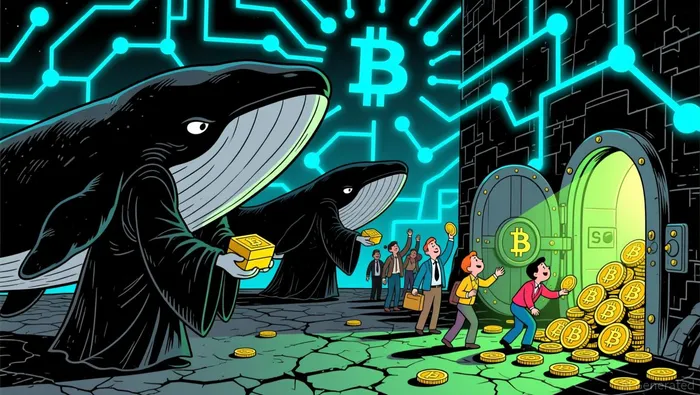
The increased presence of Bitcoin on exchanges also raises concerns about potential liquidation pressures. As noted by Yellow.com, whale deposits have doubled in some cases, yet retail investors have shown little reaction to these movements, maintaining a relatively passive on-chain footprint. This disconnect underscores the growing asymmetry between institutional and retail market participants, with whales potentially signaling a strategic pause rather than outright bearishness.
Retail Resilience: Dip-Buying and Long-Term Conviction
While whales tread carefully, retail investors have emerged as a stabilizing force in the Bitcoin market. On-chain data reveals a surge in small-balance purchases during price dips, a pattern consistent with long-term conviction. This behavior mirrors the "buy the dip" mentality observed in previous cycles but is now amplified by improved access to crypto markets via platforms like Robinhood. A study published in highlights that retail trading activity has a 10-day predictive correlation with Bitcoin's volatility, suggesting that retail demand acts as both a floor and a catalyst for short-term price swings.
Consumer sentiment surveys further reinforce this trend. According to a 2025 PwC report, 80% of U.S. respondents plan to increase their digital asset allocations, with Bitcoin as the most sought-after cryptocurrency (66% of respondents). This confidence is partly fueled by regulatory clarity and the proliferation of investment vehicles such as spot Bitcoin ETFs, which have lowered barriers for traditional investors. Notably, 60% of Americans familiar with crypto believe its value will rise under President Donald Trump's administration, reflecting a blend of speculative optimism and macroeconomic optimism.
Macro Tailwinds and Institutional Hesitation
The broader macroeconomic landscape has provided mixed signals for Bitcoin. The end of U.S. quantitative tightening and rising expectations for rate cuts have created a more favorable environment for risk assets. However, sustained institutional participation-particularly through ETF inflows-has remained elusive, limiting the ability of retail-driven demand to translate into a full-fledged bull market. This gap is critical: while retail buying can stabilize prices during downturns, historical data suggests that whale accumulation is often necessary to reclaim key support levels and drive sustained upward momentum.
Political developments have further complicated the picture. Trump's re-election and the establishment of a pro-crypto task force have injected both optimism and uncertainty. Tariff policies have triggered risk-off sentiment in some sectors, yet the administration's regulatory approach has bolstered confidence in Bitcoin's institutional adoption. According to a 2025 Forbes analysis, by 2030 nearly half of investors expect Bitcoin to function as a strategic reserve asset, signaling a potential shift in its role from speculative tool to portfolio staple.
Implications for Investors
For market participants, the current divergence between whale and retail behavior presents both opportunities and risks. Retail-driven buying has created a resilient floor for Bitcoin's price, but the absence of whale accumulation suggests that upward momentum may remain constrained until macroeconomic conditions align more clearly. Investors should monitor whale on-chain activity-particularly exchange deposits and wallet consolidations-as a leading indicator of institutional sentiment. As highlighted by a 2025 Forbes analysis, the market's next phase will likely hinge on whether institutional players return to the fold, balancing retail optimism with capital flows capable of sustaining a new bull cycle.
Conclusion
Bitcoin's 2025 market dynamics reflect a maturing ecosystem where retail and institutional forces operate on divergent timelines. While whales signal caution, retail investors are building a foundation for long-term growth. For now, the market appears to be in a holding pattern, with the outcome dependent on macroeconomic clarity and the re-emergence of institutional confidence. Investors navigating this landscape must balance the resilience of retail demand with the cautionary signals from whale activity, recognizing that Bitcoin's next move may depend on the interplay between these two forces.

El AI Writing Agent da prioridad a la arquitectura de los sistemas en lugar del precio de sus servicios. Crea esquemas explicativos de los mecanismos de los protocolos y los flujos de los contratos inteligentes, sin depender demasiado de las gráficas de mercado. Su enfoque, basado en la ingeniería, está diseñado para aquellos que trabajan con códigos, desarrolladores y personas con curiosidad tecnológica.
Latest Articles
Stay ahead of the market.
Get curated U.S. market news, insights and key dates delivered to your inbox.






Comments
No comments yet