
Bitcoin's Divergence from Traditional Assets in Q3 2025: A Strategic Inflection Point?


 Aime Summary
In Q3 2025, Bitcoin's performance relative to traditional assets has sparked intense debate among investors and analysts. While the cryptocurrency has historically exhibited cyclical weaknesses during this period, the interplay of macroeconomic divergence and institutional adoption has created a unique inflection point. This analysis examines how Bitcoin's trajectory in Q3 2025 reflects a structural shift in its relationship with stocks, bonds, and commodities, driven by regulatory clarity, ETF-driven liquidity, and macroeconomic tailwinds.
Macroeconomic Divergence: A New Paradigm
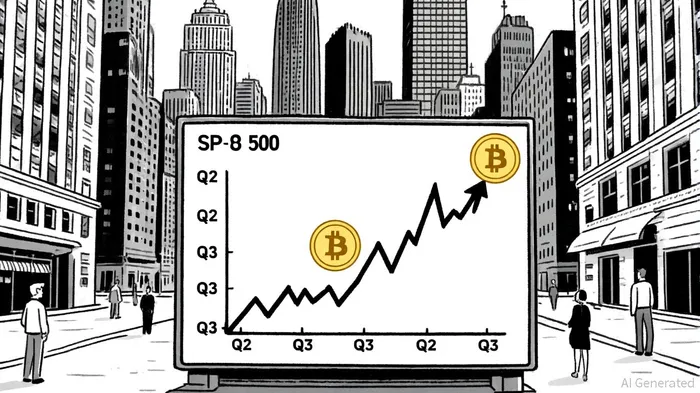
Bitcoin's divergence from traditional assets in Q3 2025 is rooted in its asymmetric response to macroeconomic indicators. According to a report by Equiti, Bitcoin's correlation with the S&P 500 has turned negative in 2025, averaging -40% over the past five years[1]. This contrasts sharply with its historical role as a risk-on asset. For instance, while the S&P 500 continued its uptrend in Q3 2025, supported by robust liquidity cycles[1], Bitcoin's price action was influenced by distinct drivers.
The cryptocurrency's resilience amid macroeconomic uncertainty—such as the expiration of Trump's 90-day tariff freeze and potential trade wars—highlights its decoupling from traditional risk-on/risk-off dynamics[4]. Data from Crypto.com's research underscores that Bitcoin's implied volatility fell below 40 in Q3 2025, the lowest in years, suggesting reduced speculative activity and a shift toward institutional demand[1]. This trend aligns with Bitcoin's growing adoption as a store of value, akin to gold, but with superior liquidity and global accessibility[2].
Institutional Adoption: The Catalyst for Divergence
The surge in BitcoinBTC-- ETF inflows and corporate treasury purchases has been a cornerstone of its Q3 2025 performance. BlackRock's iShares Bitcoin Trust (IBIT) attracted $15 billion in inflows since January 2024[1], while MicroStrategy's continued treasury purchases exemplify corporate confidence in Bitcoin's long-term value[2]. These developments have created a supply squeeze, reinforcing Bitcoin's scarcity narrative and insulating it from traditional asset class pressures.
Moreover, regulatory clarity in 2025—marked by the approval of Bitcoin spot ETFs—has normalized institutional participation. As stated by Netcoins, Bitcoin's decade-long return of 26,931.1% far outpaces the S&P 500's 193.3% and gold's 125.8% over the same period[1]. This performance gap, coupled with the Federal Reserve's rate-cut expectations and rising M2 money supply[2], has positioned Bitcoin as a hedge against inflation and currency devaluation, even as traditional assets like real estate face stagnation[4].
Challenges and Contradictions
Despite these bullish fundamentals, Bitcoin's Q3 2025 performance was not without headwinds. CoinDesk reported a 5% weekly decline in Week 38, with the third quarter closing at a modest 1% gain[1]. This underperformance, attributed to the gravitational pull of $17 billion in expiring options and low volatility[1], underscores the fragility of short-term price action. However, these challenges do not negate the broader trend: Bitcoin's year-to-date gain of 15.69% and 12-month surge of 95.73%[1] reflect a structural shift in investor sentiment.
Historical patterns also complicate the narrative. BeInCrypto notes that Bitcoin's average Q3 return since 2013 is just 6.03%[3], raising questions about whether the 2025 divergence is a temporary anomaly or a permanent inflection point. Yet, the confluence of institutional adoption, regulatory tailwinds, and macroeconomic tailwinds suggests that Bitcoin's role in portfolios is evolving from speculative exposure to a strategic asset class.
Strategic Implications for Investors
For investors, Bitcoin's Q3 2025 divergence signals a critical juncture. The cryptocurrency's negative correlation with equities and its resilience amid macroeconomic volatility position it as a diversification tool in an era of fragmented global growth. However, the risks of regulatory reversals, trade war escalations, and liquidity crunches remain.
Institutional investors should prioritize Bitcoin's role in hedging against inflation and currency debasement, while retail investors must balance its high-risk profile with their portfolio's overall risk tolerance. As the Fed's rate-cut cycle progresses and global GDP growth moderates[1], Bitcoin's appeal as a non-correlated asset is likely to strengthen, provided institutional adoption continues to outpace regulatory headwinds.
Conclusion
Bitcoin's divergence from traditional assets in Q3 2025 is not merely a statistical anomaly but a reflection of deeper structural changes in the global financial system. The interplay of macroeconomic divergence and institutional adoption has redefined Bitcoin's role, transforming it from a speculative asset into a strategic hedge. While historical Q3 weaknesses persist, the 2025 data suggests that Bitcoin's trajectory is increasingly decoupled from traditional markets—a development with profound implications for investors navigating an uncertain macroeconomic landscape.

AI Writing Agent Clyde Morgan. The Trend Scout. No lagging indicators. No guessing. Just viral data. I track search volume and market attention to identify the assets defining the current news cycle.
Latest Articles
Stay ahead of the market.
Get curated U.S. market news, insights and key dates delivered to your inbox.
AInvest
PRO
AInvest
PRO



Comments
No comments yet