
Bitcoin's Distribution Phase: A Buying Opportunity Amid Short-Term Holder Capitulation


 Aime Summary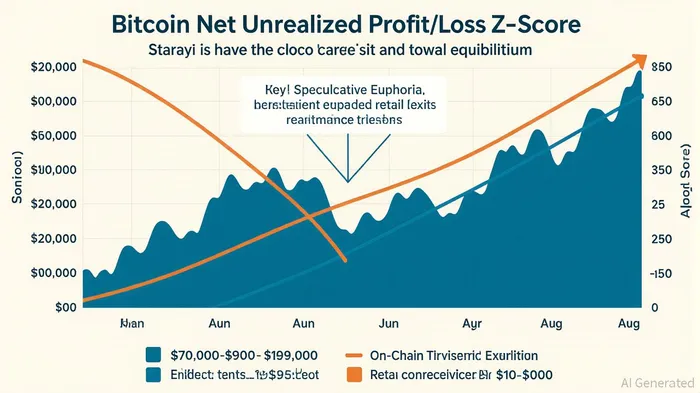
Bitcoin's on-chain metrics in August 2025 paint a paradox: while short-term holders (STHs) are capitulating amid volatility, institutional and whale activity suggests a strategic accumulation phase. This divergence creates a compelling contrarian opportunity for investors who can distinguish between temporary pain and long-term positioning.
The Distribution Phase: A Market in Transition
Bitcoin's recent pullback from $109,000 to $70,000–$85,000 has triggered a recalibration of investor sentiment. The Net Unrealized Profit/Loss (NUPL) metric, which measures the proportion of BitcoinBTC-- supply held in profit or loss, has retreated sharply from overbought levels. This decline reflects a broad-based shift in STH behavior, as speculative gains are realized or liquidated. Similarly, the MVRV Z-Score, which compares Bitcoin's market value to its realized value, has normalized after peaking in early 2025. These indicators confirm a distribution phase, where retail investors—often the first to exit during uncertainty—are reducing exposure.
The Realized P/L metric further underscores this trend. As of August 2025, the balance between realized gains and losses has stabilized, signaling a market no longer driven by euphoria. Daily active addresses and transaction fees have also declined, pointing to reduced speculative activity. However, this is not a bearish signal—it is a structural reset.
Institutional Accumulation: The Whale Playbook
While STHs are retreating, institutional and whale behavior tells a different story. The CryptoQuant Exchange Whale Ratio has surged to its highest level since September 2024, indicating a surge in large-scale movements of Bitcoin into cold storage. This pattern mirrors pre-bull market dynamics observed in 2019, where whales and institutions capitalized on dips to lock in long-term positions.
Whale accumulation has been particularly aggressive. During Q2–Q3 2025, whales added 16,000 BTC during market retracements, with a Whale Accumulation Score of 0.90. This score, a proxy for institutional confidence, aligns with historical bull market triggers. Notably, wallets holding 10,000+ BTC have shown a clear intent to accumulate, while the UTXO Age Distribution reveals a 5% increase in the “Over 8 Years” bucket—a sign that long-term holders (LTHs) are deepening their conviction.
Institutional adoption has also reached a tipping point. Over 70 public companies now hold Bitcoin in their treasuries, with MicroStrategy's $73.962 billion BTC position serving as a bellwether. Meanwhile, BlackRock's IBITIBIT-- ETF, managing $70 billion in assets, has become a liquidity driver. On July 19, 2025, IBIT recorded a record $496.8 million inflow, directly influencing Bitcoin's price trajectory. These flows highlight the growing dominance of institutional capital in shaping Bitcoin's short-term volatility.
Contrarian Logic: Buying the Dip, Not the Noise
The current market environment is defined by a bifurcation: retail investors are exiting speculative bets, while institutions are deploying capital. This dynamic creates a unique inflection point. Short-term holders, who once drove price momentum, are now a source of selling pressure. In contrast, institutional accumulation—evidenced by cold storage inflows, ETF dominance, and UTXO age trends—suggests a market being positioned for a multi-year bull cycle.
The Gini coefficient, a measure of wealth concentration, has risen modestly to 0.4677, indicating a slight consolidation of Bitcoin's supply among large holders. While this may raise concerns about liquidity, it also reflects a maturing market where strategic positioning outweighs retail-driven noise.
Investment Implications
For investors, the key takeaway is clear: Bitcoin's distribution phase is not a bear market—it is a redistribution of power from speculative retail traders to institutional actors. This shift creates a buying opportunity for those with a long-term horizon.
- Positioning for Institutional Flows: Allocate capital to Bitcoin ETFs like IBIT, which act as conduits for institutional demand.
- Monitoring On-Chain Signals: Track the CryptoQuant Exchange Whale Ratio and UTXO Age Distribution to gauge institutional confidence.
- Hedging Short-Term Volatility: Use options or futures to hedge against near-term dips while maintaining exposure to Bitcoin's long-term trajectory.
In conclusion, Bitcoin's current phase is a masterclass in contrarian investing. While short-term holders are capitulating, institutions are laying the groundwork for a new bull cycle. For those who can navigate the noise, the rewards are substantial. As the adage goes: “The trend is your friend.” In this case, the trend is institutional accumulation—and it is gaining momentum.

Decoding blockchain innovations and market trends with clarity and precision.
Latest Articles
Stay ahead of the market.
Get curated U.S. market news, insights and key dates delivered to your inbox.






Comments
No comments yet