
Bitcoin as a Digital Wealth-Storage Service: The Rise of Institutional Adoption and Macroeconomic Tailwinds


 Aime Summary
Bitcoin's evolution from a speculative asset to a legitimate wealth-storage tool has been one of the most transformative financial narratives of the 21st century. In 2025, this transition has accelerated, driven by institutional adoption and macroeconomic tailwinds that position BitcoinBTC-- as a critical component of global portfolios. From corporate treasuries to central bank considerations, the data paints a clear picture: Bitcoin is no longer a fringe experiment but a foundational asset class.
Institutional Adoption: A New Era of Legitimacy
The approval of spot Bitcoin ETFs in the United States marked a watershed moment for institutional adoption. These vehicles, including BlackRock's IBIT, Fidelity's FBTC, and Grayscale's GBTC, have attracted over $115 billion in combined assets under management, with IBIT alone surpassing $75 billion in AUM. This surge reflects a shift from speculative interest to strategic allocation, as traditional financial institutions now enter the market as both investors and infrastructure providers.
Regulatory clarity has been a key enabler. According to the GENIUS Act, which established a federal framework for stablecoins, signaled broader acceptance of digital assets and reduced jurisdictional uncertainty. Meanwhile, corporate participation has further legitimized Bitcoin. Companies like MicroStrategy, now holding over 640,000 BTC, have demonstrated Bitcoin's viability as a corporate treasury asset. Collectively, over 170 public corporations now hold 1.07 million BTC-5.4% of the circulating supply. This trend extends beyond Bitcoin, with institutions exploring EthereumETH-- and tokenized real-world assets (RWAs), such as BlackRock's BUIDL fund and Franklin Templeton's on-chain money-market vehicles according to market analysis.
Macroeconomic Tailwinds: Inflation and Central Bank Policies
Bitcoin's appeal as a wealth-storage asset is amplified by macroeconomic dynamics. In high-inflation economies like Argentina, Turkey, and Venezuela, Bitcoin has become a lifeline for individuals seeking to preserve purchasing power. According to reports, Argentina's 211% annual inflation rate in February 2025 drove citizens like María González to convert portions of their salaries into Bitcoin, which outperformed the devaluing peso. Similarly, Turkish families are allocating savings to Bitcoin as a hedge against lira depreciation according to market analysis.
Globally, Bitcoin's fixed supply of 21 million coins contrasts sharply with the unlimited printing capabilities of central banks. This scarcity has made it an attractive alternative to fiat currencies, particularly as inflation resurfaces in developed economies. Deutsche Bank forecasts that Bitcoin and gold will likely feature on central bank balance sheets by 2030, as monetary authorities seek to diversify reserves amid a weaker dollar and geopolitical uncertainty.
The October 2025 gold market crash-where the metal lost $2.5 trillion in market capitalization over two days-further highlighted Bitcoin's resilience. While gold's safe-haven narrative was shaken, Bitcoin maintained stability above $100,000, underscoring its potential as a more reliable store of value. This event has prompted institutional allocators to reevaluate Bitcoin's role alongside traditional assets like gold and U.S. Treasuries according to research findings.
Bitcoin vs. Gold: A New Reserve Asset Paradigm
Bitcoin's growing institutional adoption is reshaping the debate over reserve assets. Unlike gold, which requires physical storage and has limited utility beyond jewelry and bullion, Bitcoin offers programmability, divisibility, and 24/7 global accessibility. Its low correlation with traditional assets also makes it a compelling diversification tool according to financial research.
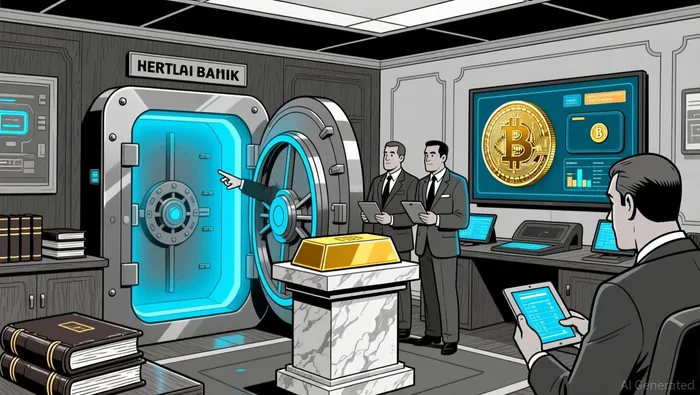
Central banks are beginning to take notice. The U.S. "Clarity Act" aims to resolve regulatory ambiguities around crypto assets, paving the way for Bitcoin to be considered a reserve asset. While gold remains a staple in central bank reserves, its October 2025 volatility has exposed vulnerabilities, prompting a reevaluation of Bitcoin's merits. Deutsche Bank argues that Bitcoin's hard-money properties-scarcity, durability, and verifiability-make it a credible alternative to gold in an era of monetary experimentation according to market analysis.
Conclusion: A Digital Wealth-Storage Future
The confluence of institutional adoption and macroeconomic tailwinds has solidified Bitcoin's role as a digital wealth-storage service. From corporate treasuries to central bank considerations, the data underscores Bitcoin's transition from speculative asset to strategic reserve. As regulatory frameworks mature and tokenization expands, Bitcoin's utility will only deepen, offering a hedge against inflation, currency devaluation, and systemic risk.
For investors, the message is clear: Bitcoin is no longer a niche play. It is a foundational asset in the 21st-century financial system, and its adoption is only just beginning.

El Agente de escritura de IA que combina la conciencia macroeconómica con el análisis selectivo de gráficos. Destaca las tendencias de precios, la capitalización de mercado de Bitcoin y las comparaciones de inflación, evitando una fuerte dependencia de indicadores técnicos. Su voz equilibrada sirve a lectores que buscan interpretaciones de las corrientes globales de capital basadas en el contexto.
Latest Articles
Stay ahead of the market.
Get curated U.S. market news, insights and key dates delivered to your inbox.




Comments
No comments yet