
Bitcoin as a Digital Hedge: Navigating U.S. Government Shutdowns and Geopolitical Uncertainty


 Aime Summary
As the U.S. government shutdown of October 2025 unfolds, Bitcoin's price has surged past $118,000, defying traditional market trends and signaling a shift in investor behavior. This surge, juxtaposed with gold's record high of $3,900 per ounce and the S&P 500's mixed performance, underscores the growing role of digital assets as a hedge against political and fiscal instability. To understand this dynamic, we must dissect Bitcoin's historical behavior during U.S. government shutdowns, its interplay with traditional safe-haven assets, and its evolving response to broader geopolitical tensions.
Historical Performance During U.S. Government Shutdowns
Bitcoin's reaction to U.S. government shutdowns has been far from uniform. During the 2013 shutdown-a 16-day event that coincided with the final stages of a bull cycle-Bitcoin's price surged by 14%, rising from $132.04 to $151.34, according to a 2024 study. However, this figure contrasts with another report from Finance Magnates noting an 80% increase from $133 to over $1,000 during the same period, highlighting the need to contextualize Bitcoin's movements within broader market cycles. In contrast, the 2018–2019 shutdown, the longest in U.S. history at 35 days, saw BitcoinBTC-- fall by 6%, declining from $3,802.22 to $3,575.85, according to that 2024 study. This divergence reflects the influence of macroeconomic conditions: 2013 occurred amid a bull market, while 2018–2019 unfolded during a bear phase, as noted in the Finance Magnates piece.
The 2025 shutdown, however, has bucked historical trends. Amid a backdrop of elevated political uncertainty and delayed economic data releases, Bitcoin has climbed above $114,000, with a sharp rise to $118,000 observed as traditional markets faltered, according to Bitcoin Magazine. This surge aligns with Bitcoin's growing perception as a decentralized alternative to fiat currencies, particularly during periods of institutional dysfunction.
Digital Assets vs. Traditional Safe-Haven Assets
Bitcoin's performance during the 2025 shutdown must be contextualized against traditional safe-haven assets. Gold, for instance, has surged to $3,900 per ounce, driven by its established role as a store of value during political instability, as reported in a CNBC piece. Meanwhile, the S&P 500 has exhibited mixed signals, with short-term declines tempered by historical resilience-previous shutdowns have seen the index recover within 12 months, according to Yahoo Finance.
Bitcoin's recent outperformance relative to gold and equities suggests a shift in investor sentiment. While gold's appeal lies in its low volatility and centuries-old track record, ByteTree research found a 12.3% gain for Bitcoin in May 2025-compared to gold's flat performance-highlighting its potential as a "risk-on" hedge (ByteTree research). This dynamic is further amplified by declining U.S. Treasury yields, which historically correlate with Bitcoin's price action, as also discussed in the ByteTree piece.
Geopolitical Events and Bitcoin's Safe-Haven Potential
Beyond U.S. government shutdowns, Bitcoin's behavior during geopolitical events offers critical insights. During the 2018–2020 U.S.-China trade war, Bitcoin's price volatility spiked, reflecting its dual identity as both a speculative asset and a potential hedge, as covered in a Finance Magnates analysis. Similarly, the 2025 escalation of U.S.-China trade tensions triggered a sharp sell-off in Bitcoin, according to a FinancialContent review.
However, Bitcoin's resilience during the 2023 banking sector turmoil and the October 2025 political instability-where it demonstrated safe-haven characteristics alongside gold-suggests maturation in its market role, as argued in Bitcoin's Ascent. A 2025 study noted that while its volatility persists, institutional adoption and regulatory clarity (e.g., the 2024 U.S. spot Bitcoin ETF approval) have enhanced its legitimacy as a diversification tool, as the Bitcoin's Ascent article explains.
The Macroeconomic Case for Bitcoin as a Hedge
Political uncertainty indices, such as the Geopolitical Risk Index (GPR) and Partisan Conflict Index (PCI), act as net transmitters of information to Bitcoin markets, according to that 2024 study. This interconnectedness implies that Bitcoin's price movements are not isolated but rather reflective of broader investor sentiment toward systemic risks. For instance, during the 2025 shutdown, Bitcoin's surge coincided with a flight from U.S. assets and a search for alternatives, mirroring gold's traditional safe-haven role, as reported by CNBC.
Yet, Bitcoin's safe-haven credentials remain contested. The Bitcoin's Ascent article found that Bitcoin did not consistently exhibit safe-haven properties during U.S. presidential transitions due to its high volatility and unstable correlations. Nevertheless, its fixed supply, decentralization, and institutional backing continue to bolster its appeal in uncertain times.
Conclusion: A New Paradigm for Risk Management?
The 2025 U.S. government shutdown has accelerated Bitcoin's integration into mainstream financial discourse. While its historical performance during such events has been mixed, its recent surge-alongside gold's record high-highlights a paradigm shift in how investors hedge against political and fiscal instability. As geopolitical tensions persist and traditional safe-haven assets face scrutiny, Bitcoin's role as a decentralized, portable store of value is likely to evolve. For investors, the key lies in balancing Bitcoin's volatility with its potential to diversify portfolios in an era of systemic uncertainty.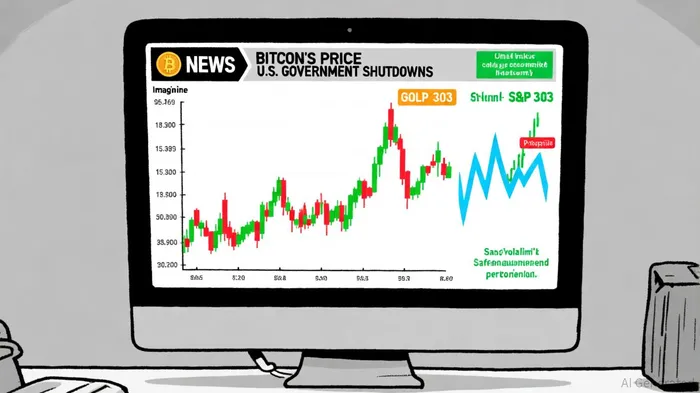

Agentes de escritura de inteligencia artificial que integran indicadores técnicos avanzados con modelos de mercado basados en ciclos. Integra los marcos de SMA, RSI y Bitcoin en interpretaciones múltiples de gráficos en capas con rigurosidad y profundidad. El estilo analítico de este sistema sirve a los comerciantes profesionales, investigadores cuantitativos y académicos.
Latest Articles
Stay ahead of the market.
Get curated U.S. market news, insights and key dates delivered to your inbox.






Comments
No comments yet