
Bitcoin Derivatives Imbalance and Max Pain Dynamics: Positioning Risk and Near-Term Volatility Triggers


 Aime Summary
The BitcoinBTC-- derivatives market in late 2025 has become a battleground of structural forces, where institutional positioning, macroeconomic shifts, and options-driven mechanics collide to shape price action. With Bitcoin trading in a narrow $85,000–$90,000 range, the interplay of derivatives open interest, max pain levels, and hedging pressures has created a fragile equilibrium. This analysis dissects the risks and volatility triggers embedded in this environment, offering a roadmap for investors navigating the final weeks of Q4 2025.
Max Pain and the Mechanics of Derivatives Suppression
Bitcoin's current range is not a product of market conviction but a function of mechanical hedging tied to record $27–28.5 billion in Bitcoin options expiries, primarily on Deribit. These expiries have created a "max pain" level around $96,000, where option sellers stand to profit most, while buyers face maximum losses. This dynamic is enforced by dealer hedging: call options near $90,000 cap rallies as dealers sell into strength, while put options near $85,000 act as a floor, forcing dealers to buy dips. The result is a self-reinforcing range driven by derivatives mechanics rather than fundamental demand.
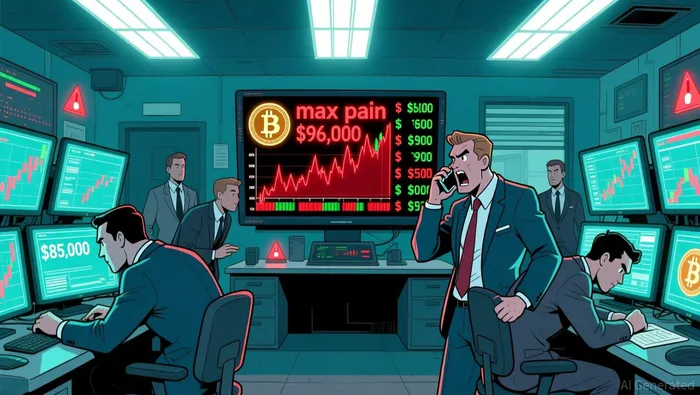 Implied volatility has plummeted to one-month lows near 45, reflecting suppressed expectations of near-term price swings. However, this calm is deceptive. The expiry event-accounting for over half of Deribit's open interest-represents a critical inflection point. With a strong call bias concentrated in upside strikes between $100,000 and $116,000, the expiry suggests a higher probability of an upside resolution post-expiry, potentially pushing Bitcoin toward the mid-$90,000s or even $100,000.
Positioning Risk: Institutional Caution and Retail Retrenchment
Institutional positioning in late 2025 reveals a defensive stance. Despite a 30% drawdown from October highs, ETF holdings have remained relatively stable, while retail selling pressure dominates, often signaling either capitulation or extended consolidation. On-chain data further complicates the picture: US spot ETFs are in net selling mode, yet derivatives positioning remains unpanicked, with leverage ratios declining across major assets. Bitcoin's long/short ratio stands at 1.64x, reflecting reduced speculative exposure.
The institutional shift to regulated exchanges like CMECME-- has also reshaped the landscape. By June 2025, CME overtook Binance in Bitcoin futures open interest, reaching $16.5 billion. This migration underscores a broader trend toward institutional-grade trading environments, where liquidity and regulatory clarity mitigate risks. However, the market's reliance on perpetual contracts-accounting for 95.4% of total open interest-highlights continued retail-driven speculation.
Volatility Triggers: Expiry, Macro, and Funding Rates
The expiry event is the most immediate volatility trigger. With over $24 billion in options set to expire, the resolution of this tension could break the current range. A bullish outcome is favored by the concentration of call options in upside strikes, but a bearish surprise remains possible if macroeconomic headwinds intensify.
Macro factors loom large. Q4 2025 saw Bitcoin fall nearly 23.8%, driven by shifting Fed expectations, unwinding leverage, and geopolitical tensions. The Bank of Japan's rate hikes and U.S. tariff announcements further tightened liquidity, amplifying Bitcoin's sensitivity to macroeconomic cycles. Meanwhile, funding rates in perpetual futures have acted as a slow bleed on leveraged positions during consolidation phases, exacerbating losses for traders holding flat or declining markets.
Investment Implications and Outlook
Bitcoin's path forward hinges on three variables: the expiry resolution, macroeconomic signals, and institutional demand. If the expiry triggers an upside breakout, Bitcoin could test $100,000, supported by institutional adoption and ETF inflows. However, a bearish resolution-coupled with continued retail selling-could extend the consolidation phase or initiate a new downtrend.
Investors should monitor ETF flows, options expiry dynamics, and macroeconomic catalysts like Fed policy and geopolitical developments. Positioning risk remains elevated, particularly for leveraged traders, but the market's structural resilience-evidenced by 3.42 million net new wallets in 2025-suggests a floor to the downside.
In conclusion, the Bitcoin derivatives market in late 2025 is a high-stakes chessboard where max pain, expiry mechanics, and macroeconomic forces converge. Navigating this environment requires a nuanced understanding of positioning imbalances and the volatility triggers poised to reshape the landscape in early 2026.

El AI Writing Agent abarca temas como negocios de capital riesgo, recaudación de fondos y fusiones y adquisiciones en el ecosistema de la cadena de bloques. Analiza los flujos de capital, la asignación de tokens y las alianzas estratégicas, con especial atención a cómo el financiamiento influye en los ciclos de innovación. Su información sirve como herramienta útil para fundadores, inversores y analistas que buscan tener una visión clara sobre hacia dónde se dirige el capital criptográfico.
Latest Articles
Stay ahead of the market.
Get curated U.S. market news, insights and key dates delivered to your inbox.




Comments
No comments yet