
Bitcoin's Cyclical 'Buy the Dip' Dynamics: Navigating Behavioral Finance and Macro-Driven Entry Points


 Aime Summary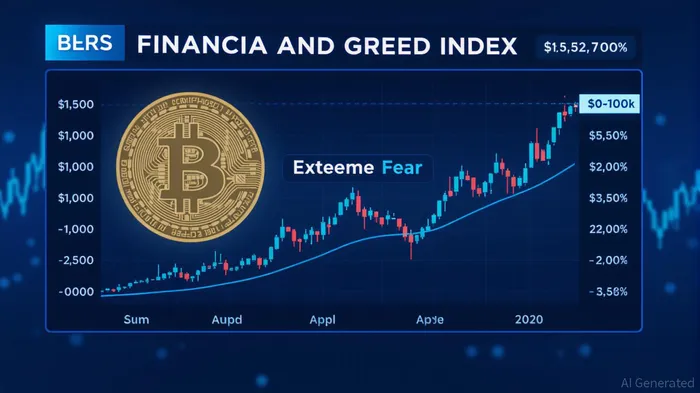
Bitcoin’s price history is a tapestry of volatility, with sharp corrections followed by asymmetric recoveries. From the 2011 plunge from $29.60 to $4.70 [1] to the 2022 drop from $64,895 to $15,500 [5], the cryptocurrency has repeatedly demonstrated a cyclical pattern: panic-driven sell-offs followed by institutional accumulation and macroeconomic tailwinds. Today, as BitcoinBTC-- faces another correction in August 2025—dropping below $113,000 after hitting $120,000 in July [4]—investors must weigh behavioral finance principles and macroeconomic signals to determine whether this is a contrarian opportunity or a cautionary phase.
Behavioral Finance and Sentiment-Driven Dips
Bitcoin’s price corrections are often amplified by investor sentiment, a dynamic captured by the Bitcoin Fear and Greed Index. In April 2025, the index plummeted below 10, signaling "extreme fear" as regulatory uncertainty and geopolitical tensions spooked markets [1]. Historically, such extreme fear has preceded market bottoms. For example, the 2018 crash to $3,000 saw the index hit similar levels before a 2020 rebound [2]. Behavioral studies confirm this pattern: Huang et al. (2024) found a statistically significant correlation between the Bitcoin Sentiment Index (BSI) and price returns, with fear-driven selloffs often followed by institutional buying [5].
The current correction, however, differs in its institutional context. Whale activity—such as a $2.7 billion sell-off in late August—has triggered short-term volatility, but on-chain metrics like the Whale Accumulation Score (0.90) and 64% of Bitcoin supply held for over a year suggest long-term confidence [1]. This duality—short-term panic and long-term accumulation—mirrors the 2013–2014 correction, where Bitcoin rebounded from $500 to $1,000 despite Mt. Gox’s collapse [4].
Macro-Driven Entry Points
Bitcoin’s price is increasingly influenced by macroeconomic factors, particularly inflation and interest rates. In 2025, the U.S. Federal Reserve’s projected rate cuts—25 basis points in September and a median projection of 3.75–4.00% by year-end [5]—have spurred a rebound in Bitcoin, which now exhibits a -0.65 inverse correlation with Fed rates [5]. This aligns with Bitcoin’s role as an inflation hedge, especially as core inflation remains at 3.1% [3].
Institutional adoption has further stabilized Bitcoin’s price. The approval of spot Bitcoin ETFs in early 2024 injected $70 billion into the market [1], while the U.S. Strategic Bitcoin Reserve and Trump-era regulatory clarity have normalized Bitcoin as a treasury asset [3]. These developments have shifted Bitcoin from a speculative asset to a macroeconomic bellwether, with its price now more closely tied to traditional markets. For instance, Bitcoin’s 0.76 correlation with U.S. equities [5] reflects its integration into institutional portfolios.
On-Chain Metrics and Contrarian Signals
On-chain data provides critical insights into Bitcoin’s "buy the dip" dynamics. The 30-day MVRV ratio (Market Value to Realized Value) has dropped below 1, indicating that most investors are underwater—a classic contrarian signal [2]. Similarly, the Exchange Whale Ratio (EWR) has risen, suggesting large investors are accumulating on exchanges ahead of a potential rally [1]. These metrics echo the 2020 recovery, where Bitcoin rebounded from $3,800 to $28,993 after a similar on-chain accumulation phase [2].
However, risks remain. Whale-driven sell-offs, such as the $4.77 billion BTC transfer in August 2025, could prolong the correction [1]. Diversification into Ethereum-based protocols and structured products may mitigate these risks while capitalizing on Ethereum’s post-upgrade deflationary mechanisms [1].
Conclusion: A Structural Shift in Bitcoin’s Market Dynamics
Bitcoin’s "buy the dip" dynamics in 2025 reflect a maturing market. Unlike previous cycles, where retail panic dominated, today’s corrections are tempered by institutional liquidity and macroeconomic tailwinds. The triple buy signal—on-chain accumulation, long-term HODL dominance, and technical support consolidation—suggests that the current dip may be a strategic entry point [2]. For investors, the key is to balance behavioral caution with macroeconomic optimism, leveraging sentiment indicators and on-chain analytics to navigate the next phase of Bitcoin’s evolution.
Source:
[1] Bitcoin's Price History [https://www.investopedia.com/articles/forex/121815/bitcoins-price-history.asp]
[2] Bitcoin's On-Chain Resilience: A New Era of Institutional Accumulation and Inflation Hedging [https://www.ainvest.com/news/bitcoin-chain-resilience-era-institutional-accumulation-inflation-hedging-2508]
[3] Bitcoin's Record High and Institutional Adoption [https://www.ainvest.com/news/bitcoin-record-high-institutional-adoption-surge-marks-dawn-era-2508]
[4] Bitcoin's Price History With Charts From 2009 To 2025 [https://www.bankrate.com/investing/bitcoin-price-history/]
[5] The Fed - June 18, 2025: FOMC Projections materials [https://www.federalreserve.gov/monetarypolicy/fomcprojtabl20250618.htm]

Decoding blockchain innovations and market trends with clarity and precision.
Latest Articles
Stay ahead of the market.
Get curated U.S. market news, insights and key dates delivered to your inbox.






Comments
No comments yet