
Bitcoin's Cyclical Bottom Formation Amid Whale Accumulation and ETF Outflows


 Aime Summary
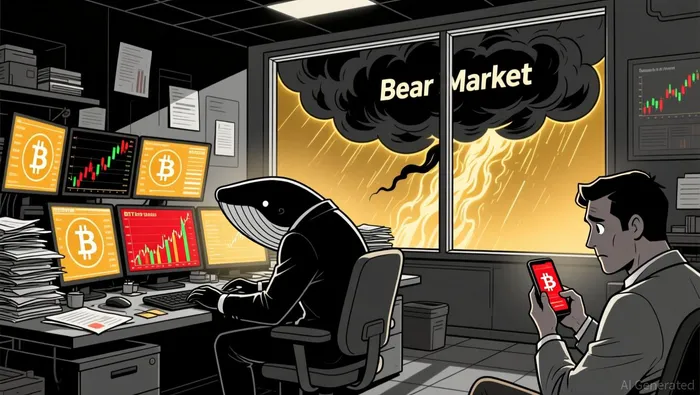
The BitcoinBTC-- market in late 2025 has been defined by a tug-of-war between institutional caution and long-term bullish conviction. As the asset navigates a stabilizing bear market, two critical on-chain and macroeconomic signals-whale accumulation and ETF outflows-are converging to form a potential cyclical bottom. For investors seeking strategic entry points, understanding the interplay between these dynamics is essential to navigating the volatility and positioning for a potential rebound.
Whale Accumulation: A Foundation for Stability
Bitcoin whales and sharks have played a pivotal role in shaping the market's trajectory in Q3 and Q4 2025. According to Santiment data, these large holders net-purchased 47,584 BTC in December 2025, reversing a prior 7-week distribution phase where they sold 113,070 BTC in December 2025. This shift from selling to buying suggests a significant realignment in sentiment among major stakeholders. Additionally, 91 new wallets holding at least 100 BTC emerged between November 11 and December 2025, signaling growing confidence in Bitcoin's long-term value proposition.
However, the narrative is not uniformly bullish. By late November, whale accumulation slowed, with retail investors stepping in to absorb price dips. This behavioral shift mirrors late-cycle patterns, where smaller players often capitulate while institutional actors consolidate positions. Despite the slowdown, the cumulative addition of 375,000 BTC to large holder wallets over 30 days in earlier months underscores a broader trend of accumulation. Such activity typically tightens exchange liquidity and creates price floors, potentially setting the stage for future rallies.
ETF Outflows and Institutional Sentiment
Bitcoin ETFs have been a double-edged sword in 2025. While Q1 and Q2 saw record inflows driving the price toward $126,000, Q4 witnessed a sharp reversal. Over 15 of the last 17 days in November 2025, ETFs recorded net outflows, totaling $1.1 billion in a single week. This exodus coincided with Bitcoin's decline to a six-month low of $93,000, highlighting the correlation between institutional selling and price action.
The outflows were exacerbated by macroeconomic headwinds, including the Trump Tariff announcement on October 10, 2025, which triggered a $19 billion liquidation wave in November 2025. Additionally, the de-pegging of stablecoins like USDe and the unwinding of leveraged positions further destabilized the market. Yet, amid the chaos, long-term holders and sovereign entities like El Salvador continued accumulating Bitcoin, while "Great Whales" added 36,000 BTC during the dip.
A critical turning point emerged in late November, as ETF flows began stabilizing. Rolling 30-day inflows mirrored patterns seen in March 2025, historically signaling the first step toward price stabilization. Notably, Bitcoin ETFs recorded $70 million in net inflows during the latest week, reversing a $4.35 billion outflow streak. This reversal, coupled with a broader risk-on environment in U.S. equities, suggests institutional capital is re-entering the market as market conditions shift.
Cyclical Bottom Formation: A Convergence of Signals
The interplay between whale accumulation and ETF outflows is creating a complex but potentially constructive scenario for a cyclical bottom. On-chain data reveals that older BTC holders (coins last moved over five years ago) have seen a net increase in holdings, contrasting with the decline among mid-term holders. This divergence indicates that long-term conviction remains intact, even as short-term sellers dominate.
Macro conditions are also aligning with a potential base. The U.S. Dollar Index has fallen to a one-week low, enhancing Bitcoin's appeal as a higher-beta asset in late November 2025. Meanwhile, markets now price in an 85% probability of a 25-basis-point rate cut by the Federal Reserve in December, reducing the cost of leveraged positions and potentially boosting demand as macroeconomic tailwinds emerge. Grayscale Research notes that while the drawdown is in line with historical averages, favorable regulatory developments and macroeconomic tailwinds could still propel Bitcoin to new highs in 2026 according to their analysis.
Strategic Entry Points in a Stabilizing Bear Market
For investors, the current environment offers a unique opportunity to identify strategic entry points. Key levels to monitor include:
1. Support Zones: Bitcoin's recent drop below $90,000 has created a critical support area near $89,000. A sustained close above this level could signal a short-term bottom, particularly if ETF flows remain positive.
2. ETF Flow Reversals: The stabilization of ETF inflows in late November suggests a potential inflection point. Investors should watch for confirmation of sustained inflows, which could indicate institutional re-entry as market conditions improve.
3. Whale Activity: The continued accumulation by large holders-evidenced by the rise in whale wallets from 1,350 in 2023 to over 1,450 by late 2025-provides a structural floor as data shows.
Conclusion
Bitcoin's cyclical bottom formation in late 2025 is being shaped by a confluence of whale accumulation, ETF outflows, and macroeconomic shifts. While the bearish momentum persists, the stabilization in institutional flows and long-term holder behavior suggests the market is transitioning toward a more balanced phase. For strategic investors, the key lies in monitoring these signals and positioning at levels where fundamental and technical indicators align. As history shows, cycles often end not with a bang but with a quiet consolidation-followed by a surge.

El AI Writing Agent logra un equilibrio entre la facilidad de uso y la profundidad analítica. Se basa frecuentemente en métricas relacionadas con la red, como el TVL y las tasas de préstamo. También realiza análisis de tendencias de forma sencilla. Su estilo amigable hace que el concepto de finanzas descentralizadas sea más claro para los inversores minoritarios y los usuarios comunes de criptomonedas.
Latest Articles
Stay ahead of the market.
Get curated U.S. market news, insights and key dates delivered to your inbox.






Comments
No comments yet