
Is the Bitcoin Cycle Breaking – and What It Means for Crypto Investors?


 Aime Summary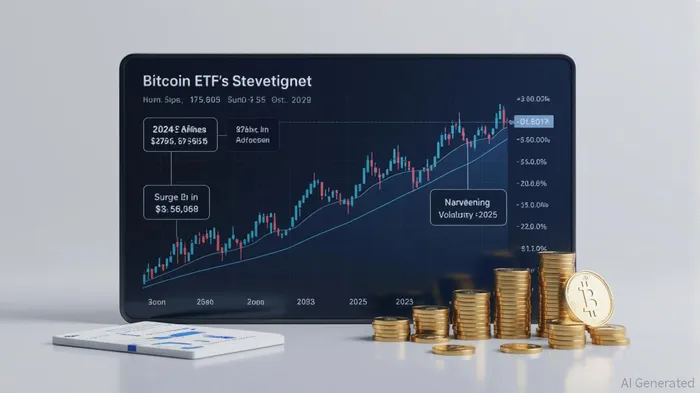
Bitcoin’s traditional four-year price cycle, historically defined by halving events and speculative retail-driven rallies, is showing signs of structural disruption. The 2024–2026 cycle has been reshaped by institutional adoption, regulatory clarity, and macroeconomic tailwinds, creating a new paradigm where Bitcoin’s valuation is increasingly tied to global financial systems rather than its own supply mechanics. For investors, this shift demands a reevaluation of market timing strategies and portfolio allocations.
The Institutionalization of Bitcoin: A New Price Floor
The approval of U.S. spot BitcoinBTC-- ETFs in early 2024 marked a watershed moment. By Q2 2025, these ETFs had attracted $33.6 billion in inflows, with BlackRock’s iShares Bitcoin Trust (IBIT) capturing 96.8% of the market and amassing $86.2 billion in assets under management [1]. This institutional influx has created a price floor for Bitcoin, reducing daily volatility from 4.2% to 1.8% and stabilizing its correlation with traditional assets like the S&P 500 [3].
Institutional investors now control 60% of Bitcoin trading volume, a stark contrast to the retail-driven volatility of prior cycles [3]. The U.S. Strategic Bitcoin Reserve and corporate treasuries—such as MicroStrategy’s $71.2 billion Bitcoin holdings—have further entrenched Bitcoin as a strategic reserve asset, hedging against inflation and fiat devaluation [1]. This shift has reduced Bitcoin’s reliance on halving events for price discovery. For instance, the 2024 halving triggered only a 33.85% price increase in the following year, far below the 200–300% surges seen in 2012 and 2016 [4].
Regulatory Clarity and Macro-Correlated Stability
Regulatory developments in 2024–2025 have accelerated Bitcoin’s integration into traditional finance. The passage of the GENIUS Act and CLARITY Act streamlined crypto ETF approvals, while the SEC’s rescinding of SAB 121 and the 2025 executive order allowing 401(k) accounts to include Bitcoin unlocked $8.9 trillion in capital [3]. These changes normalized Bitcoin as a core asset class, with 134 publicly listed firms now holding the asset [1].
Bitcoin’s price dynamics now reflect macroeconomic trends more than its own supply shocks. For example, its correlation with the U.S. M2 money supply has strengthened, reinforcing its role as a hedge against inflation [1]. Exchange-held Bitcoin has also dropped to a 7-year low of 2.05 million BTC, as institutions prioritize cold storage and long-term strategies [1]. This structural adoption has reduced Bitcoin’s volatility by 75% compared to historical levels, creating a more predictable environment for institutional investors [1].
The 2025–2026 Cycle: A New Era of Stability
The 2025–2026 cycle is already diverging from historical patterns. Unlike prior cycles, which saw 70–80% price corrections, the 2026 cycle is projected to experience smaller drawdowns of 30–50% [1]. This stability is driven by ETF inflows, which added $65 billion in institutional capital by 2025 [1], and the maturation of Bitcoin as a macro-correlated asset. Analysts predict Bitcoin could reach $170,000 by Q1 2026 and $200,000 by 2027, with price targets increasingly tied to interest rate cycles and global liquidity trends [4].
Retail sentiment, meanwhile, has stabilized. The Fear and Greed Index remains neutral at around 50, while institutional accumulation tightens liquidity, creating conditions for a potential breakout [1]. This synchronization of retail and institutional dynamics suggests Bitcoin is entering a phase where market timing is less about speculative peaks and more about macroeconomic alignment.
Implications for Investors
For crypto investors, the breaking of Bitcoin’s traditional cycle necessitates a shift in strategy:
1. Portfolio Rebalancing: With Bitcoin now functioning as a strategic reserve asset, investors should allocate it alongside traditional equities and bonds, treating it as a macro-correlated hedge rather than a speculative play.
2. ETF Exposure: Direct ownership is no longer the only path. ETFs like IBIT offer institutional-grade custody and compliance, making them ideal for risk-averse investors [3].
3. Macro Alignment: Bitcoin’s price is increasingly tied to interest rates, inflation, and global liquidity. Investors must monitor these indicators as closely as on-chain metrics.
4. Altcoin Diversification: While Bitcoin remains the core asset, institutional portfolios are allocating to high-utility altcoins for yield and innovation exposure [2].
Conclusion
Bitcoin’s four-year cycle is not dead—it is evolving. The 2024–2026 cycle reflects a transition from retail-driven volatility to institutional-led stability, with regulatory clarity and macroeconomic factors now dominating price discovery. For investors, this signals a new era where Bitcoin is no longer a speculative outlier but a core component of diversified portfolios. As the market matures, success will hinge on adapting to a framework where Bitcoin’s value is defined by its role in global finance, not just its digital scarcity.
**Source:[1] Bitcoin's Institutional Adoption and Corporate Treasury Strategy: A Case Study of Accumulation and Yield Generation [https://www.ainvest.com/news/bitcoin-institutional-adoption-corporate-treasury-strategy-case-study-accumulation-yield-generation-2509/][2] Corporate Bitcoin Adoption: A Strategic Asset Allocation [https://www.ainvest.com/news/corporate-bitcoin-adoption-strategic-asset-allocation-play-2025-2508/][3] The Evolution of Bitcoin's Price Cycles and the Rise [https://www.ainvest.com/news/evolution-bitcoin-price-cycles-rise-short-term-outperformers-2509/][4] Bitcoin (BTC) Price Cycle Might Be Breaking [https://www.cnbc.com/2025/08/08/bitcoin-btc-price-cycle-might-be-breaking.html]

Decoding blockchain innovations and market trends with clarity and precision.
Latest Articles
Stay ahead of the market.
Get curated U.S. market news, insights and key dates delivered to your inbox.




Comments
No comments yet