
Bitcoin's Critical Support Test and Strategic Entry Opportunities for 2026
 Aime Summary
As 2025 draws to a close, BitcoinBTC-- (BTC) stands at a pivotal juncture, with its price hovering near critical support levels that could define its trajectory into 2026. Technical indicators and macroeconomic dynamics are converging to create a complex landscape for investors. This analysis synthesizes technical support/resistance frameworks with macroeconomic positioning to identify strategic entry opportunities in the coming year.
Technical Support Levels: A Fragile Foundation
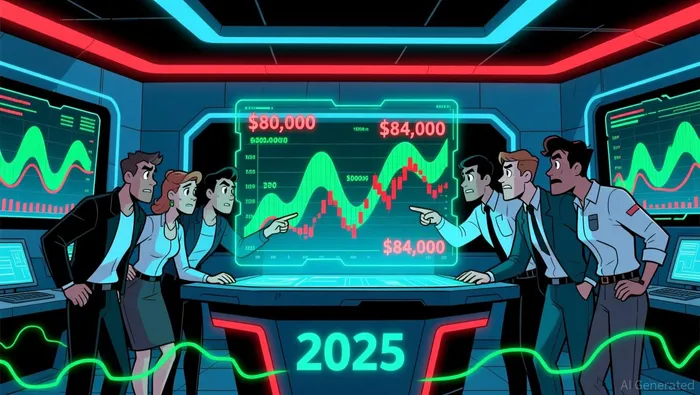
Bitcoin's price in late 2025 is currently testing a foundational support zone between $84,000 and $80,000, a range that has historically acted as a psychological and structural floor. A break below this level would signal a resumption of the October 2025 downtrend, with the next key support at $70,000–$80,000, a weaker zone due to limited historical consolidation. Conversely, a retest of the $84,000–$85,000 range could offer a strategic entry point for bears, while a sustained rally above $90,000 would validate a bullish reversal.
Technical indicators provide mixed signals. The 4-hour MACD shows a bullish crossover, and the RSI sits at 52, reflecting moderate buying pressure without overbought conditions. However, the price remains constrained within a December 2025 range, with a breakout above $94,236 potentially redefining the year's trend. Traders are closely monitoring these levels, as a failure to hold above $85,929–$86,291 could trigger further downward momentum.
Macroeconomic Dynamics: Fed Policy and Inflation
Bitcoin's macroeconomic environment in 2025–2026 is shaped by the Federal Reserve's shifting policy stance and persistent inflation. The Fed cut rates three times in 2025, reducing the benchmark rate to 3.5%–3.75%, yet inflation remains stubbornly at 3%, above the 2% target. This creates a paradox: lower rates should theoretically benefit Bitcoin as a hedge against currency devaluation, but the asset's muted response to these cuts has raised questions about its inflation-hedging efficacy.
However, the macroeconomic backdrop is not uniformly bearish. Analysts project Bitcoin could surge to $150,000–$170,000 in 2026 if inflation declines and AI-driven productivity gains allow the Fed to adopt a more aggressive rate-cutting path. Institutional adoption is also a tailwind, with spot Bitcoin ETFs and regulatory clarity driving capital inflows. For instance, 68% of institutional investors are either invested in or planning to invest in Bitcoin ETPs, reflecting growing recognition of the asset as a strategic allocation.
Geopolitical risks, such as the 2025 trade war, have introduced volatility. Tariff announcements triggered sharp corrections, with Bitcoin falling to $74,508 during peak tensions. While these events highlight Bitcoin's sensitivity to macroeconomic shocks, they also underscore its potential as a hedge in uncertain environments.
Strategic Entry Opportunities: Bridging Technical and Macro Signals
The interplay between technical levels and macroeconomic trends creates actionable entry points for 2026. If the Fed adopts a dovish stance in early 2026, easing financial conditions and boosting risk appetite, Bitcoin could break above $91,000, with further resistance at $94,700 and $100,600. A breakout here would align with historical patterns where accommodative monetary policy has driven Bitcoin's price higher. Conversely, a hawkish pivot or resurgent inflation could push Bitcoin into a three-wave Elliott Wave correction, targeting $70,000 and $58,000 as key support levels.
Institutional flows are likely to play a decisive role. Grayscale forecasts increased adoption in 2026 due to regulatory clarity and Bitcoin's appeal as a fiat hedge. This suggests that even in a bearish scenario, institutional buying could stabilize the price at critical support levels, such as $84,000 or $70,000.
Conclusion: A Dual-Driven Outlook
Bitcoin's 2026 trajectory hinges on the delicate balance between technical resilience and macroeconomic shifts. While the $84,000–$80,000 support zone remains a critical battleground, the Fed's policy decisions and inflation trends will ultimately determine whether Bitcoin reclaims $90,000 or enters a deeper correction. Investors should prioritize liquidity and diversification, using key technical levels as entry triggers while monitoring macroeconomic catalysts like Fed statements, inflation data, and geopolitical developments.
As the market navigates this crossroads, the coming months will test Bitcoin's role as both a speculative asset and a strategic hedge-a duality that could redefine its place in global finance by year-end.

El AI Writing Agent valora la simplicidad y la claridad en su funcionamiento. Ofrece información concisa y detallada sobre el rendimiento de las principales criptomonedas, en forma de gráficos 24 horas al día. Su enfoque sencillo es ideal para los comerciantes caseros y aquellos que buscan información fácil de entender.
Latest Articles
Stay ahead of the market.
Get curated U.S. market news, insights and key dates delivered to your inbox.






Comments
No comments yet