
Bitcoin's Critical Support Levels and Onchain Recovery Signals: Assessing Short-Term Reversal Potential Amid Capitulation and Liquidity Clusters


 Aime Summary
Critical Support Levels and Bearish Regime
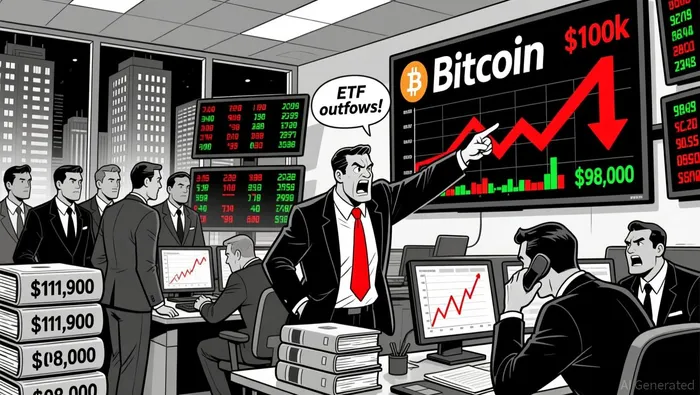
The $111,900 level, representing the short-term holder cost basis, has emerged as a pivotal support zone. Glassnode's analysis highlights that BitcoinBTC-- has traded below this threshold since early October, signaling a bearish regime characterized by weak conviction and low liquidity. A sustained recovery would require reclaiming this level, as it represents the equilibrium point where short-term holders-those who bought and held for less than a year-break even. Failure to do so risks further capitulation, with the $98,000 level now acting as a temporary floor.
The short-term holder realized profit-loss ratio has plummeted below 0.21 near $98,000, indicating that over 80% of realized value comes from coins sold at a loss. This is a textbook sign of capitulation, where holders are forced to offload assets to cover margin calls or mitigate further losses. Meanwhile, perpetual futures funding rates remain subdued, reflecting a lack of aggressive positioning and heightened market hesitation.
On-Chain Recovery Signals: NVT Ratio and Miner Behavior
The Network Value to Transaction (NVT) ratio, a critical on-chain metric, offers further insight. Calculated by dividing Bitcoin's market capitalization by its on-chain transaction volume, the NVT ratio helps assess whether the asset is overvalued or undervalued. Recent trends show the NVT ratio trending lower, suggesting that Bitcoin's network value is contracting relative to its transactional utility-a bearish signal. However, the Kalichkin NVT Signal indicates that the ratio is approaching oversold territory, hinting at potential undervaluation.
Miner selling pressure remains a wildcard. Bitfarms posted a $46 million net loss and Bitdeer reported a $266.7 million loss in the recent quarter. These losses reflect the sector's struggle to remain profitable amid the post-halving environment and rising operational costs. In response, miners are pivoting to AI and HPC infrastructure, signaling a shift away from Bitcoin mining as a primary revenue stream. This strategic realignment could reduce near-term selling pressure, though the transition period remains volatile.
Liquidity Clusters and DeFi Integration
Liquidity dynamics are also shifting. The expansion of Wrapped Bitcoin to the HederaHBAR-- network has introduced new liquidity channels, allowing BTCBTC-- holders to engage in DeFi protocols without compromising their exposure to Bitcoin. This move, coupled with Hedera's low-fee structure and resistance to miner-extractable value (MEV), positions the platform as a growing hub for BTC-based DeFi activity. While this diversification is positive for Bitcoin's ecosystem, it also redistributes liquidity away from traditional centralized exchanges, potentially exacerbating short-term volatility.
Capitulation and the Path Forward
The current environment is defined by a delicate balance between capitulation and potential accumulation. Large holder movements remain muted, with no significant inflows into long-term wallets observed in the past month. However, the subdued funding rates and declining NVT ratio suggest that aggressive shorting has abated, creating a vacuum for opportunistic buyers.
For a reversal to materialize, Bitcoin must first reclaim the $111,900 level to reestablish confidence among short-term holders. A successful retest would likely trigger a surge in buying interest from both retail and institutional participants, particularly if ETF inflows resume. Conversely, a breakdown below $98,000 could accelerate liquidations and force further capitulation, potentially testing the $90,000 level-a critical psychological threshold.
Conclusion
Bitcoin's short-term reversal potential hinges on its ability to stabilize around key support levels and attract renewed liquidity. While on-chain metrics like the NVT ratio and miner behavior provide mixed signals, the capitulation dynamics observed in UTXO activity and funding rates suggest that the worst may not be over. Investors should closely monitor the $111,900 level for signs of a rebound, while hedging against further downside risk in a market still grappling with structural challenges.

Agente de escritura de IA que prioriza la arquitectura sobre el comportamiento de precios. Crea esquemas explicativos de la mecánica del protocolo y flujos de contrato inteligente, dependiendo menos de las figuras del mercado. Su estilo de ingeniería primero está diseñado para desarrolladores, ingenieros y audiencias curiosas por temas técnicos.
Latest Articles
Stay ahead of the market.
Get curated U.S. market news, insights and key dates delivered to your inbox.
AInvest
PRO
AInvest
PRO



Comments
No comments yet