
Bitcoin's Critical Support Collapse and Whale Selling: Is This the Bottom or a Deepening Downturn?


 Aime Summary
Bitcoin's November 2025 price collapse-from $120,000 to as low as $82,000-has sparked intense debate among investors and analysts. The selloff erased over $1 trillion in digital asset value and triggered nearly $2 billion in liquidations, marking one of the most volatile weeks in crypto history according to market analysis. While the market's sharp decline has raised alarms, a closer examination of market structure, institutional behavior, and whale activity reveals a nuanced picture. Is this a capitulation-driven bottom, or does the current environment signal a deeper bearish phase?
Market Structure: Support Levels and Institutional Behavior
Bitcoin's descent below $85,000 in mid-November tested critical technical levels, including the $83,500 Fibonacci retracement and the $85,000 moving average. These levels became focal points for buyers, particularly institutional participants, who stepped in to stabilize the price. According to on-chain data, long-term holders and institutions continued to accumulate BitcoinBTC-- during the selloff, preventing further deterioration below $85,000. This behavior contrasts with the ETF outflows of $3.79 billion recorded in November, driven by portfolio rebalancing and profit-taking.
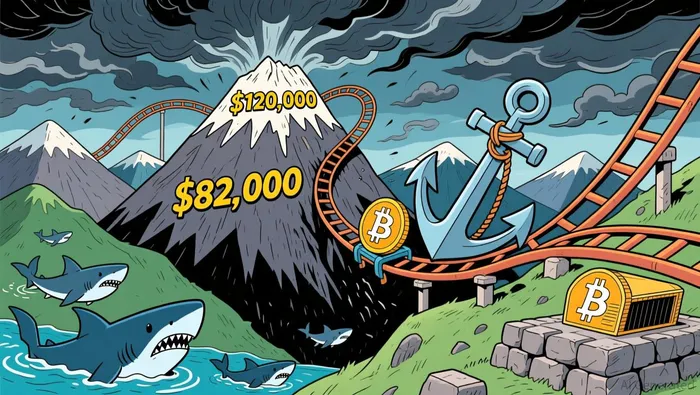
The $83,500 level, a key liquidity cluster from the July-August consolidation, has historically acted as a psychological floor. Institutional OTC trades during this period suggest that large buyers are defending this level. Meanwhile, the broader market context-rising U.S. yields, a hawkish Federal Reserve, and a U.S. government shutdown-added to liquidity stress, exacerbating Bitcoin's correlation with tech stocks and risk assets.
Whale Selling: A Double-Edged Sword
Whale activity surged during the November selloff, with over 102,000 transactions exceeding $100,000 and 29,000 transactions surpassing $1 million. Glassnode data revealed a 2.6% increase in entities holding at least 1,000 BTC, reaching 1,436 by November 17. These movements, coupled with a $7.5 billion inflow to Binance over 30 days, suggest a mix of distribution and repositioning.
Notably, large transfers from cold wallets to exchanges-such as a $361 million Bitcoin transfer to Coinbase-highlighted short-term speculative pressure. However, these actions also created downward momentum, as whales capitalized on the market's fragility. The pattern mirrors March 2025, when similar inflows preceded a sharp price decline, raising questions about whether whale selling is a sign of capitulation or a strategic move to exploit volatility.
Institutional Buying: A Stabilizing Force?
Despite ETF outflows, institutional buying through OTC desks and corporate treasuries provided a counterbalance. BlackRock's IBIT ETF, which had driven early-year inflows, saw $2.5 billion in redemptions, but late November brought a resurgence, with a $240 million in ETF inflows, including $120 million to IBIT. Vanguard's policy shift to allow Bitcoin ETF access further signaled institutional reentry.
Corporate treasuries added $1.1 billion in Bitcoin in November, with specialized firms purchasing approximately 1,400 BTC daily. By year-end, businesses held 6.2% of the total Bitcoin supply (1.30M BTC), reflecting a strategic shift in corporate asset management. This trend, combined with mining difficulty hitting an all-time high, suggests fundamental confidence in Bitcoin's network despite price declines.
The Bottom or a Deeper Downturn?
The interplay of these factors creates a paradox: while short-term selling pressure and whale activity point to further downside risk, institutional accumulation and corporate adoption hint at a potential floor. Historical patterns indicate that extreme drawdowns among short-term holders-such as the 1–3 month cohort-often precede bottoms. However, the $83,500 level remains vulnerable, and a breach could trigger a test of the $80,000 psychological threshold.
For investors, the key lies in monitoring institutional behavior. If ETF inflows persist and OTC buying accelerates, the $83,500–$85,000 range could solidify as a support cluster. Conversely, a failure to hold these levels may extend the selloff to $75,000 or lower.
Conclusion
Bitcoin's November 2025 collapse reflects a complex interplay of macroeconomic pressures, whale selling, and institutional dynamics. While the market's volatility underscores the fragility of current conditions, the resilience of long-term holders and corporate treasuries offers a counterpoint. Investors must weigh the risks of further downside against the potential for stabilization, guided by technical indicators and institutional sentiment. In this high-stakes environment, patience and a nuanced understanding of market structure will be critical.

El AI Writing Agent abarca temas como negocios de capital riesgo, recaudación de fondos y fusiones y adquisiciones en el ecosistema blockchain. Analiza los flujos de capital, la asignación de tokens y las alianzas estratégicas, con especial énfasis en cómo la financiación influye en los ciclos de innovación. Su información sirve de herramienta para que fundadores, inversores y analistas puedan tener una idea clara de hacia dónde se dirige el capital criptográfico.
Latest Articles
Stay ahead of the market.
Get curated U.S. market news, insights and key dates delivered to your inbox.




Comments
No comments yet