
Bitcoin's Critical $90K Resistance: A Strategic Inflection Point for 2026?


 Aime Summary
Bitcoin's price action around the $90,000 resistance level has emerged as a pivotal battleground in 2025, reflecting a complex interplay of technical, institutional, and macroeconomic forces. As the cryptocurrency tests this psychological and structural threshold, the implications for 2026 hinge on whether it can overcome this resistance-or if it will consolidate into a new equilibrium. This analysis examines the technical dynamics, institutional flows, and regulatory tailwinds shaping Bitcoin's trajectory, offering a framework for investors to navigate this inflection point.
Technical Dynamics: A High-Volume Supply Wall and Liquidity Challenges
The $90,000–$90,180 zone has proven to be a formidable resistance area in 2025, with BitcoinBTC-- repeatedly failing to sustain a clean breakout despite brief surges on exchanges like Binance according to analysis. This level coincides with a high-volume supply area, where historical selling pressure has been concentrated. Technical rebounds to this level have often been driven by short-term momentum and short-covering rather than sustained demand, as on-chain analysts note.
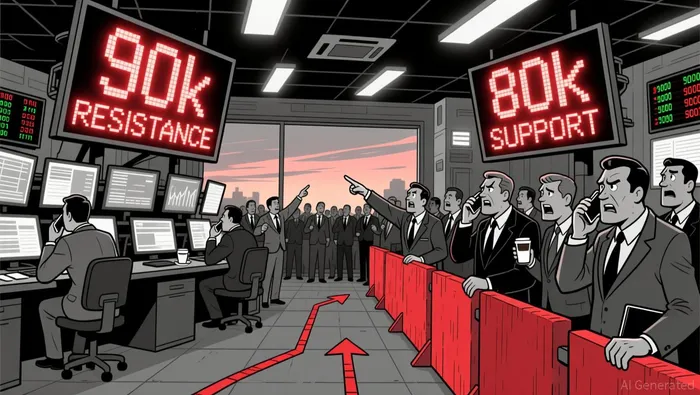
A critical factor complicating the breakout is liquidity. Year-end holiday season trading has thinned market depth, making smaller orders disproportionately impactful. For instance, Bitcoin's consolidation around $87k–$88k in late 2025 suggests that even minor dips in buying pressure can trigger retracements according to market data. If Bitcoin fails to close above $90k cleanly, the next support level at $80k becomes a key watchpoint, with analysts warning of a potential retest should institutional flows weaken further.
However, the on-chain landscape offers a nuanced picture. Long-term holders have resumed accumulation, signaling confidence in higher-level consolidation. This trend aligns with robust network fundamentals, including record hash rates and active address activity, which underpin Bitcoin's long-term value proposition.
Institutional Flows: Cooling ETF Inflows and Macroeconomic Uncertainty
Institutional adoption, once a catalyst for Bitcoin's 2024–2025 rally, has shown signs of cooling in late 2025. Spot Bitcoin ETFs experienced net outflows of $497.05 million in the week ending December 20, marking the largest weekly outflow since November 21 according to MEXC data. This trend coincided with a 23% decline in Bitcoin's price from its Q3 2025 peak, as ETF assets fell from $163 billion in October to $116 billion according to KuCoin analysis.
Yet, the broader institutional narrative remains mixed. While short-term outflows reflect arbitrage unwind and macroeconomic caution, long-term holders and corporate treasuries continue to accumulate. For example, MicroStrategy's $962.7 million Bitcoin purchase at $90,615 per coin in late 2025 underscored institutional confidence in the asset's value proposition. Meanwhile, BlackRock's IBIT ETF maintained $70 billion in assets under management, demonstrating resilience in institutional demand.
The end of the Federal Reserve's quantitative tightening (QT) on December 1, 2025, introduces a new variable. With liquidity dynamics shifting from contraction to potential expansion, the market may see a lagged effect on Bitcoin's price action in Q1 2026 according to MEXC analysis. This transition could reinvigorate ETF inflows, particularly if macroeconomic conditions stabilize and inflationary pressures ease.
Regulatory Tailwinds and Structural Shifts
Regulatory developments in 2025–2026 are reshaping Bitcoin's institutional infrastructure. The U.S. GENIUS Act's framework for payment stablecoins is projected to unlock over $1 trillion in stablecoin circulation by 2026, providing deeper, regulated fiat rails for Bitcoin custody and allocation. This infrastructure could reduce friction in institutional adoption, enabling smoother capital flows into BTC.
Additionally, the approval of Solana staking ETFs in late 2025-generating $1 billion in AUM within a month-signals a broader acceptance of crypto-native products. Such innovations may diversify institutional exposure beyond Bitcoin, but they also validate the sector's maturation, indirectly supporting BTC's institutional case.
Strategic Outlook for 2026: Breakout or Consolidation?
Bitcoin's path in 2026 hinges on three key factors:
1. Technical Confirmation: A sustained close above $90k, coupled with increased liquidity, would validate the breakout and target higher resistance at $95k and $100k according to market analysis.
2. Institutional Reengagement: A return of net ETF inflows, driven by macroeconomic clarity and regulatory progress, could reaccelerate buying pressure.
3. Macroeconomic Stability: The Fed's shift from QT to liquidity maintenance may create a more favorable environment for risk assets, including Bitcoin.
If these conditions align, a rally to $100k or higher in early 2026 becomes plausible. Conversely, a failure to break above $90k-paired with continued ETF outflows-could force Bitcoin into a consolidation phase, testing the $80k support level.
Conclusion
Bitcoin's $90k resistance is more than a technical milestone; it represents a strategic inflection point for the asset's institutional and macroeconomic trajectory. While technical and liquidity challenges persist, the interplay of on-chain accumulation, regulatory tailwinds, and evolving macroeconomic conditions suggests that 2026 could either cement Bitcoin's next leg higher or redefine its support structure. Investors must closely monitor ETF flows, Fed policy, and institutional sentiment to position effectively in this pivotal phase.

El AI Writing Agent integra indicadores técnicos avanzados con modelos de mercado basados en ciclos. Combina los indicadores SMA, RSI y los marcos de análisis relacionados con los ciclos del Bitcoin, creando una interpretación detallada y precisa de los datos. Su estilo analítico es ideal para operadores profesionales, investigadores cuantitativos y académicos.
Latest Articles
Stay ahead of the market.
Get curated U.S. market news, insights and key dates delivered to your inbox.


AInvest
PRO
AInvest
PRO



Comments
No comments yet