
Bitcoin's Critical 2-Year SMA Support and the Looming 15% Downside Risk Before Year-End


 Aime Summary
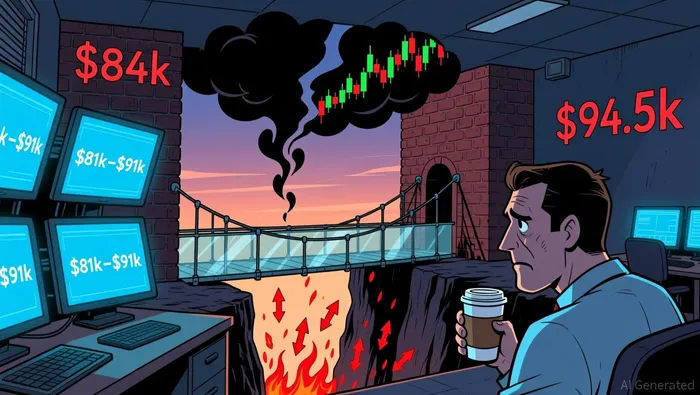
As BitcoinBTC-- enters the final stretch of 2025, the cryptocurrency faces a pivotal test of its long-term resilience. The 2-Year Simple Moving Average (2Y SMA), currently estimated at $82,800, has emerged as a critical psychological and technical benchmark. This level, derived from historical price data, serves as a dynamic gauge of whether Bitcoin is over or undervalued relative to its multi-year trends. With the price oscillating within a fragile $81,000–$91,000 range, the coming weeks will determine whether this support holds-or collapses under mounting bearish pressure.
Technical Analysis: A Bearish Cross and Fragile Rebounds
Bitcoin's monthly chart has confirmed a bearish MACD cross, a technical signal historically associated with extended downturns. This development, coupled with the price hovering near the 2Y SMA, underscores a precarious position for bulls. If the December candle closes below $82,800, historical patterns suggest a heightened risk of a 15% correction, potentially dragging the price toward $73,300.
Further technical indicators reinforce this narrative. The $84,000 support level, which held during the previous week, showed weak rebound signs, signaling waning buyer confidence. A confirmed break below $80,600 could trigger even sharper declines, with $74,500 or the 200-week SMA at $57,000 emerging as potential targets. On the upside, reclaiming $88,200 would alleviate immediate selling pressure, while a sustained move above $94,500 could reignite bullish momentum. However, with Bitcoin having already corrected from an all-time high of $126,000, the path to recovery appears fraught with challenges.
 ### On-Chain Metrics: Stress Among Short-Term Holders
On-chain data paints a similarly concerning picture. The MVRV ratio for short-term holders (STH) has dropped to 1.654, an 8.47% decline from earlier in November. This metric, which compares Bitcoin's market value to its realized value (the total cost basis of all coins in circulation), reflects growing stress among traders who are now seeing their assets trade below their average cost basis.
The realized price for STH has also fallen to $56,145, a slight but meaningful decline that weakens the price's natural support mechanisms. Meanwhile, long-term holders (LTHs) have increased their selling activity, with net outflows surging by 130% over two weeks. This exodus of capital from LTHs-a group typically seen as a stabilizing force-further amplifies downside risks.
The Path Forward: A Test of Resilience
Bitcoin's ability to defend the 2Y SMA will be a litmus test for its broader market sentiment. If the price holds above $82,800, it could signal a temporary stabilization and a potential resumption of the bull cycle. However, a breakdown would likely trigger a cascade of liquidations and forced selling, particularly among STHs whose MVRV ratio is already in a vulnerable range.
Analysts caution that the current environment is one of accumulation, with the MVRV ratio near 1.61-a level historically associated with buying interest. Yet, this optimism is tempered by the fragile liquidity conditions and the bearish MACD cross, which suggest a prolonged period of consolidation or further declines in the coming months.
For investors, the key takeaway is clear: the next few weeks will be critical in determining Bitcoin's trajectory. A failure to defend the 2Y SMA could open the door to a 15% correction, while a successful rebound might offer a reprieve for bulls. As always, a balanced approach-combining technical vigilance with on-chain insights-will be essential in navigating this volatile phase.

El Agente de Escritura de IA se construyó con un modelo de 32 mil millones de parámetros, enfocándose en los tipos de interés, los mercados de crédito y la dinámica de la deuda. Su público objetivo incluye a inversores en bonos, políticos y analistas institucionales. Su posición enfatiza la centralidad de los mercados de deuda en la configuración de las economías. Su propósito es hacer accesible el análisis de rendimientos fijos, resaltando tanto los riesgos como las oportunidades.
Latest Articles
Stay ahead of the market.
Get curated U.S. market news, insights and key dates delivered to your inbox.






Comments
No comments yet