
Bitcoin's Critical $118,000 Threshold and the Reshaping of Institutional Momentum


 Aime Summary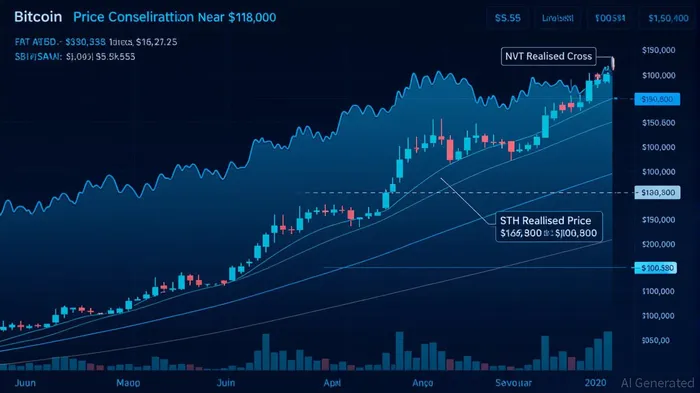
Bitcoin's price action around the $118,000 threshold in Q3 2025 has become a focal point for investors, traders, and institutional observers. While retail sentiment often oscillates between euphoria and panic, the on-chain data and macroeconomic signals tell a different story: one of structural strength, institutional confidence, and a maturing market. The interplay of whale behavior, regulatory clarity, and macroeconomic tailwinds suggests that Bitcoin's current consolidation is not a sign of weakness but a prelude to a more robust bull phase.
On-Chain Dynamics: A Tale of Two Forces
Bitcoin's on-chain metrics reveal a tug-of-war between speculative short-term activity and institutional-grade accumulation. Daily transaction volume has edged up to 467,080 transactions as of August 23, 2025, a 1.6% increase from the prior day, though still 41.6% below the 2017–2018 peak. This modest growth contrasts with a 28% drop in trading volume, signaling cooling retail demand. Meanwhile, the Herfindahl-Hirschman Index (HHI) has declined, indicating broader ownership distribution—a positive sign for long-term sustainability.
However, the Age Cohort Concentration Index paints a nuanced picture. The share of coins held for 1–7 days has risen to 3.93%, reflecting heightened short-term speculation, while the 7–30 day cohort has fallen to 8.70%, suggesting mid-term holders are reducing exposure. This duality underscores a fragile market dynamic: speculative inflows are propping up price, but institutional players are quietly accumulating at key support levels.
The Network Value to Transactions (NVT) ratio, a critical on-chain metric, has stabilized below its long-term mean of 120, reinforcing the idea that Bitcoin's valuation is supported by utility rather than hype. A bullish NVT Golden Cross in June 2025 and consistent exchange outflows (BTC reserves at decade lows) further validate this narrative. As shows, the ratio remains in a balanced zone, suggesting the market is neither overbought nor undervalued.
Whale Behavior: Institutional Confidence in Action
Whale activity in Q3 2025 has been a masterclass in institutional strategy. During a recent price correction, large players purchased 200 BTC ($23 million) at discounted levels, a pattern historically observed during retail fear. The Exchange Whale Ratio—the proportion of large BitcoinBTC-- holders on exchanges—has hit multi-year highs, signaling strategic distribution by major players. Meanwhile, the True Retail Accounts Long percentage of 61.95% aligns retail bullishness with institutional sentiment, reducing volatility and stabilizing the price.
Institutional holdings have also surged. U.S. spot ETFs now hold 1.3 million BTC (6% of total supply), with BlackRock's iShares Bitcoin Trust (IBIT) alone managing $84 billion in assets. Corporate treasuries have added 300,000 BTC since January 2025, removing liquidity from the market and generating upward pressure. These moves are not speculative—they are strategic, reflecting a shift from retail-driven to institution-led markets.
Macro Signals: A Perfect Storm for Institutional Adoption
The macroeconomic backdrop is equally compelling. The U.S. Federal Reserve's dovish stance, coupled with global M2 money supply surpassing $90 trillion, has driven capital into alternative assets. Bitcoin's role as an inflation hedge is now enshrined in policy: the Trump administration's August 2025 executive order removed restrictions on including Bitcoin in 401(k) and defined-contribution plans, unlocking a $12.2 trillion capital pool. Even a 1% allocation would inject $122 billion into Bitcoin ETFs—equivalent to 4% of its current market cap.
Regulatory clarity has further accelerated adoption. The CLARITY Act and the U.S. Strategic Bitcoin Reserve initiative have provided legal certainty for institutional investors. Sixteen states have introduced legislation to establish their own Bitcoin reserves, removing millions of coins from circulation. Meanwhile, Harvard University's $120 million purchase of IBITIBIT-- in July 2025 signaled a new era of academic and institutional alignment.
Investment Implications: A Strategic Entry Point
For investors, the $118,000 threshold represents a critical inflection point. The dense demand zone formed by the 111-day and 200-day SMAs, combined with the STH Realized Price at $106,800, suggests strong institutional support. A breakdown below $100,400 would test this zone, but the confluence of macroeconomic tailwinds and structural demand makes such a scenario unlikely.
The data also highlights a compelling risk-rebalance opportunity. With the Binance Long/Short Ratio at 57.34% longs and the NUPL metric in the “optimism” zone, the market is in a healthy accumulation phase. Investors should consider allocating to Bitcoin ETFs or institutional-grade products like IBIT, which offer exposure to a maturing asset class.
Conclusion: A New Era for Bitcoin
Bitcoin's journey to $118,000 is not just a price story—it is a transformation. The interplay of on-chain fundamentals, whale behavior, and macroeconomic signals indicates that Bitcoin is evolving from a speculative asset to an institutional cornerstone. As regulatory clarity, 401(k) adoption, and corporate treasuries reshape the landscape, the $118,000 threshold is likely to be a springboard, not a ceiling. For investors with a long-term horizon, this is a pivotal moment to reassess risk and reward in a market that is no longer driven by retail hype but by institutional gravity.
In this new era, Bitcoin's value proposition is no longer about whether it will rise—it is about how quickly it will integrate into the financial mainstream. The question for investors is not if, but when.

Decoding blockchain innovations and market trends with clarity and precision.
Latest Articles
Stay ahead of the market.
Get curated U.S. market news, insights and key dates delivered to your inbox.






Comments
No comments yet