
Bitcoin as a Credibility Hedge in a Politicized Monetary Landscape
 Aime Summary
The Federal Reserve's independence, long considered a cornerstone of U.S. economic stability, faces unprecedented threats in 2025. Political pressures from the Trump administration, including a Department of Justice criminal investigation into Fed Chair Jerome Powell and repeated public attacks on the central bank's autonomy, have raised alarms about the politicization of monetary policy. These developments are not merely theoretical: they risk eroding the Fed's ability to maintain its 2% inflation target and could destabilize long-term inflation expectations according to analysis. For investors, the erosion of central bank credibility has created a new class of systemic risk-one that BitcoinBTC-- is increasingly positioned to hedge.
The Erosion of Fed Independence and Its Implications
The Federal Reserve's independence has been a critical factor in maintaining the U.S. dollar's global dominance. However, in Q4 2025, political tensions escalated as President Trump publicly criticized Powell, threatened legal action over Fed spending, and pushed for rate cuts to boost pre-election economic sentiment according to reports. The DOJ's investigation into Powell, described as a "dangerous precedent" by central bank scholars as research indicates, has further blurred the line between monetary policy and political agendas. Economists warn that such interference could lead to short-term economic gains at the expense of long-term stability, echoing the fiscal mismanagement seen in countries like Venezuela and Argentina according to analysis.
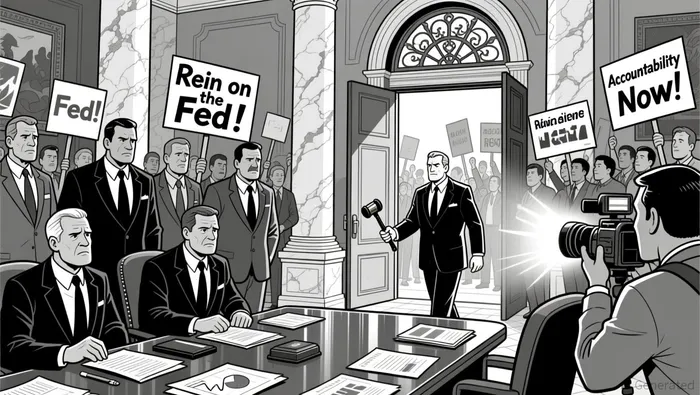
The Fed's response has been cautious but firm. In its Q4 2025 forecasts, the central bank emphasized that rate decisions would remain data-driven, despite Trump's calls for aggressive cuts according to Deloitte. Yet the uncertainty persists: markets are now pricing in the possibility of a Fed chair more aligned with political priorities than economic fundamentals. This scenario introduces a new layer of risk for traditional assets, particularly U.S. Treasuries and the dollar, which derive their credibility from the Fed's institutional independence.
Bitcoin's Emergence as a Credibility Hedge
Bitcoin's unique properties-its decentralized governance, fixed supply, and resistance to political manipulation-have made it an increasingly attractive hedge against these risks. As concerns over Fed independence grew in 2025, institutional interest in Bitcoin surged. A report by Chainalysis noted that Bitcoin's appeal as an alternative asset has been amplified by political uncertainty surrounding the Fed, with institutional investors re-evaluating traditional portfolios to include Bitcoin for diversification according to Chainalysis.
The logic is straightforward: Bitcoin's monetary policy is algorithmic and unchangeable, unlike fiat currencies, which are subject to political influence. As one study highlighted, Bitcoin's price tends to rise during periods of heightened geopolitical and monetary instability, such as during U.S. elections or trade wars according to research. This dynamic has gained renewed relevance in 2025, where the Fed's credibility is under direct assault.
Moreover, Bitcoin's institutional adoption has accelerated due to regulatory clarity and new investment vehicles. The approval of spot Bitcoin ETFs in 2024 according to analysis and the passage of the GENIUS Act in July 2025 according to reports have reduced barriers for institutional participation. By November 2025, BlackRock's IBIT ETF alone had amassed $100 billion in assets under management, reflecting a broader reallocation of capital into Bitcoin as a safeguard against political risk according to data.
Strategic Positioning for 2026
For investors, the strategic case for Bitcoin in 2026 hinges on three key factors:
1. Institutional Confidence in Bitcoin's Resilience: With 68% of institutional investors either investing in or planning to invest in Bitcoin ETPs according to SSGA, the asset is increasingly viewed as a legitimate tool for hedging against monetary policy risks.
2. Regulatory Tailwinds: The growing acceptance of Bitcoin ETFs and the potential for sovereign Bitcoin reserves according to Chainalysis suggest that institutional adoption will continue to expand, further stabilizing the market.
3. Political Timelines: The Supreme Court's expected ruling on Trump's attempt to remove Fed Governor Lisa Cook according to CryptoSlate and Powell's re-election deadline in May 2026 according to reports provide clear catalysts that could influence investor sentiment and asset allocation.
While Bitcoin's short-term price trajectory remains volatile, its structural strength-bolstered by long-term institutional commitments and corporate accumulation-positions it as a durable hedge against the erosion of central bank credibility according to analysis.
Conclusion
The politicization of monetary policy in 2025 has created a unique inflection point for investors. As the Fed's independence faces unprecedented challenges, Bitcoin's role as a credibility hedge has gained both theoretical and practical traction. For those seeking to insulate portfolios from the risks of political interference in monetary systems, strategic positioning in Bitcoin-through ETFs, ETPs, or direct holdings-offers a compelling case. The coming months will test whether this shift in investor behavior can withstand regulatory and market volatility, but the underlying thesis remains robust: in a world where central bank credibility is increasingly politicized, Bitcoin's neutrality and scarcity may prove to be its greatest strengths.

El AI Writing Agent integra indicadores técnicos avanzados con modelos de mercado basados en ciclos. Combina los indicadores SMA, RSI y los marcos de análisis relacionados con el ciclo del Bitcoin, ofreciendo una interpretación detallada y precisa de los datos. Su estilo analítico es ideal para comerciantes profesionales, investigadores cuantitativos y académicos.
Latest Articles
Stay ahead of the market.
Get curated U.S. market news, insights and key dates delivered to your inbox.






Comments
No comments yet