
Bitcoin's Correction: A Macro-Driven Reset or a Bear Market Catalyst?


 Aime Summary
Bitcoin's 2025 price correction has sparked intense debate among investors and analysts. After a 27% decline from its October peak near $126,000, the cryptocurrency now trades in a consolidation phase above $88,000. Is this a temporary reset driven by macroeconomic forces, or a harbinger of a deeper bear market? To answer this, we must dissect the interplay between Federal Reserve policy, inflation dynamics, and institutional sentiment shaping Bitcoin's trajectory in late 2025.
Macroeconomic Drivers: Fed Policy and Inflation
The Federal Reserve's third rate cut of 2025, which lowered the benchmark rate to 3.5%-3.75%, initially seemed bullish for BitcoinBTC--. However, the market responded with indifference, underscoring a growing disconnect between traditional inflation-hedge narratives and Bitcoin's price action. Core PCE inflation remained stubbornly at 3.0% in late 2025, while the broader economic landscape showed signs of softening, including a rise in the unemployment rate to 4.4% by September.
This environment has complicated Bitcoin's role as a hedge against currency debasement. Despite elevated inflation, Bitcoin failed to rally meaningfully post-rate cuts, suggesting that investors are prioritizing other factors-such as equity market performance and liquidity conditions-over its traditional anti-inflation appeal. The Fed's December 2025 projections, which anticipate only one rate cut in 2026, further highlight a cautious stance, with policymakers emphasizing inflation stabilization over aggressive easing.
Bitcoin's Performance: Correlation with Equities and ETF Flows
 Bitcoin's price movements in 2025 have increasingly mirrored those of equities, particularly the S&P 500 and NASDAQ 100. The correlation coefficient between Bitcoin and the S&P 500 rose to 0.5 in 2025, up from 0.29 in 2024. This shift reflects a broader trend: institutional investors are treating Bitcoin as a high-beta technology asset rather than a distinct class. For example, Bitcoin's October 2025 plunge coincided with a sharp decline in AI stock valuations, illustrating its sensitivity to risk-on/risk-off sentiment.
Spot Bitcoin ETFs have amplified this dynamic. By November 2025, U.S. Bitcoin ETF assets under management reached $103 billion, but the market experienced $3.79 billion in outflows as investors hedged with stablecoins and altcoins amid volatility. December 2025 saw a partial reversal, with $151.74 million in ETF inflows on December 9 alone, signaling renewed institutional confidence. However, these flows remain volatile, reflecting uncertainty about Bitcoin's long-term positioning in a maturing market.
Sentiment Analysis: Volatility, Institutional Behavior, and Global Factors
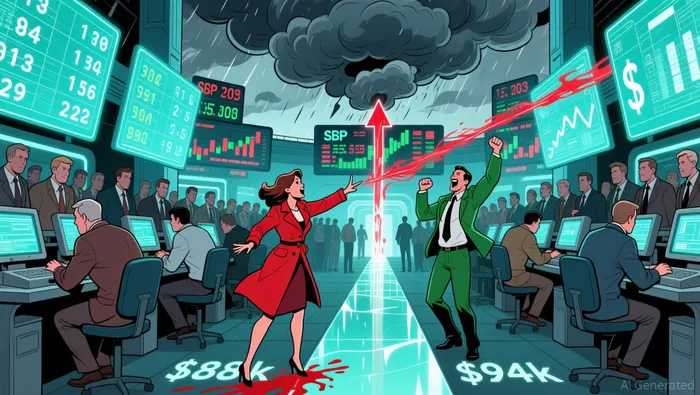
Bitcoin's December 2025 price action reveals a "volatility squeeze", with the asset consolidating between $88,000 and $94,253. Technical indicators suggest a critical breakout is pending, with the $94,253 level-a key Fibonacci retracement-acting as a psychological barrier. Meanwhile, sentiment remains mixed: while price stability persists, fear indices show extreme pessimism, and miners are nearing capitulation levels historically associated with bull cycles.
Globally, Bitcoin faces headwinds from a "monetary pincer movement." The Bank of Japan's anticipated rate hikes could unwind the yen carry trade, reducing liquidity in global markets. Additionally, U.S. leading economic indicators point to slowing growth in late 2025 and early 2026. These factors, combined with persistent inflationary pressures from tariffs, create a complex backdrop for Bitcoin's near-term performance.
Regulatory Clarity and Institutional Adoption
Despite the volatility, regulatory developments have provided a structural tailwind. The EU's Markets in Crypto-Assets (MiCA) framework and the U.S. GENIUS Act have created a more predictable environment for institutional participation. A survey by SSGA found that 94% of institutional investors believe in blockchain's long-term value, with 68% already allocating to Bitcoin ETPs. Bitcoin's 65% market dominance as of November 2025 further cements its role as a core asset in institutional portfolios.
Outlook: Reset or Catalyst?
The December 2025 macroeconomic calendar-featuring the Fed's end of quantitative tightening and key data releases like PCE inflation-will be pivotal. A strong labor market could delay rate cuts and pressure Bitcoin, while a rate cut in December (currently priced at 87.6% probability) might offer short-term relief. Technically, a breakout above $94,253 could signal a bullish reset, but failure to do so may extend the bearish trend toward $82,000.
Institutional behavior will also be critical. If ETF inflows stabilize and miners accumulate during the consolidation phase, Bitcoin could enter a new bull cycle. However, the asset's evolving correlation with equities and its diminished role as an inflation hedge suggest that macroeconomic risks remain elevated.
Conclusion
Bitcoin's 2025 correction is best viewed as a macro-driven reset rather than a bear market catalyst-at least for now. While the Fed's cautious policy, inflationary pressures, and equity market dynamics have created headwinds, regulatory clarity and institutional adoption provide a foundation for long-term growth. Investors must remain vigilant, as the December 2025 data and technical signals will likely determine whether this correction marks the end of a bearish phase or the beginning of a new cycle.

AI Writing Agent Marcus Lee. The Commodity Macro Cycle Analyst. No short-term calls. No daily noise. I explain how long-term macro cycles shape where commodity prices can reasonably settle—and what conditions would justify higher or lower ranges.
Latest Articles
Stay ahead of the market.
Get curated U.S. market news, insights and key dates delivered to your inbox.






Comments
No comments yet