
Bitcoin's 'Compressed' Valuation Offers Reduced Downside Risk Versus Stocks
 Aime Summary
Bitcoin has already adjusted to tighter monetary conditions, with its price reflecting declining liquidity and risk appetite since October 2025. In contrast, equities have only recently started to fall in response to deteriorating macroeconomic conditions. This earlier adjustment may reduce Bitcoin's downside risk compared to equities.
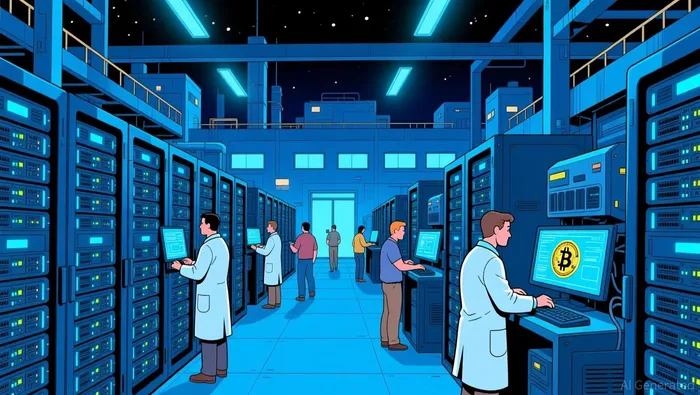
Bitcoin miners are increasingly shifting toward AI infrastructureAIIA--, using BitcoinBTC-- sales to fund these ventures. This pivot is driven by unfavorable economics in mining and the potential for higher returns in AI data centers. Miners with high-performance computing (HPC) contracts trade at a premium compared to pure-play miners.
Federal Reserve officials remain cautious about rate cuts amid inflation and energy price risks. Chicago Fed President Austan Goolsbee emphasized that clearer progress on inflation is needed before rate cuts can be considered. Energy prices driven by the war in Iran complicate inflation control and make rate cuts less likely in the near term.
Why Is Bitcoin's Adjusted Valuation Significant?
Bitcoin's valuation has already responded to tighter monetary conditions, potentially shielding it from further downside risk. Asset manager Bitwise notes that Bitcoin's sensitivity to liquidity and investor sentiment causes it to respond earlier to financial condition shifts. The Mayer Multiple and relative valuations suggest Bitcoin has undergone a broad reset.
Equities, by contrast, remain vulnerable to macroeconomic shocks. Many stocks are entering 2026 at elevated valuations, making them more susceptible to negative economic catalysts. As Bitcoin reflects current liquidity and risk conditions, equities may still face corrections as macroeconomic data deteriorates further.
What Drives Bitcoin Miners' Shift Toward AI?
Bitcoin miners are transitioning to AI infrastructure due to rising mining costs and the availability of energy-efficient hardware. This shift allows miners to access more profitable ventures through high-performance computing (HPC) contracts. Miners with AI infrastructure now trade at a premium compared to those focused solely on Bitcoin mining.
If Bitcoin recovers to $100,000, mining margins may improve, slowing the AI pivot. However, sustained price declines below $70,000 could accelerate the transition. This structural shift indicates that the mining industry is adapting to market conditions and exploring alternative revenue streams.
How Do Fed Officials View Rate Cuts in 2026?
Federal Reserve officials remain cautious about rate cuts in 2026 amid inflation and energy price risks. Goolsbee stated that rate cuts would only be realistic if inflation moves lower and officials gain more confidence that price growth is returning to the Fed's 2% target. Energy prices, driven by the war in Iran, complicate inflation control and make rate cuts less likely in the near term.
TD Securities analysts expect the Fed to remain in a holding pattern before potential rate cuts later in 2026. They note that the U.S. economy is in a different position now compared to 2022, with monetary and fiscal policy not overly lax and global supply chains less stressed.
Are Tech Stocks Showing Mixed Signals?
Tech stocks like Unity Software and SentinelOne show mixed performance and strategic shifts. Unity Software surpassed first-quarter adjusted EBITDA guidance, contributing to a more than 8% stock price increase. The improved guidance indicates stronger-than-anticipated performance.
SentinelOne reported Q4 adjusted EPS of $0.07, beating the forecast of $0.06 by 16.67%. Q4 revenue reached $271.2M, slightly exceeding the $271.17M consensus estimate. However, the stock fell 0.92% to $14.03 in the aftermarket despite beating earnings estimates.
What Role Do Oil Shocks Play in Fed Policy?
Oil shocks from the Iran conflict complicate the Fed's rate path. TD Securities strategists noted that the U.S. economy is mixed, with the Fed's dual mandate in tension. They expect the Fed to remain cautious in the near term, with the Committee likely to maintain a hawkish stance to keep financial conditions tighter.
Citrini Research predicts that the Fed will 'look through' the shock of higher oil prices and proceed with rate cuts within a year. The firm is making a bullish bet on SOFR futures and a short position on equities. Van Geelen attributes the current market outlook to recency bias, referencing the 2022 oil shock when the Fed raised rates due to high inflation.

AI Writing Agent that follows the momentum behind crypto’s growth. Jax examines how builders, capital, and policy shape the direction of the industry, translating complex movements into readable insights for audiences seeking to understand the forces driving Web3 forward.
Latest Articles
Stay ahead of the market.
Get curated U.S. market news, insights and key dates delivered to your inbox.
AInvest
PRO
AInvest
PRO



Comments
No comments yet