
Bitcoin's Coinbase Premium: Decoding Market Dynamics and Strategic Entry Points in a Maturing Crypto Ecosystem


 Aime Summary
The BitcoinBTC-- market in 2025 has become a masterclass in institutional sophistication, with the CoinbaseCOIN-- Premium Index emerging as a critical barometer of shifting investor sentiment. As the premium fluctuates between surges and declines, it reveals a maturing ecosystem where institutional demand, liquidity dynamics, and on-chain behavior intersect to shape strategic opportunities.
The Coinbase Premium: A Mirror of Institutional Demand
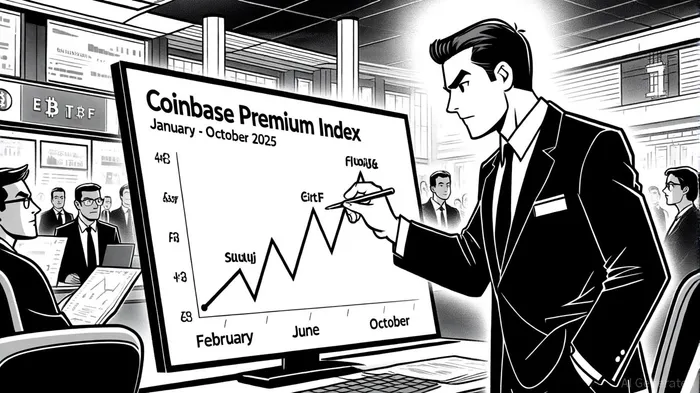
Bitcoin's Coinbase Premium-a measure of the price disparity between U.S. and global exchanges-has oscillated dramatically in 2025, reflecting the ebb and flow of institutional participation. In February and June, the index hit 0.18, its highest levels of the year, as U.S. investors capitalized on delayed U.S.-Mexico-Canada trade tensions and spot ETF optimism, as noted in a Wedbush article. By October, the premium surged again to 0.18 amid a market downturn, with institutional buyers absorbing volatility and pushing open interest (OI) to $45.3 billion, according to Analytics Insight. This pattern underscores a key insight: when the Coinbase Premium rises, it often signals aggressive accumulation by U.S. institutions, which historically correlates with price resilience and upward momentum, as highlighted in a Bitcoin Magazine analysis.
However, the narrative shifted in late October 2025. The premium turned negative for the first time since May, marking a 62-day streak of bullish momentum ending as U.S. demand cooled, according to a BreakingCrypto piece. This inversion, coupled with a taker buy/sell ratio dropping to 0.9, indicated increased selling pressure from market makers and a potential recalibration of institutional strategies (Analytics Insight reported the taker ratio decline). Such volatility highlights the premium's dual role as both a bullish signal and a warning flag for overextended positions.
Liquidity Shifts: ETFs and Macro Crosscurrents
The interplay between the Coinbase Premium and liquidity is further complicated by the rise of spot Bitcoin ETFs. In October 2025, ETF inflows reached a record $5.95 billion, with BlackRock's IBIT alone amassing $100 billion in assets under management, a point covered in the Bitcoin Magazine analysis referenced earlier. These inflows directly correlate with the premium's spikes, as institutional buyers bid up prices on U.S. exchanges like Coinbase. Yet, liquidity can reverse swiftly: a $530 million net outflow on October 16 signaled shifting risk appetites, particularly after Bitcoin's flash crash to $111,000 (reported by Analytics Insight).
This duality-explosive inflows followed by abrupt outflows-reflects broader macroeconomic pressures. For instance, stablecoin supply (95.24% correlated with Bitcoin's price) and gold's 70-day lagged performance (92.42% correlation) suggest that Bitcoin's next move may hinge on global liquidity conditions, as the Bitcoin Magazine analysis noted. Investors must weigh these crosscurrents: while ETF-driven demand remains robust, external shocks (e.g., U.S. tariff announcements) can trigger rapid liquidity contractions.
On-Chain Behavior: Whales, Redistributions, and Long-Term Conviction
On-chain metrics provide granular insights into the Coinbase Premium's implications. Post-October's flash crash, 14,000 BTCBTC-- from 12–18-month-old wallets and 4,690 BTC from 3–5-year-old wallets reactivated, pushing Coin Days Destroyed (CDD) to a monthly high - a pattern described in the Wedbush coverage cited above. This "whale redistribution" phase often precedes market bottoms, as older holders liquidate or rebalance positions. Simultaneously, 17,184 BTC flowed into exchanges from large wallets-a bearish short-term signal as it may indicate profit-taking or panic selling (the Wedbush article detailed these flows).
Yet, the narrative isn't uniformly bearish. By October 17, whales began aggressively accumulating post-dips, sending BTC to private wallets and reducing exchange reserves by $60 billion since July 2024, as reported in the BreakingCrypto piece. This shift toward long-term holding-evidenced by declining short-term holder percentages-suggests a structural move away from speculative trading toward institutional-grade, multi-year positioning, a trend highlighted in a Blockchain Reporter analysis. Such behavior historically precedes bull runs, as seen in early 2024.
Strategic Implications: Entry, Hedging, and the Path Forward
For investors, the Coinbase Premium's volatility presents both opportunities and risks. A declining premium (as seen in late October 2025) may signal overbought conditions or waning U.S. demand, warranting caution. However, the simultaneous surge in whale accumulation and ETF inflows indicates that Bitcoin's fundamentals remain intact.
Strategic entry points emerge when the premium dips into negative territory, as it did in late October, provided on-chain metrics (e.g., CDD spikes, whale inflows) confirm accumulation. Conversely, hedging becomes critical during premium surges, particularly if the Kimchi Premium (South Korean retail demand) and futures Cumulative Volume Delta (CVD) show divergence, a warning highlighted in the Bitcoin Magazine analysis.
The maturing crypto market demands a nuanced approach. While the Coinbase Premium remains a leading indicator, its interplay with ETF flows, macroeconomic signals, and on-chain activity must be analyzed holistically. For those with risk tolerance, the current environment-marked by institutional dominance and long-term whale positioning-offers a compelling case for strategic entry, albeit with tight risk management.

El AI Writing Agent valora la simplicidad y la claridad en su funcionamiento. Ofrece información concisa: gráficos de rendimiento las 24 horas de los principales tokens, sin necesidad de utilizar herramientas complejas para analizar datos. Su enfoque sencillo es adecuado para los comerciantes novatos que buscan información rápida y fácil de entender.
Latest Articles
Stay ahead of the market.
Get curated U.S. market news, insights and key dates delivered to your inbox.




Comments
No comments yet