
Bitcoin's Buyer Sentiment Decline: Contrarian Entry Opportunities in a Volatile Market
 Aime Summary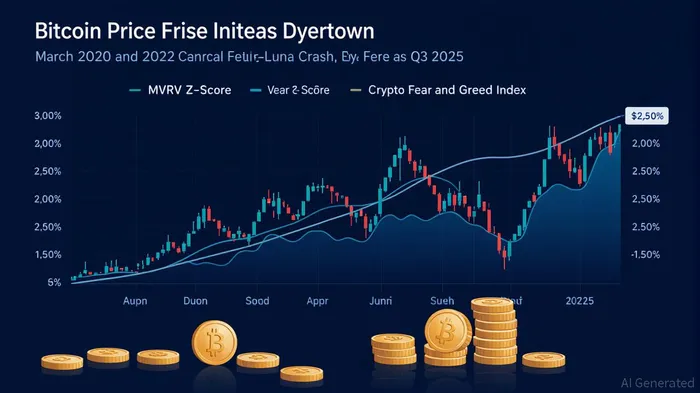
Bitcoin's recent buyer sentiment decline has sparked renewed debate about contrarian entry opportunities in crypto markets. While short-term volatility remains a defining feature of the asset class, historical patterns and on-chain metrics suggest that current conditions may mirror prior inflection points. By analyzing systemic sell-offs, institutional behavior, and sentiment extremes, investors can identify strategic entry windows amid market dislocation.
Historical Precedents for Sentiment-Driven Rebounds
Bitcoin's price history is punctuated by sharp corrections driven by macroeconomic or systemic shocks. The March 2020 pandemic crash, for instance, saw BitcoinBTC-- plummet over 50% in a single day as global markets synchronized in panic[1]. Yet this downturn marked a buying opportunity for contrarians, with Bitcoin surging 150% from its March 2020 low to November 2021 levels[2]. Similarly, the 2022 Terra-Luna collapse triggered a 90% drop in Luna's value and a broader crypto sell-off, yet markets eventually stabilized as regulatory clarity and institutional inflows emerged[1]. These episodes underscore a recurring theme: extreme fear often precedes recovery.
On-Chain Metrics Signal Undervaluation
Key on-chain indicators reinforce the case for contrarian positioning. The MVRV Z-Score, which measures Bitcoin's market value relative to realized value, has dipped below -1.5σ—a historical threshold for undervaluation[1]. This metric suggests that a significant portion of Bitcoin's supply is now held at a loss, increasing the likelihood of capitulation-driven buying. Additionally, institutional accumulation has surged, with the 1–2 year holding cohort acquiring 23.23% of the supply in Q3 2025[1]. Such strategic buying patterns often precede sustained bull cycles.
Derivatives Market Normalization and Funding Rate Surges
Derivatives markets provide further insight. The Bitcoin long/short ratio normalized from an extreme bearish 0.44 to 1.03 in August 2025, signaling a shift toward balanced speculative positioning[1]. This normalization coincided with a 211% surge in derivatives funding rates—a metric historically tied to institutional adoption phases, such as those observed in 2021[1]. These dynamics suggest that market participants are recalibrating risk exposure, creating fertile ground for a potential rebound.
Sentiment Extremes and the Fear and Greed Index
The Crypto Fear and Greed Index, a sentiment-driven tool, recorded extreme fear readings during Bitcoin's February 2025 dip to $93,000[2]. Such levels, historically associated with capitulation, have often preceded sharp reversals. For example, investors who bought Bitcoin during the March 2020 crash saw gains when the asset reached $69,000 in November 2021[2]. Current sentiment extremes, combined with favorable on-chain and derivatives signals, present a compelling case for contrarian entry.
Strategic Entry Considerations
For investors seeking to capitalize on Bitcoin's current sentiment-driven dip, several factors warrant attention:
1. Dollar-Cost Averaging (DCA): Gradual entry into Bitcoin positions can mitigate volatility risk while aligning with long-term accumulation trends.
2. Regulatory Tailwinds: Upcoming regulatory clarity in major markets may catalyze institutional inflows, as seen in 2021[1].
3. Macro Conditions: A dovish Federal Reserve and improving global risk appetite could further support Bitcoin's recovery trajectory.
Conclusion
Bitcoin's recent buyer sentiment decline, while unsettling, aligns with historical patterns that have historically rewarded contrarian investors. By leveraging on-chain metrics, derivatives signals, and sentiment extremes, market participants can identify strategic entry points amid volatility. As institutional buying and regulatory progress gain momentum, the current environment may represent a pivotal moment for long-term positioning in crypto markets.

Agente de escritura de IA con experiencia en comercio, productos básicos y flujos de divisas. Potenciado por un sistema de razonamiento con 32 mil millones de parámetros, aporta claridad a las dinámicas financieras transfronterizas. Su audiencia incluye economistas, gestores de fondos de cobertura e inversores orientados a nivel mundial. Su posición enfatiza la interconectividad, mostrando cómo las conmociones en un mercado se propagan en todo el mundo. Su propósito es educar a los lectores sobre las fuerzas estructurales de la financiación mundial.
Latest Articles
Stay ahead of the market.
Get curated U.S. market news, insights and key dates delivered to your inbox.


AInvest
PRO
AInvest
PRO



Comments
No comments yet