
Bitcoin's Bullish Cycle Reawakens: Why 2025 Halving Signals a Bottom with Asymmetric Upside
The BitcoinBTC-- network is once again at a pivotal inflection point. The 2024 halving, which reduced block rewards by 50%, has reshaped the asset's scarcity dynamics, network security, and institutional appeal. By comparing current metrics to historical cycles (2012, 2016, 2020), we uncover a compelling case for Bitcoin's valuation bottoming and a cyclical price surge ahead. Here's why investors should pay attention.
The Stock-to-Flow Ratio: Scarcity at Unprecedented Levels
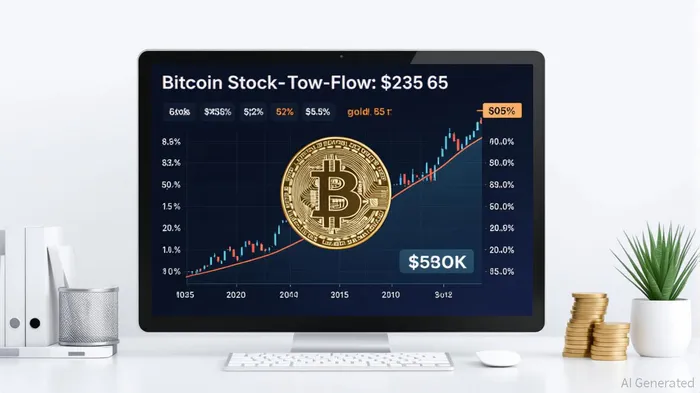
The stock-to-flow (S2F) ratio—a measure of an asset's scarcity—has hit 103 in 2025, the highest since Bitcoin's creation. This surpasses gold's S2F of 65, underscoring Bitcoin's growing rarity. Historically, S2F has been a powerful predictor of Bitcoin's valuation:
- 2012 Halving (S2F ~15): Price rose 7,000% in 12 months.
- 2016 Halving (S2F ~25): Price surged 291%.
- 2020 Halving (S2F ~50): A 541% gain followed.
At S2F 103, Bitcoin's scarcity is now in a league of its own. Plan B's S2F model suggests a price target of $1 million+ by 2025's end—a 200%+ upside from current $80k–$90k levels. While skeptics dismiss models as oversimplified, the historical correlation is undeniable.
Hash Rate: Network Resilience Amid Stagnant Prices
The Bitcoin network's computational power (hash rate) has reached an all-time high of 700 EH/s by early 2025, defying expectations. Unlike prior halvings, this surge occurred without a corresponding price rally, signaling unprecedented miner resilience.
- Historical Context:
- Post-2012 halving: Hash rate dipped briefly before rising 8,000% by 2020.
- Post-2016 halving: Hash rate grew 394% by 2023 despite a 40% drop in 2021.
- 2024's Anomaly:
- Hash rate rebounded to record highs within months of the halving, even as Bitcoin's price languished.
- Miner consolidation and energy-efficient ASICs (e.g., 10 J/TH hardware) enabled this feat.
This divergence between hash rate and price creates a hidden bullish signal: miners are doubling down on Bitcoin's long-term value. A 51% attack now costs billions, ensuring security while price lags—a stark contrast to 2012–2020 cycles.
Institutional Adoption: Maturing Beyond the Bull Run
Bitcoin's institutional acceptance has evolved from speculative hype to strategic allocation. Key indicators:
1. Regulatory Clarity:
- U.S. crypto ETFs and EU's MiCA-compliant stablecoins (e.g., USDC, EURC) have doubled in volume to $209 billion, with euro-denominated coins growing 363% in 2024–2025.
- Exchange holdings (a proxy for retail speculation) fell to a five-year low, signaling reduced short-term volatility.
2. Corporate Interest:
- Major miners like TeraWulfWULF-- and Core ScientificCORZ-- are diversifying into AI, leveraging stranded energy and creating hybrid revenue streams.
- Microstrategy's BTC reserves ($3.2 billion as of Q1 2025) remain a testament to corporate conviction.
Derivatives Markets: Longs Accumulate Silently
The derivatives market—once prone to panic selling—now reflects a calmer, more structured landscape:
- Open Interest:
- Total futures and options open interest remains near $10 billion, far below 2021's peak. This suggests less speculative overextension.
- Volatility:
- 60-day price volatility dropped to 50% in 2025, down from over 200% in 2012. Reduced volatility often precedes sustained rallies.
- Skew Data:
- Options markets show a slight tilt toward long positions, with 2025's low volatility enabling investors to buy downside protection cheaply.
The Bull Case: Asymmetric Upside Ahead
The confluence of record scarcity (S2F 103), unshaken network security, and maturing institutional demand positions Bitcoin for a multiyear rally. Key catalysts:
1. Next Halving (2028): The S2F will jump to ~200, pushing the S2F model's price target to $5 million+—a number that feels absurd today but has historical precedent.
2. Macro Tailwinds:
- A potential global recession could drive capital into Bitcoin as a digital safe haven.
- Central bank digital currency (CBDC) developments may indirectly legitimize Bitcoin as a peer.
Investment Strategy: Accumulate the Bottom
The data paints a clear path:
- Current Price: $80k–$90k is a valuation floor given S2F and hash rate trends.
- Target: Aim for $150k–$200k by 2026, with the 2028 halving driving a parabolic move.
Actionable Steps:
1. DCA (Dollar-Cost Average): Buy increments of Bitcoin monthly to mitigate volatility.
2. HODL: Hold for the long term—cycles take years, and Bitcoin's scarcity advantage compounds.
3. Monitor Derivatives: Watch for a sustained skew toward longs or rising open interest as entry signals.
Conclusion
Bitcoin's 2024 halving has created a paradox: a weaker price response but stronger fundamentals. The S2F ratio, hash rate, and institutional adoption all point to a bottoming phase. History shows that Bitcoin's cycles are relentless—this one is no exception. For investors with a multiyear horizon, now is the time to position for the next leg up.
Investment advice: Always consider personal risk tolerance and diversification. Past performance does not guarantee future results.

Delivering real-time insights and analysis on emerging financial trends and market movements.
Latest Articles
Stay ahead of the market.
Get curated U.S. market news, insights and key dates delivered to your inbox.


AInvest
PRO
AInvest
PRO



Comments
No comments yet