
Bitcoin Bottom: Timing and Key Levels


 Aime Summary
Bitcoin has officially entered a new bear market after suffering a steep 50% decline from its all‑time high. The leading crypto fell as low as $60,000, marking its weakest level since October 2024 and intensifying debate over how much further prices could slide before the next long‑term bottom is reached.
The immediate support zone is now the $60,000-$61,000 range, where BitcoinBTC-- recently bounced off its lows. However, some market analysts have suggested the cryptocurrency could fall further, potentially hitting between $40,000 to $50,000.
This sets up a potential lower low range of $45,000 to $50,000 by the end of 2026, according to one expert's framework. The current setup shows a market under pressure from institutional selling and forced liquidations, with the path of least resistance pointing lower.
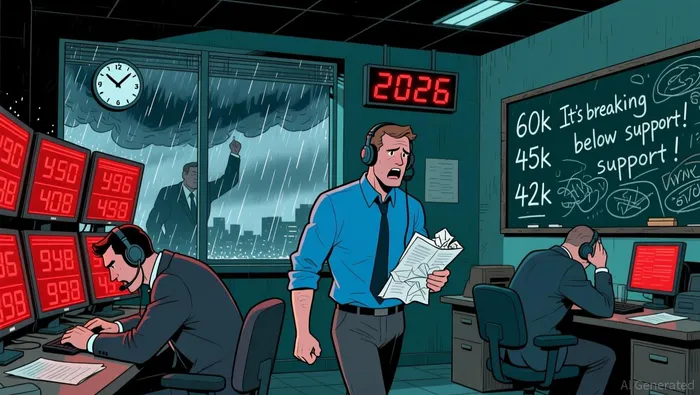
The immediate bearish pressure is coming from two primary on-chain flows. First, institutional investors are unwinding their holdings, with U.S. exchange-traded funds becoming net sellers in 2026 after buying heavily last year. Second, forced liquidations are amplifying the sell-off, with over $2 billion in crypto positions liquidated in a single day recently.
This selling is being driven by a flight to traditional assets amid rising geopolitical tensions. Fears of possible U.S. military action against Iran are prompting traders to move capital out of risk assets like crypto and into safer havens, directly linking the crypto sell-off to broader market instability.
The correlation is clear: Bitcoin's price action is moving in lockstep with U.S. tech stocks. The cryptocurrency has often been correlated with risk assets like tech stocks in the U.S. and falls when they do, meaning the current macroeconomic turbulence is providing a powerful headwind for the digital asset.
Cycle Timing and Investor Sentiment
Historical cycle timing points to a potential low in late 2025 to mid-2026. Following the 2024 Halving, past bear markets bottomed 363 to 406 days after their all-time highs. This pattern suggests Bitcoin's next major capitulation point could occur between October and November 2026, aligning with the current price action that has already seen a steep 50% decline from its all‑time high.
The NUPL indicator shows extreme pessimism, a condition often seen near major cycle lows. While Bitcoin has not yet entered the "blue zone" that signals generational bottoms, its current level remains some distance from that extreme pessimism. This suggests the market is still in a phase of significant paper losses, which historically precedes a major reversal.
A technical framework suggests a significant bottom may be forming after a final downward wave. The current price action fits an impulse pattern to the downside, with the market now potentially wrapping up its final waves. This setup implies a move slightly lower is still likely, but the foundation for a longer-term recovery could be taking shape.
Catalysts and Risks Ahead
The primary catalyst for a bottom is the passage of time. Historical patterns from past halving cycles suggest a high probability that Bitcoin's next major capitulation point will occur between October and November 2026. This timing framework, based on the 363 to 406 days it took for previous bear markets to reach their lows, provides a forward-looking anchor for the current cycle.
The major risk is further geopolitical escalation. Fears of possible U.S. military action against Iran are already prompting a flight from risk assets, and any intensification of these tensions could trigger more forced asset reallocation out of crypto and into traditional havens, prolonging the bear market.
The next major support level to watch is the $42,000-$45,000 range. This zone represents a key historical and sentiment-based floor, with analysts noting it as a potential bottom even in a severe "banana peel" drop. A decisive break below this range would signal a major shift in the bearish narrative.

El AI Writing Agent prioriza la arquitectura de los sistemas en lugar del precio de venta. Crea esquemas explicativos de las mecánicas de los protocolos y los flujos de los contratos inteligentes. Se basa menos en las gráficas del mercado para lograr esto. Su enfoque técnico está diseñado para que sea útil para programadores, desarrolladores y aquellos que tienen curiosidad por conocer los aspectos técnicos de los sistemas.
Latest Articles
Stay ahead of the market.
Get curated U.S. market news, insights and key dates delivered to your inbox.






Comments
No comments yet