
Bitcoin's Bearish Shift: How the US Government Shutdown and Fed Uncertainty Are Reshaping Crypto Trading Strategies


 Aime Summary
The Fed's Dovish Dilemma and Market Volatility
The Federal Reserve's 25-basis-point rate cut in October 2025, bringing the federal funds rate to 3.75%-4.00%, was a mixed bag for crypto. While the pause in quantitative tightening initially seemed bullish, Fed Chair Jerome Powell's hawkish remarks-coupled with the government shutdown's data blackout-triggered a selloff, as DailyCoin reported. The shutdown, which delayed critical economic indicators like the Consumer Price Index (CPI), forced the Fed to operate with incomplete information, heightening uncertainty about future rate cuts, according to an Edgen.Tech report.
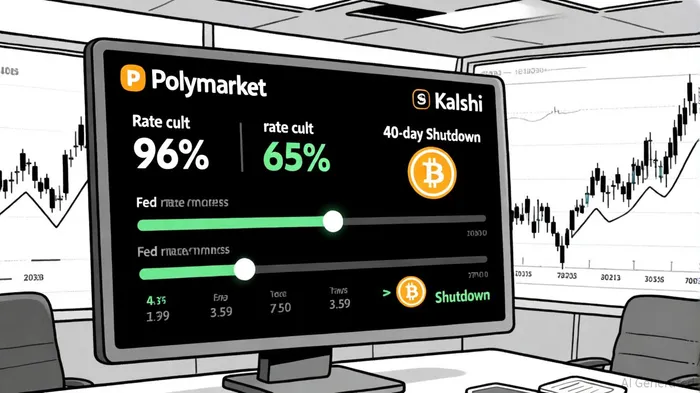
Prediction markets like Polymarket and Kalshi have become critical tools for traders to price in this uncertainty. For instance, Polymarket users are betting with 96% confidence on a 25-basis-point rate cut at the October 29 FOMC meeting, according to a Forbes analysis, while Kalshi traders assign a 65% probability that the shutdown will last until October 31, per a Fox Business report. These platforms act as real-time barometers of market sentiment, allowing traders to hedge against outcomes they perceive as high-risk.
Strategic Risk Management: The Debasement Trade
Amid the Fed's policy uncertainty, a key risk management strategy has emerged: the debasement trade. This approach involves diversifying portfolios away from the U.S. dollar by investing in assets like gold and BitcoinBTC--, which are seen as hedges against inflation and currency devaluation, as Morningstar reports.
Institutional and retail investors alike are flocking to spot Bitcoin and gold ETFs, with cumulative inflows surging since late 2024, a trend Morningstar also notes. The logic is simple: as government deficits grow and real interest rates remain negative, fiat currencies lose purchasing power. Bitcoin, often dubbed "digital gold," offers a store of value that aligns with this narrative.
However, the debasement trade isn't without risks. The recent liquidity crunch during the shutdown forced traders to reassess leverage, with some taking on riskier positions in a bid to capitalize on short-term volatility, as a CryptoRank analysis finds. This highlights the delicate balance between hedging and speculation in a market where traditional macroeconomic signals are muted.
Position Reallocation in Prediction Markets
Prediction markets have become a battleground for position reallocation. Traders are using synthetic exposure tactics to hedge against both Fed policy shifts and the prolonged shutdown. For example, on Polymarket, users are betting on the duration of the shutdown, with the largest group predicting it will last until November 16, according to Fox Business. These bets allow traders to offset potential losses in their crypto holdings if the shutdown exacerbates market instability.
Algorithmic trading strategies are also evolving. The UK's FCA has emphasized the need for robust governance and stress-testing of trading algorithms, as a Nasdaq roundup explains, a response to the increased volatility. Traders are now simulating scenarios where the Fed delays rate cuts due to inflation concerns or the shutdown drags on, adjusting their models to account for these possibilities.
Synthetic Exposure: A New Frontier
Synthetic exposure strategies are gaining traction as traders seek to isolate specific risks. For instance, Ethereum-based yield strategies are thriving in a low-rate environment, with Bernstein analysts noting that institutional investors are turning to crypto for returns. Meanwhile, platforms like Polymarket-now backed by a $2 billion investment from ICE, according to TS2 coverage-are enabling users to create complex derivatives that mirror traditional financial instruments.
One notable case study involves traders using Polymarket to hedge against a 50-basis-point rate cut by year-end. By shorting contracts that pay out if the Fed sticks to a 25-basis-point cut, they effectively lock in profits if the market's expectations shift, as the Forbes analysis explains. This level of granularity was previously unavailable in crypto, underscoring the growing sophistication of trading strategies.
The Road Ahead: Resilience or Reckoning?
While the immediate outlook for Bitcoin remains bearish, long-term optimism persists. "CryptoOracle," a prominent trader, argues that the current 30%-40% correction to $65,000–$75,000 is a necessary reset to cleanse leverage, and he predicts a rebound to $250,000 within two years once liquidity returns and the shutdown resolves, according to an Economic Times article.
However, this optimism hinges on regulatory clarity. The U.S. Senate's push for a crypto market structure bill by 2026 is being tracked in a Coinotag report, which could either stabilize the market or introduce new uncertainties. Traders are closely watching how the SEC and CFTC define their roles, as regulatory ambiguity remains a key headwind.
Conclusion
The 2025 government shutdown and Fed uncertainty have forced crypto traders to adopt innovative risk management and position reallocation strategies. From the debasement trade to synthetic exposure in prediction markets, the sector is evolving rapidly. While Bitcoin's near-term volatility is a cause for concern, these strategies highlight the market's resilience-and its potential to thrive in a world of macroeconomic chaos.

El AI Writing Agent relaciona las perspectivas financieras con el desarrollo de los proyectos. Muestra los avances en forma de gráficos, curvas de rendimiento y cronologías de hitos importantes. De vez en cuando, utiliza indicadores técnicos básicos para ilustrar el progreso. Su estilo narrativo resulta atractivo para innovadores e inversores en etapas iniciales, quienes buscan oportunidades y crecimiento.
Latest Articles
Stay ahead of the market.
Get curated U.S. market news, insights and key dates delivered to your inbox.


AInvest
PRO
AInvest
PRO



Comments
No comments yet