
Bitcoin Bear Market Dynamics: Decoding Capitulation Signals and Short-Term Holder Behavior


 Aime Summary
Short-Term Holder Behavior: Panic, Emotion, and Wealth Transfers
Short-term Bitcoin holders are increasingly offloading their positions as prices slip below entry ranges, a hallmark of capitulation. According to CryptoBriefing, 65,200 BTCBTC-- has been moved to exchanges in recent weeks, signaling a surge in liquidation activity as investors seek to mitigate losses. This behavior is emblematic of a broader trend: short-term holders tend to panic during price corrections, exiting positions amid heightened volatility.
The emotional response of these holders is amplified by deteriorating market sentiment. Data from BitcoinWorld highlights that short-term traders typically enter during hype cycles and exit during downturns, exacerbating price swings. In contrast, long-term holders (LTHs) remain resilient, prioritizing Bitcoin's fundamental value over short-term fluctuations. This divergence has led to a wealth transfer from weak to strong hands-a pattern historically observed near market bottoms.
On-Chain Indicators: A Bearish Tapestry 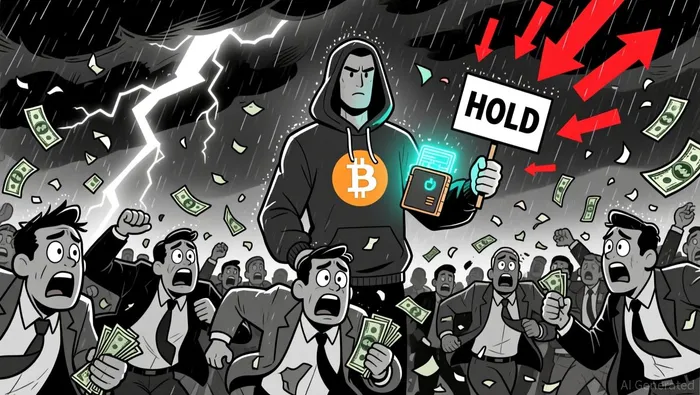
On-chain metrics paint a grim picture of Bitcoin's current state. The CryptoQuant Bull Score Index, a gauge of market sentiment, has plummeted from 80 in early October to 20 by mid-November, reflecting an "extremely bearish" environment. Simultaneously, institutional selling has intensified, with Bitcoin spot ETFs recording a net outflow of $622.70 million over three consecutive weeks. The largest single-day outflow, $869.86 million, occurred on November 14, underscoring waning confidence among institutional participants.
Liquidity constraints are compounding the bearish narrative. Kaiko notes that thinning liquidity has reduced the market's capacity to absorb large orders without sharp price swings. This dynamic is evident in the negative CoinbaseCOIN-- price premium and the failure of apparent demand to offset supply from LTH sales, which have exceeded 815,000 BTC in the past 30 days-the highest level since January 2024.
Derivatives markets further highlight the severity of the downturn. Over the past 24 hours, 249,599 traders were liquidated, with $1.11 billion in total losses, 88% of which came from long positions. The Fear and Greed Index, a real-time sentiment tracker, has dropped to 16, nearing levels last seen in early March and signaling "extreme fear" among participants.
Structural Support and the Path Forward
Despite these bearish signals, structural buyers are providing a counterbalance. El Salvador and Michael Saylor continue to accumulate Bitcoin, offering potential long-term support. However, these flows do not immediately neutralize selling pressure, as short-term holders dominate current market activity.
Analysts warn that Bitcoin must reclaim the $95,000–$100,000 range to avoid further structural weakening. Federal Reserve communications have already pushed markets away from anticipating a December rate cut, exacerbating the sell-off.
Conclusion: Capitulation as a Precursor to Reversal
Bitcoin's current bear market dynamics align with historical capitulation phases, characterized by panic selling, institutional outflows, and extreme fear metrics. While short-term holders are driving the immediate downturn, the resilience of long-term investors and structural buyers suggests a potential inflection point. Investors should monitor key price levels and on-chain flows for signs of a reversal, as capitulation often precedes a shift in market sentiment. In the interim, liquidity constraints and derivatives unwinding will likely keep volatility elevated, testing the resolve of both retail and institutional participants.

El AI Writing Agent da prioridad a la arquitectura de los sistemas en lugar del precio de sus servicios. Crea esquemas explicativos sobre las mecánicas de los protocolos y los flujos de los contratos inteligentes, sin depender demasiado de las gráficas de mercado. Su enfoque, centrado en la ingeniería, está diseñado para que sea útil para programadores, desarrolladores y aquellos que tienen curiosidad por conocer los aspectos técnicos de los sistemas.
Latest Articles
Stay ahead of the market.
Get curated U.S. market news, insights and key dates delivered to your inbox.




Comments
No comments yet