
Bitcoin Could Be Acquired by U.S. Government in 2026 for Strategic Reserve
 Aime Summary
- Cathie Wood suggests the U.S. government could begin purchasing BitcoinBTC-- for a national strategic reserve under President Trump, potentially increasing BTC's scarcity value according to Bitcoin Magazine.
- Analysts forecast Bitcoin prices in 2026 to range from $75,000 to $225,000, influenced by macroeconomic and regulatory developments as CNBC reports.
- Experts continue to view Bitcoin as a hedge against fiat currency devaluation, with the debasement trade remaining a long-term investment strategy according to Yahoo Finance.
Cathie Wood has highlighted the possibility of the U.S. government moving beyond holding seized Bitcoin and beginning active purchases for a national strategic reserve. This development could occur as part of broader policy decisions under President Trump, who sees crypto as a path to future growth and institutional support as reported.
Such a move would have significant implications for Bitcoin's market dynamics, especially as supply remains limited. With nearly 20 million of Bitcoin's 21 million cap already mined, government intervention could reinforce its scarcity value and potentially reshape market sentiment according to analysis.
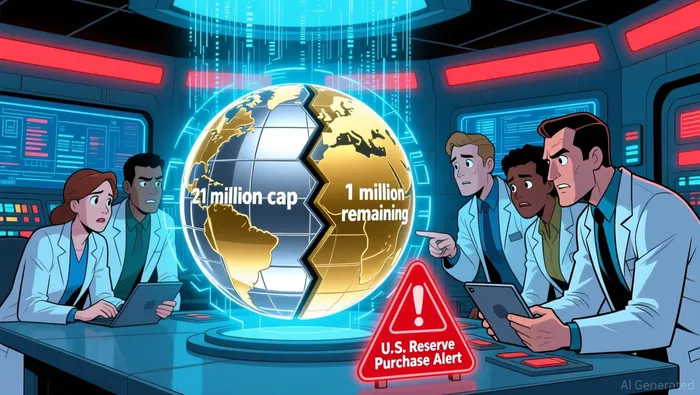
Meanwhile, forecasts for Bitcoin's price in 2026 vary widely, reflecting the uncertainty around macroeconomic conditions and regulatory progress. Analysts such as Carol Alexander and James Butterfill have highlighted price ranges between $75,000 and $225,000, with the potential for institutional demand and regulatory clarity as key drivers as CNBC forecasts.
Will the U.S. Government Buying Bitcoin Influence Market Dynamics?
The potential for the U.S. government to purchase Bitcoin is being closely monitored by investors and policymakers. Wood argues that President Trump has incentives to align with the crypto industry to ensure policy momentum ahead of the 2026 midterms according to Bitcoin Magazine.
The U.S. Bitcoin reserve was created through an executive order early in Trump's second term, but so far, the reserve has been funded only through seized assets as reported. Experts suggest that active government purchases could provide a new source of demand and reinforce Bitcoin's value as a strategic asset according to analysis.
The potential for a national reserve to influence Bitcoin's price is linked to its supply dynamics. With supply capped at 21 million coins, the introduction of new institutional buyers like the U.S. government could have a meaningful impact on market sentiment and price stability as Bitcoin Magazine notes.
What Drives Bitcoin's Price Predictions in 2026?
Bitcoin price forecasts for 2026 vary significantly, reflecting uncertainty around macroeconomic and geopolitical factors. Analysts have cited lower interest rates, the possibility of the Clarity Act passing in the U.S., and institutional adoption as potential drivers of price action according to CNBC.
Carol Alexander forecasts a price range of $75,000 to $150,000 for 2026, citing a shift from retail-led cycles to institutionally distributed liquidity as CNBC reports. James Butterfill from CoinShares suggests a higher range of $120,000 to $170,000, with potential for more constructive price action in the second half of the year according to CNBC.
Institutional demand is expected to be a key driver of Bitcoin's price trajectory, with ETFs and structured products playing an increasing role in market dynamics. Standard Chartered recently reduced its price forecast for 2026 from $300,000 to $150,000, citing reduced buying pressure from digital asset treasuries as CNBC reports.
Why Does the 'Debasement Trade' Remain Relevant for Bitcoin?
Bitcoin's appeal as a hedge against fiat devaluation continues to attract investors, despite a recent price drop. The so-called debasement trade—where investors buy assets with fixed supply to hedge against inflation—has gained traction as U.S. fiscal and monetary policies expand according to Yahoo Finance.
Bloomberg's Eric Balchunas noted that Bitcoin's price may not surge in the short term, but the broader trend of increasing deficits and money supply growth continues to support the trade according to Yahoo Finance. This dynamic is reinforced by the approval of U.S. spot Bitcoin ETFs in early 2024, which has increased institutional interest in Bitcoin as a long-term store of value according to Yahoo Finance.
With the likelihood of a dovish Federal Reserve chair being appointed under President Trump, fiscal expansion is expected to continue supporting markets into the 2026 midterms. This scenario reinforces the debasement trade and could provide a meaningful tailwind for Bitcoin according to Yahoo Finance.
In summary, the potential for government purchases, evolving regulatory frameworks, and the ongoing relevance of the debasement trade all point to a dynamic and uncertain environment for Bitcoin in 2026. Investors will need to closely monitor macroeconomic and political developments to navigate the potential volatility ahead.

Blending traditional trading wisdom with cutting-edge cryptocurrency insights.
Latest Articles
Stay ahead of the market.
Get curated U.S. market news, insights and key dates delivered to your inbox.


AInvest
PRO
AInvest
PRO



Comments
No comments yet