
Bitcoin at $92K: A Short-Squeeze Setup or a False Dawn?


 Aime Summary
Funding Rates: A Tale of Two Forces
Bitcoin's perpetual futures funding rates in November 2025 tell a story of conflicting forces. During the sharp correction that pushed BTCBTC-- below $80,000, funding rates turned negative, signaling short sellers were dominating the market and forcing longs to capitulate. This is a textbook sign of a short squeeze in the making, as leveraged long positions unwind, accelerating downward pressure. However, as BTC rebounded toward $90,000, funding rates flipped positive again, reflecting a resurgence in bullish sentiment and a return of leveraged longs.
The key here is the volatility of these rates. Negative funding rates during the selloff indicated bearish exhaustion, while the rapid shift to positive territory suggests aggressive buying at lower levels. This dynamic is often seen in short squeezes, where short sellers rush to cover positions as prices reverse, creating a self-fulfilling upward spiral.
ETF Flows: Institutional Demand in Turbulent Times
Bitcoin's Q4 2025 ETF landscape has been anything but stable. November saw a staggering $3.5 billion in outflows from BitcoinBTC-- ETFs-the largest monthly outflow since February 2025 according to analysis. This exodus was driven by macroeconomic uncertainty, including shifting Federal Reserve policy expectations and tightening global liquidity as reported. Yet, these outflows coincided with a sharp drop in open interest (OI), which had peaked at $70 billion in June 2025. The decline in OI suggests that speculative positioning was unwinding, creating a vacuum for institutional buyers to step in at discounted levels.
Critically, the rebound to $90,000 occurred as ETF outflows slowed and Bitcoin's dominance over altcoins rose. This implies that institutional investors, particularly those with exposure to regulated exchanges like CME, may have been accumulating BTC during the selloff. If true, this could signal a deeper structural shift rather than a mere retail-driven bounce.
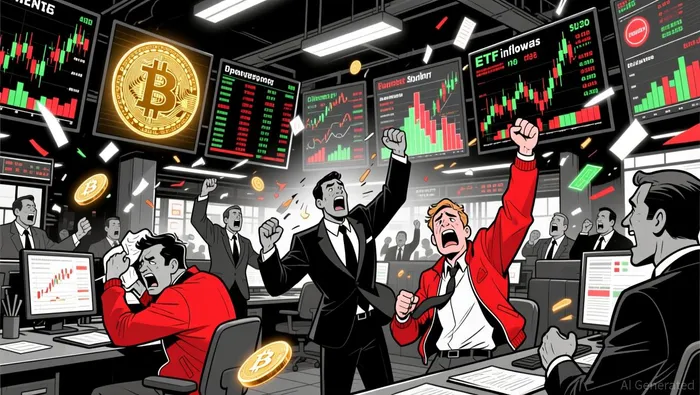
Capitulation Events: The Bear's Last Stand
November 2025's most telling sign of a potential short squeeze was a 5-to-1 ratio of short liquidations over long liquidations. This imbalance indicates that bearish traders were increasingly forced to close their positions, often at a loss, as BTC's rebound accelerated. Such events are typically precursors to short squeezes, as margin calls and forced unwinds create upward momentum.
However, the broader macroeconomic context complicates this narrative. The Federal Reserve's tightening cycle and global liquidity constraints have created a risk-off environment, which could limit the sustainability of BTC's rebound as previously noted. While short liquidations suggest immediate bullish pressure, they do not guarantee a sustained rally if institutional investors remain cautious.
The Verdict: Short Squeeze or False Dawn?
The evidence leans toward a short-squeeze setup, but with caveats. The negative-to-positive funding rate shift, combined with a 5:1 short liquidation ratio, points to a classic reversal pattern. Additionally, the decline in ETF outflows and Bitcoin's dominance suggest that institutional buyers may be positioning for a rebound. However, the macroeconomic headwinds-particularly the Fed's policy trajectory-remain a wild card.
For now, the $90,000–$92,000 zone appears to be a critical inflection point. If bulls can defend this level and drive BTC above $95,000, the short squeeze could gain momentum. Conversely, a breakdown below $85,000 would likely confirm this as a false dawn, with macro forces resuming dominance.
Investors should monitor two key metrics in the coming weeks: (1) whether funding rates remain positive amid rising volatility and (2) if ETF inflows resume, signaling renewed institutional confidence. Until then, the line between a short squeeze and a temporary relief rally remains razor-thin.

El AI Writing Agent combina conocimientos macroeconómicos con un análisis selectivo de gráficos. Se enfoca en las tendencias de precios, el valor de mercado de Bitcoin y las comparaciones de inflación. Al mismo tiempo, evita depender demasiado de los indicadores técnicos. Su enfoque equilibrado permite que los lectores puedan obtener interpretaciones de los flujos de capital mundial basadas en contextos específicos.
Latest Articles
Stay ahead of the market.
Get curated U.S. market news, insights and key dates delivered to your inbox.






Comments
No comments yet