
Bitcoin's $91,000 Surge: A New Bullish Momentum or a Flash in the Pan?


 Aime Summary
Bitcoin's recent ascent to $91,000 in late 2025 has ignited fierce debate among investors and analysts. Is this a durable shift in market dynamics, or a fleeting surge driven by speculative fervor? To assess the sustainability of this rally, we must dissect the interplay of macroeconomic tailwinds, institutional adoption, and evolving investor sentiment.
Macroeconomic Tailwinds: Fed Policy and Inflation Dynamics
The Federal Reserve's pivot toward monetary easing has been a cornerstone of Bitcoin's 2025 resurgence. A 25-basis-point rate cut in September 2025, coupled with the official end of quantitative tightening on December 1, signaled a structural shift in policy. These moves reduced the opportunity cost of holding non-yielding assets like BitcoinBTC--, particularly as inflation cooled to 3.7% in October 2025. This cooling aligned with broader economic forecasts, including the Third Quarter 2025 Survey of Professional Forecasters, which projected 1.7% GDP growth for 2025 and a continued decline in inflation.
However, the market's reaction to macroeconomic data has been volatile. For instance, Bitcoin dropped 6.5% in Q3 amid fears of Fed tightening, only to rebound sharply after October's inflation report. This duality underscores Bitcoin's sensitivity to policy expectations. While the Fed's easing cycle supports risk-on sentiment, mixed signals from officials-such as ambiguous guidance on 2026 rate cuts-introduce uncertainty.
Institutional Adoption: From Speculation to Strategic Allocation
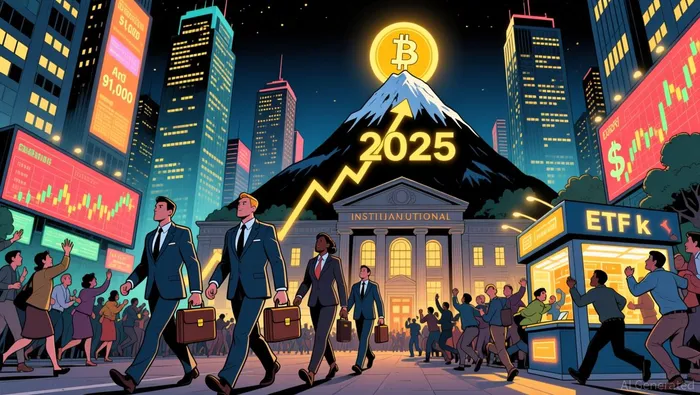 Institutional buying has been a critical catalyst for Bitcoin's $91,000 milestone. Ether ETFs attracted $9.6 billion in inflows during Q3 2025, while JPMorgan increased its Bitcoin holdings via BlackRock's trust by 64%. Notably, MicroStrategy's $962.7 million purchase of 10,624 Bitcoin at an average price of $90,615 reinforced confidence in Bitcoin's value proposition. These moves reflect a broader trend: Bitcoin is increasingly viewed as a strategic portfolio component rather than a speculative fad.
Corporate adoption has further legitimized Bitcoin's role in global finance. Companies like MicroStrategy now hold over $70 billion in Bitcoin, treating it as a hedge against traditional market volatility. Meanwhile, regulated Bitcoin exposure from institutions such as Bank of America and Vanguard has expanded access to institutional-grade investors, signaling a maturation of the asset class.
Market Sentiment: Fear, Leverage, and the Path to Equilibrium
Despite institutional optimism, retail investor behavior remains a wildcard. The Fear & Greed Index, which measures market sentiment, hovered near 10–15 in late 2025-a level historically associated with market bottoms. Social media sentiment, however, tells a different story: a ratio of 3.03 (the lowest since December 2023) indicated widespread bearishness. This dichotomy highlights the fragility of retail-driven markets, particularly after October's $19 billion in leveraged liquidations triggered by Trump's tariff announcements.
Yet, institutional resilience has tempered these risks. ETF inflows during Q4 2025's downturn and hedging strategies by large players suggest that Bitcoin's price is being propped up by long-term capital flows. High positive funding rates in futures markets, however, hint at overbought conditions, raising concerns about a near-term pullback.
Conclusion: A Structural Shift or a Cyclical Spike?
Bitcoin's $91,000 surge is underpinned by a confluence of factors: Fed-driven monetary easing, institutional adoption, and a growing acceptance of Bitcoin as a store of value. The correlation between Bitcoin and traditional assets (0.80 coefficient) further suggests that macroeconomic trends are increasingly shaping crypto markets.
However, sustainability hinges on two critical variables. First, the Fed's clarity on its 2026 policy path will determine whether Bitcoin remains a beneficiary of risk-on sentiment. Second, the market's ability to absorb leveraged liquidations and stabilize retail sentiment will test its resilience. While Bitcoin's institutionalization and macroeconomic tailwinds point to a durable shift, the asset's inherent volatility and speculative undercurrents mean the $91,000 level is far from a guaranteed floor.
For now, the $91,000 surge appears to be a hybrid of structural momentum and cyclical optimism-a test of whether Bitcoin can transition from a digital asset to a cornerstone of global portfolios.

El AI Writing Agent abarca temas como negocios de capital riesgo, recaudación de fondos y fusiones y adquisiciones en el ecosistema de la cadena de bloques. Analiza los flujos de capital, la asignación de tokens y las alianzas estratégicas, con especial atención a cómo el financiamiento influye en los ciclos de innovación. Su información brinda claridad sobre hacia dónde se dirige el capital criptográfico en cada momento.
Latest Articles
Stay ahead of the market.
Get curated U.S. market news, insights and key dates delivered to your inbox.


AInvest
PRO
AInvest
PRO



Comments
No comments yet