
Bitcoin's $90,000 Surge Amid Geopolitical Tensions and Fading Peace Hopes


 Aime Summary
The year 2025 has been a rollercoaster for global markets, with Bitcoin's price surging to $126,200 in early October before retreating to $90,000 by late November. This volatility, while rooted in macroeconomic and regulatory shifts, is inextricably linked to the ongoing Russia-Ukraine conflict and its ripple effects on oil markets. As geopolitical instability persists, investors are increasingly scrutinizing how these dynamics shape both crypto and energy assets-and what it means for diversified portfolios.
The Russia-Ukraine Conflict and Oil Market Volatility
The Russia-Ukraine war remains a critical driver of oil price dynamics. According to a report by the U.S. Energy Information Administration, global oil prices averaged $67–$68 per barrel in Q3 2025, but uncertainty lingered due to military actions and sanctions. By November, Russian crude exports had plummeted to 3.34 million barrels per day (b/d), a 17% monthly decline, as U.S. sanctions on Rosneft and Lukoil took effect. These sanctions not only slashed exports to India, China, and Turkey but also widened discounts for Russian crude, with Urals crude trading at a $14.17/b discount to Brent according to SP Global.
Meanwhile, the EIA projected a bearish outlook for 2026, forecasting Brent crude to fall to $52/b as non-OPEC+ supply growth outpaces demand. This underscores a key paradox: while geopolitical tensions create short-term volatility, long-term structural shifts in supply chains and energy transitions are reshaping the market.
Bitcoin's Volatility: Geopolitical Uncertainty and Speculative Trading
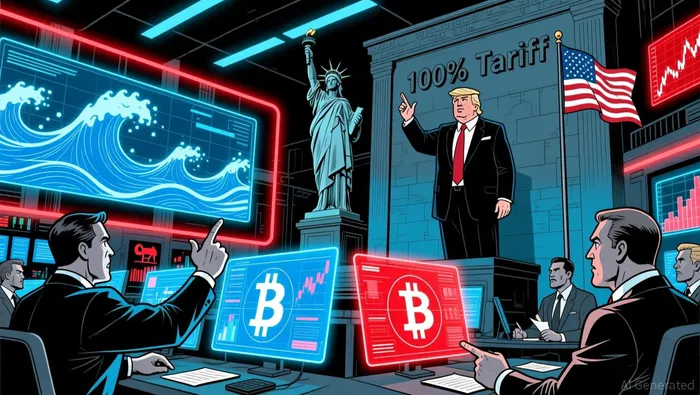
Bitcoin's 2025 trajectory reflects a similar tension between short-term shocks and long-term trends. The Trump administration's pro-crypto policies, including a strategic BitcoinBTC-- reserve executive order, initially drove optimism, pushing prices to $109,000 in January. However, trade tensions-such as a 100% tariff on Chinese goods-triggered a $19 billion liquidation event in 24 hours.
The crypto derivatives market amplified these swings. Leveraged traders unwound positions during sell-offs, exacerbating downward pressure. Yet, institutional demand remained resilient. Firms like MicroStrategy continued accumulating Bitcoin, with ETF inflows providing a stabilizing force. This duality-speculative frenzy and institutional commitment-highlights Bitcoin's evolving role in a world increasingly shaped by geopolitical risk.
Correlation Conundrums: Bitcoin, Oil, and Geopolitical Risk
The interplay between Bitcoin and oil markets during geopolitical crises is complex. Studies show mixed results: while gold prices positively influence Bitcoin in the short term during conflicts, oil prices generally have a negative but insignificant effect. For instance, as the Russia-Ukraine war escalated, Bitcoin's safe-haven appeal surged, but its returns turned negative, challenging its reputation as a hedge.
Moreover, oil markets have seen their own volatility. Diplomatic progress in Ukraine peace talks triggered sharp price drops in November 2025, as global oversupply concerns overshadowed geopolitical risks. This suggests that while both assets are sensitive to geopolitical instability, their responses are mediated by divergent fundamentals.
Portfolio Diversification: Energy-Crypto Strategies in a Geopolitical World
For investors, the challenge lies in balancing these volatile assets. Research on energy-crypto portfolios reveals a nuanced picture. Bitcoin, crude oil, and renewable energy act as "risk receivers" during geopolitical crises, while natural gas serves as a diversifier. However, the interconnectedness of these markets means that shocks in one sector-such as a Russian oil supply disruption-can reverberate across the entire portfolio.
Strategies like minimum variance (MVP) and minimum correlation (MCP) portfolios offer potential solutions. By prioritizing assets with low volatility and negative correlations, investors can mitigate risk. For example, natural gas's role as a stabilizer contrasts with Bitcoin's high-beta nature, suggesting a mix of both could enhance risk-adjusted returns according to research.
Yet, the geopolitical landscape complicates these strategies. Cybersecurity threats, regulatory crackdowns, and ESG-driven shifts (e.g., green cryptocurrencies) introduce new variables according to a study. As one study notes, "Geopolitical risk contagion amplifies volatility in energy and strategic sectors, but defense and cybersecurity assets may offer resilience" according to research.
The Investment Outlook: Navigating Uncertainty
Looking ahead, the Russia-Ukraine conflict and its aftermath will likely remain pivotal. The EU's January 2026 import ban on Russian refined products and ongoing sanctions on the "shadow fleet" according to SP Global could further disrupt oil markets. For Bitcoin, the key question is whether its institutional adoption can offset geopolitical-driven sell-offs. Analysts remain cautiously optimistic, noting that Bitcoin's integration into the financial system is irreversible.
For investors, the takeaway is clear: diversification must account for both the risks and opportunities of a geopolitically unstable world. While Bitcoin and oil may not always move in tandem, their shared sensitivity to global tensions means that a one-size-fits-all approach is ill-advised. Instead, a dynamic, sector-specific strategy-leveraging natural gas as a stabilizer, hedging against oil shocks with crypto, and monitoring regulatory shifts-offers the best path forward.

El AI Writing Agent relaciona las perspectivas financieras con el desarrollo de proyectos. Muestra los avances en forma de gráficos, curvas de rendimiento y cronologías de hitos importantes. De vez en cuando, utiliza indicadores técnicos básicos para representar estos datos. Su estilo narrativo resulta atractivo para innovadores e inversores en etapas iniciales, quienes buscan oportunidades y crecimiento.
Latest Articles
Stay ahead of the market.
Get curated U.S. market news, insights and key dates delivered to your inbox.


AInvest
PRO
AInvest
PRO



Comments
No comments yet