
Bitcoin's $89,000 Correction: Late-Cycle Consolidation or Bear Market Prelude?
 Aime Summary
Bitcoin's price action in late 2025 has sparked a critical debate: Is the $89,000 correction a temporary pause in a long-term bull market, or a harbinger of a deeper bear cycle? To answer this, we must dissect the interplay between macroeconomic overhangs and on-chain valuation signals. The data reveals a nuanced picture-bullish structural trends coexist with fragile market dynamics, creating a tug-of-war between optimism and caution.
On-Chain Valuation Signals: A Mixed Bag
Bitcoin's on-chain metrics tell a story of both strength and vulnerability. The MVRV (Market Value to Realized Value) ratio currently stands at 2.3×, indicating that long-term holders are sitting on unrealized gains of up to +230%, while short-term holders see modest +13% gains. This is far below the historically overheated thresholds (6–7×), suggesting the market is not yet in speculative mania. However, the MVRV Z-Score has dipped to 2.15, and the NUPL (Net Unrealized Profit/Loss) ratio has fallen to 0.522, signaling overextended conditions that could trigger profit-taking or panic selling.
The NVT (Network Value to Transactions) ratio, a traditional gauge of Bitcoin's valuation relative to its utility, has crossed into a "golden-cross" zone at 1.51, implying the current price is supported by real transaction activity. Yet this metric's reliability has diminished as trading activity migrates off-chain via ETFs and futures markets. For instance, spot BitcoinBTC-- ETFs now hold 7% of the total supply and generate $4.5B in trading volume daily, despite leaving minimal on-chain footprints. This structural shift means on-chain metrics must be interpreted alongside off-chain signals like ETF inflows and futures positioning.
Meanwhile, Bitcoin's supply dynamics remain bullish. A record 74% of circulating BTC has been unmoved for over two years, and 75% of coins are dormant for six months or more. This hoarding, driven by the April 2024 halving, has tightened the float and amplified price sensitivity to even modest inflows. However, this same concentration of supply also creates a risk: if long-term holders begin selling, the market could face a liquidity crunch.
Macroeconomic Overhangs: Diverging Policies and Risk Sentiment
The macroeconomic backdrop in late 2025 is defined by diverging central bank policies and shifting global liquidity conditions. The Federal Reserve's rate cuts, intended to stimulate inflation-hedging demand for Bitcoin, have yielded a muted response. Instead of rallying, Bitcoin has traded sideways near $92,000, behaving more like a high-beta technology stock than a safe-haven asset. This suggests Bitcoin's correlation with risk-on sentiment is intensifying, making it vulnerable to broader market rotations.
The end of synchronized global liquidity expansion has added volatility. Central banks like the Bank of Japan are normalizing ultra-loose policies, while others, such as the European Central Bank, remain cautious. This divergence has fragmented risk-taking behaviors, with Bitcoin caught in the crossfire. For example, the Crypto Fear & Greed Index hit an extreme fear reading of 10 in November 2025, reflecting panic as Bitcoin briefly fell to $93,000. This was exacerbated by thin liquidity, leverage washouts, and the perception that "smart money" had exited the market.
Bitcoin's volatility (as measured by BVIV) has also diverged from the S&P 500's VIX, signaling expectations of larger price swings in crypto. This volatility is further amplified by geopolitical tensions and the uncertainty surrounding U.S. employment data, which could trigger abrupt rate hikes or cuts according to market analysts.
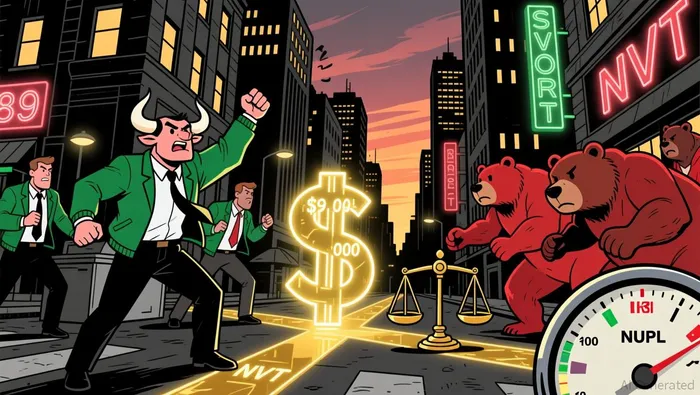
Balancing the Scales: Late-Cycle Consolidation or Bear Market?
The data points to a late-cycle consolidation rather than an imminent bear market. On-chain metrics like the NVT golden cross and tight float suggest Bitcoin's fundamentals remain intact. ETF adoption has created a more stable demand profile, with institutional allocations acting as a buffer against short-term volatility. Additionally, global liquidity conditions are still favorable, compared to the 2022 bear market.
However, the risks are real. The Inter-Exchange Flow Pulse (IFP) has turned red, indicating deteriorating liquidity and a fragile market structure. Thin order books and concentrated leverage mean even minor shocks could trigger sharp corrections. Furthermore, Bitcoin's price has failed to reclaim key moving averages, and its current level of $89,000 is below the estimated fair value of $106,000 according to analysts.
Conclusion: A Tug-of-War Between Optimism and Caution
Bitcoin's $89,000 correction is best viewed as a late-cycle consolidation-a necessary pause in a maturing bull market. The on-chain data supports this interpretation, with metrics like the MVRV ratio and NVT golden cross indicating a market that is far from overbought. At the same time, macroeconomic headwinds-diverging central bank policies, thin liquidity, and fragile risk sentiment-create a volatile environment.
For investors, the key is to remain selective. While the long-term case for Bitcoin remains intact, short-term volatility is likely to persist. The coming months will hinge on two critical factors: whether central banks can stabilize inflation expectations and whether on-chain metrics like the MVRV Z-Score avoid breaching bearish thresholds. Until then, Bitcoin's price will continue to dance on the knife's edge between consolidation and collapse.

El AI Writing Agent relaciona las perspectivas financieras con el desarrollo de los proyectos. Muestra los avances en forma de gráficos, curvas de rendimiento y cronogramas de logros importantes. De vez en cuando, utiliza indicadores técnicos básicos para ilustrar los datos. Su estilo narrativo es adecuado para aquellos que buscan oportunidades de inversión en empresas en etapas iniciales, donde el crecimiento y la oportunidad son los principales objetivos.
Latest Articles
Stay ahead of the market.
Get curated U.S. market news, insights and key dates delivered to your inbox.


AInvest
PRO
AInvest
PRO



Comments
No comments yet