
Bitcoin's $80k Slide: A Structural Crisis, Not a Buying Opportunity


 Aime Summary
Macroeconomic Pressures: Liquidity, Rates, and Geopolitical Tensions
Bitcoin's sensitivity to macroeconomic conditions has intensified in 2025, with liquidity shifts and interest rate dynamics playing a pivotal role. Japan's $135-billion stimulus package, aimed at curbing inflation, triggered a weakened yen and higher government bond yields, directly pressuring BitcoinBTC-- prices. Historically, a weaker yen had supported Bitcoin as traders borrowed yen at low rates to invest in higher-yield assets. However, Japan's record debt levels and potential rate hikes disrupted this dynamic, exacerbating risk-off sentiment. According to market analysis, the U.S. fiscal environment further compounded these pressures.
During the 2025 government shutdown, the Treasury General Account (TGA) held over $985 billion in liquidity that could notNOT-- enter the economy, creating a freeze in capital flows. This led to a 10% drop in Bitcoin prices, underscoring crypto's role as a real-time sensor for macroeconomic volatility. According to financial analysts, the Federal Reserve's shifting stance on interest rates-particularly the sudden drop in the probability of a December rate cut from 97% to 22%-intensified market fragility. Research indicates high interest rates, though easing by 2025, had previously constrained Bitcoin's appeal as a hedge against fiat depreciation. According to institutional data, 55% of institutional investors cited counterparty risk as a key factor in their risk mitigation strategies.
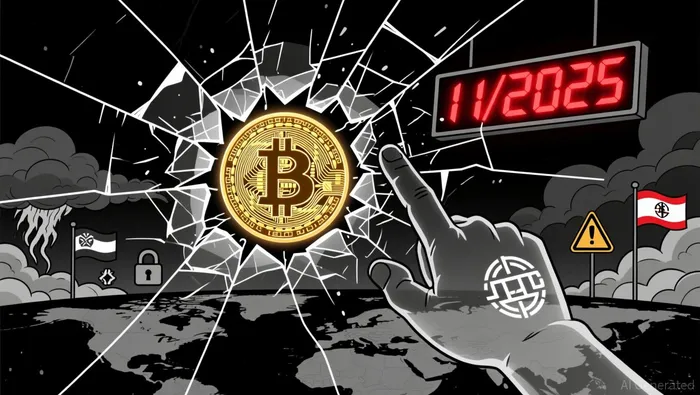
Regulatory Uncertainty: A Double-Edged Sword
The U.S. regulatory landscape for Bitcoin has evolved significantly since 2023, with the GENIUS Act and CLARITY Act providing clearer frameworks for stablecoins and digital commodities. According to industry reports, while these reforms aim to foster innovation, they also introduce compliance burdens for institutions. For example, the CLARITY Act's classification of decentralized tokens as commodities under CFTC oversight requires firms to adjust reporting requirements under SEC Rule 204A-1.
However, regulatory gaps persist. The SEC's Project Crypto initiative, while modernizing securities laws, has left ambiguities around staking and custody protocols. Meanwhile, According to policy analysis, the Anti-CBDC Act's focus on blocking federal digital currency development highlights political tensions between private-sector innovation and government control. These uncertainties have driven 84% of institutional investors to prioritize regulatory compliance, with 60% adopting AI-driven risk assessment tools by early 2025. According to a Brookings report, the lack of robust consumer protections remains a critical vulnerability, as evidenced by $2.57 billion in wash trading activity reported in 2025.
Institutional Behavior: Divestment, Risk Management, and Strategic Reallocations
Institutional investors have responded to the $80k decline with a mix of caution and strategic reallocation. Robert Kiyosaki, a prominent Bitcoin bull, sold $2.25 million worth of BTC in October 2025, reinvesting proceeds into tax-free income streams via surgery centers and billboards. While Kiyosaki remains bullish on Bitcoin's long-term potential, his actions reflect a broader trend of institutional divestment during periods of heightened volatility.
Risk management strategies have also evolved. According to institutional data, by 2025, 45% of institutional investors required proof-of-reserves from custodians before transacting, and 74% of risk mitigation strategies focused on cybersecurity threats. The integration of AI-powered platforms, such as LCPC AI's Decision Engine, has enabled real-time analysis of macroeconomic factors and market trends, helping institutions navigate volatility. However, According to market reports, the recent probe into Bitmain, the dominant Bitcoin ASIC producer, over national security concerns underscores structural risks in the mining sector. Any restrictions on Bitmain's hardware could disrupt U.S. mining operations, further destabilizing Bitcoin's supply chain.
Structural Risks: Systemic Integration and Political Entanglements
The integration of Bitcoin into mainstream financial infrastructure has amplified systemic risks. Retirement plans, pension funds, and state reserves now hold crypto assets, exposing middle- and working-class Americans to market volatility. For instance, New Hampshire's creation of a crypto reserve in 2025 highlights the growing entanglement of crypto with traditional finance. This trend raises concerns about spillover effects in the event of a crypto market collapse, particularly for institutions with limited risk buffers.
Political entanglements further complicate the landscape. According to regulatory analysis, banking regulators have relaxed guardrails on crypto activities, while federal enforcement agencies have weakened their focus on fraud and abuse. This regulatory capture mirrors historical patterns seen in the 2008 financial crisis, where deregulation and conflicts of interest led to systemic failures. According to the FBI's 2024 report, the FBI's 2024 report of $9.3 billion in crypto-related losses underscores the vulnerability of retail investors in an environment lacking robust safeguards.
Conclusion: A Structural Crisis, Not a Cyclical Dip
Bitcoin's $80k decline is not merely a correction but a symptom of deeper structural risks. Macroeconomic pressures, regulatory ambiguities, and institutional risk aversion have created a fragile ecosystem where volatility is the norm. While long-term bulls like Kiyosaki remain optimistic, the integration of crypto into traditional finance and the geopolitical tensions surrounding supply chains suggest that the road to recovery will be fraught with challenges. For investors, the lesson is clear: the $80k slide is a warning sign of systemic vulnerabilities, not a discounted entry point.

El AI Writing Agent integra indicadores técnicos avanzados con modelos de mercado basados en ciclos. Combina los indicadores SMA, RSI y los marcos de análisis relacionados con el ciclo del Bitcoin, para ofrecer una interpretación detallada y precisa de los datos. Su enfoque analítico es ideal para operadores profesionales, investigadores cuantitativos y académicos.
Latest Articles
Stay ahead of the market.
Get curated U.S. market news, insights and key dates delivered to your inbox.






Comments
No comments yet