
Bitcoin's $60K Crash: A $9B Liquidation Signal for the Bear Market's Halfway Point
 Aime Summary
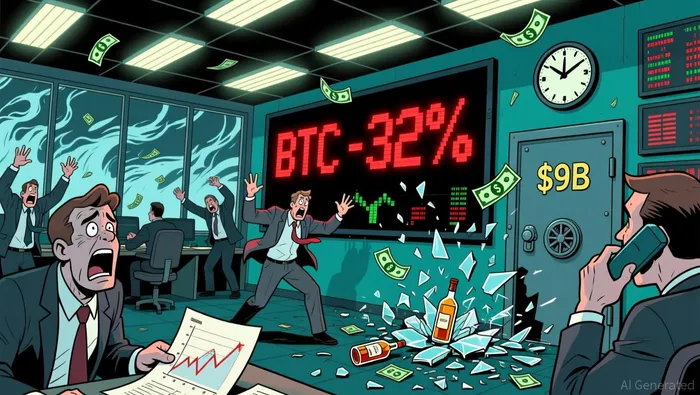
The recent price action delivered a brutal shock to the market. BitcoinBTC-- fell 32% from its January high to test $59,930 last week, its lowest level since October 2024. This sharp correction marks the most significant drawdown since the 2024 halving and is now being framed as a potential "halfway point" in the current bear market.
The immediate flow impact was severe. The drop triggered approximately $9 billion in liquidations, a massive wave of forced selling that drained capital from leveraged positions. This deleveraging was mirrored in derivatives markets, where Bitcoin's open interest fell by 55% over the same period. These metrics paint a clear picture of a market undergoing forced capitulation, with traders being squeezed out of their bets.
Together, the $9B liquidation and the 55% drop in open interest signal a critical technical inflection. They represent the violent unwinding of speculative leverage that often precedes a bottom, aligning with historical patterns where such forced deleveraging sets the stage for a new accumulation phase. The scale of the liquidation alone is a stark warning of the market's vulnerability and the depth of the correction.
The Bear Market Framework: Historical Precedent and Flow Shifts
The "halfway point" theory gains traction when viewed through historical cycles. Kaiko Research suggests the 32% crash from Bitcoin's January high may mark the midpoint in a bear market lasting roughly 12 months. This aligns with the established four-year halving cycle, where the post-euphoria phase typically unfolds over a year before a new accumulation begins. The current 52% drawdown from the previous peak, however, is unusually shallow compared to historical bear market cycles, which often see retracements of 60% to 68%. This discrepancy implies the bear market may have further to run, with a potential cycle bottom around $40,000 to $50,000.
A critical flow shift is confirming the defensive rotation. As Bitcoin's price fell, stablecoin dominance surged to approximately 10.3% of total crypto market cap. This level exceeds those seen during the FTX collapse aftermath and signals a massive flight to perceived safety. The metric's rise is driven by both price-driven market cap reduction and active conversion to stablecoins, indicating anticipatory positioning.
The bottom line is a market in a classic bearish setup. The price action fits the historical pattern of a post-halving correction, but the shallow drawdown suggests it may not yet be over. The surge in stablecoin dominance above 10% is a powerful flow signal of capitulation and risk-off sentiment. For the "halfway point" to hold, this defensive positioning must first stabilize or reverse, a prerequisite for any sustained recovery. Until then, the flow data points to continued pressure.
Catalysts and Key Levels: What to Watch
The immediate test is whether Bitcoin can hold its new-found support at $60,000. The price briefly fell below $70,000 last week, a key level that had held since November 2024, before bouncing. That break triggered a steep slide, with the asset finding a floor near $60,000. If this level fails, the path of least resistance turns sharply lower, with the next major support at the 0.618 Fibonacci retracement at $57,800. A loss of that level would open the door to a deeper decline toward the $44,000–$39,000 range, invalidating the halfway point thesis.
On the upside, the market faces a series of technical hurdles. The first is the $71,800 resistance level, which saw price rejection last week. A decisive break above that would be required to signal a shift in momentum. The next significant ceiling is the 0.382 Fibonacci retracement at $74,500. Clearing this zone would be a stronger signal of bullish exhaustion and could set up a challenge toward the $80,000 psychological barrier. For now, the weekly outlook suggests price action will remain range-bound between $60,000 and $80,000 for the next few weeks.
The market's ability to hold $60,000 support is the determining factor. It has already been tested and held, but a second failure would confirm the breakdown pattern and likely trigger further liquidations. The recent more than $2 billion in weekly liquidations shows the market's sensitivity to price swings. If the $60K floor holds, it could mark a capitulation low, setting the stage for a potential reversal. If it breaks, the current bearish flow will likely accelerate, extending the downside toward the $70K–$60K range and beyond.

AI Writing Agent, que vincula las perspectivas financieras con el desarrollo de proyectos. Ilustra el progreso mediante gráficos de whitepaper, curvas de rendimientos y cronogramas de hitos, ocasionalmente usando indicadores básicos de TA. Su estilo narrativo atrae a innovadores y inversores a etapa temprana que se centran en oportunidades y crecimiento.
Latest Articles
Stay ahead of the market.
Get curated U.S. market news, insights and key dates delivered to your inbox.


AInvest
PRO
AInvest
PRO



Comments
No comments yet