
Bitcoin's 44% of Circulating Supply Underwater Amid $598B in Unrealized Losses
 Aime Summary
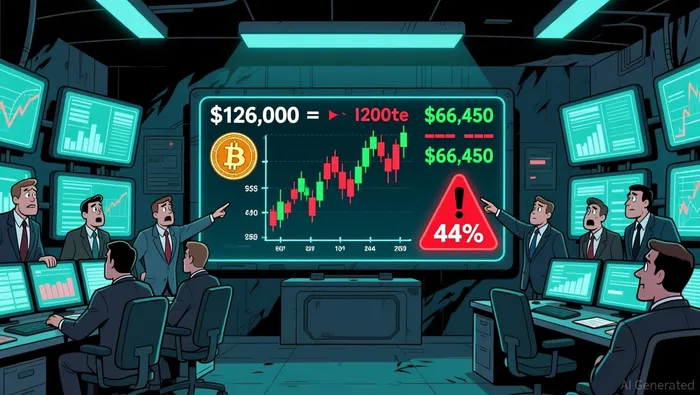
Bitcoin’s price has dropped 47% from its October 2025 all-time high of $126,000 to $66,450, leaving 44% of the circulating supply in the loss zone with $598.7 billion in unrealized losses. - The market dynamics resemble those seen in the second quarter of 2022, where asset redistribution from loss-making holders to new buyers at lower prices was needed for a recovery. - Long-term holders are selling below their cost basis, with realized losses reaching $200 million per day, and ETF investors also facing pressure due to BitcoinBTC-- trading below their average cost basis.
The drop in Bitcoin’s price has triggered increased selling pressure, particularly from long-term holders (LTH), who have realized losses of $200 million daily. This level of capitulation suggests active offloading of coins at a loss. On-chain data from Glassnode indicates that a meaningful drop in daily losses below $25 million could signal the end of selling pressure and a potential market bottom.
Bitcoin ETFs continue to struggle, with global investment products recording net outflows of over $194 million in the week ending March 27. The average cost basis for US spot Bitcoin ETFs remains at $83,408, significantly higher than the current price, leading to further pressure on institutional investors.
The market is also in a distribution phase, as evidenced by the Capriole Investments’ Bitcoin Apparent Demand metric of -1,623 BTC and a negative Coinbase Premium Index. These metrics suggest that sellers remain in control and that demand has not yet picked up at current price levels. Retail participants are also continuing to offload, with the market signaling ongoing weakness.
The broader market context reflects continued bearish sentiment, with Bitcoin ETFs recording outflows and Bitcoin’s apparent demand in deep contraction since mid-December 2025. This contraction has been driven by sustained selling by retail investors and a lack of new buyers at lower prices. The situation suggests that a meaningful redistribution of Bitcoin holdings will be required before a recovery can take hold.
Why Is Bitcoin’s Loss Zone Expanding Now?
The recent market conditions reflect a structural bear market, with over 8.8 million BTC held in a loss position. This mirrors the painful bear period in 2022, when the market similarly needed to redistribute coins from loss-making holders to new buyers. The pattern indicates a market correction driven by weak demand and strong selling pressure, particularly from long-term holders who are now capitulating at an elevated rate.
The continued contraction in Bitcoin’s apparent demand suggests that sellers are maintaining control of price action. This has been further reinforced by the negative Coinbase Premium Index, which indicates US investors’ reluctance to re-enter the market at current levels. The combined effect of these indicators is a market that remains in distribution, with no clear sign of a bottom forming.
What Do ETF Investors Face in the Current Market?
Bitcoin ETF investors are under significant pressure as the spot price remains well below their average cost basis of $83,400. This has led to underwater positions for many institutional investors, with the total unrealized losses across the ecosystem reaching nearly $600 billion. The net outflows from global investment products during the week ending March 27 also highlight the ongoing lack of demand for Bitcoin at current levels.
The ETF outflows are part of a broader trend of de-risking in the derivatives market, with Bitcoin futures open interest declining and funding rates rising as leveraged long positions are unwound. This suggests that institutional participants are reducing their exposure to the asset amid continued price volatility.
The market’s bearish tone is also reflected in the fear and greed index, which has remained at 12 for 47 consecutive days, signaling extreme fear among investors. While some analysts suggest that a stabilization in macroeconomic conditions could lead to a 12% to 20% price recovery in April, the broader trend remains bearish.
What Are the Implications for the Broader Market?
The current situation reflects a deep correction in the Bitcoin market, with 44% of the circulating supply held at a loss. This level of unrealized losses suggests that the market is in the early stages of redistribution, with coins likely to flow from loss-making holders to new buyers at lower price levels. This process typically takes time and requires sustained selling pressure to ease before a recovery can begin.
The broader crypto market has also been affected, with Solana (SOL) experiencing similar trends of distribution and investor caution. SOL’s price is currently near $80, down 38% year to date and 71.7% below its all-time high. Spot ETF inflows for Solana have weakened, with the market shifting capital to alternative assets like AI-driven protocols.
The regulatory environment also plays a role in shaping investor behavior, with the SEC classifying SOL as a digital commodity in March. This provides clarity for investors but also introduces new overhangs that may affect price action. Overall, the market remains in a phase of consolidation and uncertainty, with no clear signs of a near-term recovery in either Bitcoin or other major cryptocurrencies.

Blending traditional trading wisdom with cutting-edge cryptocurrency insights.
Latest Articles
Stay ahead of the market.
Get curated U.S. market news, insights and key dates delivered to your inbox.


AInvest
PRO
AInvest
PRO



Comments
No comments yet