
Bitcoin's 4-Year Cycle in the Institutional Age: A New Paradigm for Market Dynamics


 Aime Summary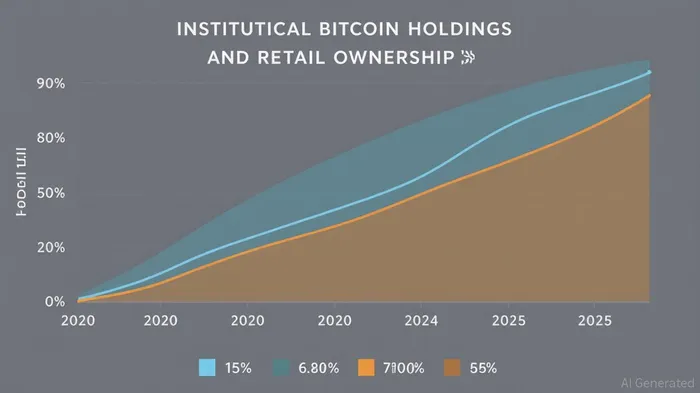
The BitcoinBTC-- market is undergoing a seismic shift. For decades, the four-year halving cycle served as a predictable rhythm for price action, with historical peaks aligning closely to this cadence. However, as institutional adoption accelerates and exchange-traded funds (ETFs) redefine liquidity dynamics, the traditional cycle is losing its grip. This article examines how structural changes—driven by institutional capital, regulatory clarity, and novel investment vehicles—are creating a new framework for Bitcoin’s price discovery, rendering the old playbook obsolete for many investors.
The Erosion of the 4-Year Cycle
Bitcoin’s halving events, which reduce blockXYZ-- rewards every four years, once acted as a binary on/off switch for market sentiment. Analysts like Matt Hougan of Bitwise Asset Management argue that this mechanism is now “half as important” with each cycle, as institutional forces increasingly dictate price movements [1]. The 2020 halving, for instance, coincided with a surge in retail speculation, but the 2024 halving occurred amid a backdrop of $70 billion in institutional assets (e.g., BlackRock’s iShares Bitcoin Trust) and a U.S. Strategic Bitcoin Reserve [1]. These developments have shifted the locus of control from retail traders to entities with long-term horizons, dampening the volatility historically tied to halving events.
The data underscores this shift: corporate treasuries, ETFs, and government reserves now control ~15% of Bitcoin’s total supply, a figure that has grown exponentially since 2023 [1]. This concentration of power means price discovery is no longer a function of speculative retail demand but of institutional capital allocation. For example, BlackRock’s July 2025 inflow of $496.8 million into its Bitcoin ETF—equivalent to ~1.2% of the fund’s total assets—demonstrates how institutional flows can stabilize or destabilize markets irrespective of halving timelines [1].
Regulatory Clarity and the Rise of ETFs
The U.S. government’s establishment of a Strategic Bitcoin Reserve and the passage of the GENIUS Act have provided a regulatory backbone for institutional participation [1]. These measures have reduced the “blow-up risk” that once plagued crypto cycles, enabling large players to treat Bitcoin as a strategic asset rather than a speculative gamble. The result is a market where price action is increasingly decoupled from retail-driven narratives and more aligned with macroeconomic factors like interest rates and portfolio diversification.
Spot Bitcoin ETFs have further amplified this trend. By offering a regulated, liquid vehicle for institutional investment, ETFs have created a “bridge” between traditional finance and crypto markets. This has led to steady inflows—particularly from pension funds and endowments—that operate on multi-year time horizons. As a result, the market is witnessing a transition from parabolic price surges (e.g., 2017, 2021) to a more sustained bull phase, where demand is driven by capital preservation rather than FOMO [1].
The Debate: Cycle Resilience vs. Institutional Supremacy
While some analysts, like CryptoQuant’s Ki Young Ju, suggest the 4-year cycle is “weakened but not dead,” their arguments rely on historical patterns that may no longer apply [2]. For instance, Ju’s 100-day peak prediction hinges on a 997-day cycle since the 2022 low—a metric that assumes retail-driven momentum. However, the presence of ETFs and institutional demand could elongate the cycle, as large players prioritize gradual accumulation over rapid price appreciation [2].
This tension highlights a critical question: Is Bitcoin entering a new era where cycles are dictated by institutional behavior rather than halving events? The answer lies in the interplay between legacy patterns and emerging dynamics. While the 2026 “up year” narrative (as proposed by Hougan) may gain traction, it is not a direct function of the halving but rather a reflection of institutional confidence in Bitcoin’s role as a macro hedge [1].
Implications for Investors
For investors, the death of the traditional 4-year cycle signals a need to reorient strategies. Retail traders who once timed the market based on halving dates must now focus on institutional indicators—ETF inflows, corporate buy-ins, and regulatory developments. Meanwhile, institutional investors should prioritize long-term allocation, leveraging Bitcoin’s low correlation with equities and its role as a hedge against monetary debasement.
However, risks persist. Treasury companies holding large Bitcoin reserves could exacerbate short-term volatility if forced to liquidate during downturns [3]. This underscores the importance of diversification and risk management in an era where institutional actors wield outsized influence.
Conclusion
Bitcoin’s market structure is evolving from a retail-driven asset to an institutionalized one. The 4-year cycle, once a cornerstone of crypto analysis, is being supplanted by forces that prioritize stability, regulation, and long-term capital flows. While historical patterns may still offer some predictive value, the future of Bitcoin investing will be defined by its integration into traditional financial systems—a transformation that is only just beginning.
**Source:[1] Who Controls Bitcoin Now? A 2025 Deep Dive into Whales, ETFs, Regulation and Sentiment [https://yellow.com/research/who-controls-bitcoin-now-a-2025-deep-dive-into-whales-etfs-regulation-and-sentiment][2] Bitcoin 4-Year Cycle Faces Test: Analyst Predicts 100 Days Ahead [https://thecurrencyanalytics.com/bitcoin/bitcoins-4-year-cycle-faces-test-analyst-predicts-100-days-ahead-191157][3] Bitcoin Four-Year Cycle Ends as Institutional Adoption Changes Market Dynamics [https://coincentral.com/bitcoin-four-year-cycle-ends-as-institutional-adoption-changes-market-dynamics/]

Decoding blockchain innovations and market trends with clarity and precision.
Latest Articles
Stay ahead of the market.
Get curated U.S. market news, insights and key dates delivered to your inbox.




Comments
No comments yet