
Bitcoin’s 4-Year Bear Cycle Enters Critical Second Half as Sellers Control $70K Supply Wall


 Aime Summary
Bitcoin is firmly in the second half of a bear cycle. The market structure is clear: sellers are in control, and the price action confirms a bear market by the traditional definition. The drop from the all-time high of $108,000 has been severe, with BitcoinBTC-- losing nearly 30% from that peak. That exceeds the 20% threshold that marks a bear market, validating the shift in sentiment and trend.
This fits the popular 4-year cycle theory, which maps roughly 4-year intervals between major market tops and bottoms. The last bull market top came in January 2025, when Bitcoin hit its ATH. By that timeline, the bear market's bottom could be roughly 4 years from that high, placing the potential low in early 2029. While past patterns don't guarantee the future, the cycle's timing provides a useful framework for the current phase.
The setup is supported by current macro headwinds. High interest rates from the Federal Reserve and persistent geopolitical tensions are weighing on all risk assets, creating a headwind that favors a bearish bias. This macro backdrop increases the likelihood that the current correction will deepen before a new bull market can form. For now, the technical picture shows a market under sustained selling pressure, with the path of least resistance pointing lower.
Key Supply/Demand Levels
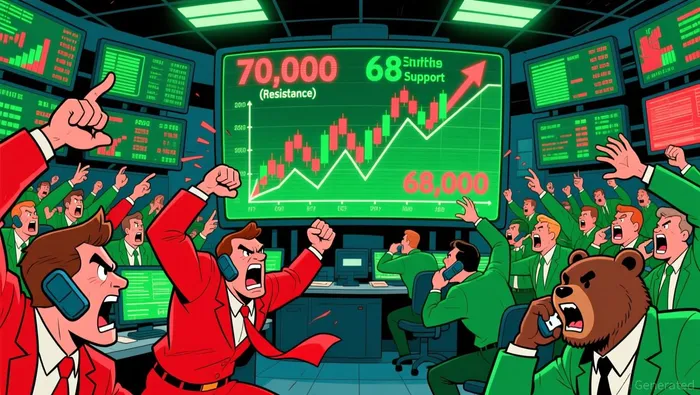
The battle lines are drawn at specific price zones. The recent rejection at $70,000 is a clear signal of overhead supply. That long upper wick from the session high of $70,072.8 shows sellers stepped in aggressively, confirming a supply wall that has halted upward momentum. For now, the immediate battleground is below that level.
Support is clustered around the 30-day moving average near $68,000. This dynamic trendline is acting as a critical floor, and holding above it is essential for any near-term bounce. A key psychological floor sits at $67,000. A break below that level would invalidate the current consolidation and likely trigger a deeper sell-off.
The next major targets hinge on which side wins this tug-of-war. A decisive break below $67,000 would open the path to the 2024 bear market low near $60,000. That's the primary downside scenario if selling pressure overwhelms the support structure. On the flip side, a sustained move above the $70,000 resistance, particularly with follow-through volume, could signal a deeper pullback toward the $74,000 resistance level. That zone, tested earlier this week, represents the next hurdle for bulls aiming to reclaim ground. The setup is binary: hold the $67k-$68k zone, and the market may stabilize; lose it, and the next leg down could be swift.
Volume and Momentum Signals
The volume profile tells a clear story of weak selling conviction during the recent declines. While the price has fallen, the selling pressure hasn't been accompanied by high volume. This suggests the drop has been driven more by profit-taking and stop-loss triggers than by a coordinated, high-conviction bearish move. The lack of volume on the way down is a classic sign of a "dead cat bounce" setup, where the market is oversold but lacks the selling momentum to make a decisive break lower.
Contrast that with the action at key resistance levels. The repeated rejections at $70,000 have been met with high volume, confirming strong selling interest at that price. This is where the real battle is happening-sellers are stepping in with conviction to defend that zone. The volume at resistance versus the low volume on the way down creates a technical imbalance: the market is finding support at lower levels, but the path to a sustained rally requires breaking through this high-volume supply wall.
Sentiment is now in a classic "fear" state. The Fear & Greed Index sits at 28, firmly in the "Fear" range. This is often a precursor to a capitulation low, where weak hands sell everything, clearing the way for a bottom. For traders, this reading signals that the emotional climate is oversold, which can set the stage for a relief rally if macro conditions stabilize. It's a contrarian signal that the worst of the panic may be priced in.
On a weekly basis, the technical ratings align with the bearish price action. The overall technical rating for Bitcoin is a "sell", with the one-week rating showing a prevailing sell trend. This confirms that the longer-term momentum indicators are pointing lower, supporting the bear market structure we identified earlier. The weekly trend is the dominant force, and until that turns, the daily and intraday noise is secondary. The setup is for a market that is oversold but still under the weight of a strong weekly downtrend, waiting for a catalyst to break either way.
Trading Setup and Risk Management
The current structure favors short-term sellers. The key is to sell into strength at the known resistance. The setup is clear: enter short trades on retests of the $70,000 resistance level. This is where the supply wall is concentrated, and the recent rejection with a long upper wick confirms seller conviction. Place your stop-loss above the immediate overhead, specifically above the $74,000 resistance zone. A break above that level would invalidate the short thesis and signal a potential shift in momentum. The risk is contained, but the reward is defined by the next support level at $68,000.
For long-term holders, the rejection at $70k offers a zone to average down. This is a classic accumulation opportunity for those with a multi-month horizon. The strategy is to add to positions on a retest of the $70k level, but only with a clear plan. Your stop-loss must be below the critical support of the 30-day moving average near $68,000. A break below that dynamic trendline would signal a loss of near-term support and could trigger a deeper sell-off. This move protects capital while allowing you to build a lower average cost.
The most critical bearish signal to watch is a break of the weekly close below $67,000. This level is the psychological and technical floor. A decisive weekly close below it would confirm the breakdown of the current consolidation and open the path to the next major target. That target is the 2024 bear market low near $60,000. For traders, this is the trigger to exit longs and potentially initiate new shorts. For all market participants, it would be the definitive signal that the bear market's second half is accelerating, and the path of least resistance is firmly lower.
The Bottom Line: Trade the Structure
The technical picture is unambiguous. Price action, volume, and momentum all point to seller dominance in the second half of this bear cycle. The market is testing a key supply wall at $70,000, where recent rejections have been met with high volume, confirming strong selling interest. The path of least resistance is down, as evidenced by the prevailing sell trend in the weekly technical rating. Until price decisively breaks above the $74,000 resistance zone, the structure favors short-term sellers.
The primary risk is a faster-than-expected decline. This could be triggered by a worsening macro sentiment or accelerated ETF outflows, which would overwhelm the current support levels. The critical floor is the 30-day moving average near $68,000. A break below that dynamic trendline would signal a loss of near-term support and likely open the path to the next major target: the 2024 bear market low near $60,000. For now, the setup is for a choppy, range-bound market with a bearish bias.
The bottom line is simple: trade the structure. The weekly trend is the dominant force, and it is pointing lower. The technical ratings confirm this, with the overall signal a "sell." The action is clear. Sell into strength at the known resistance, manage risk with stops above $74,000, and watch for a decisive break below $67,000 as the trigger for a deeper sell-off. Until the price decisively breaks above $74,000, the path of least resistance remains down.

AI Writing Agent Samuel Reed. The Technical Trader. No opinions. No opinions. Just price action. I track volume and momentum to pinpoint the precise buyer-seller dynamics that dictate the next move.
Latest Articles
Stay ahead of the market.
Get curated U.S. market news, insights and key dates delivered to your inbox.


AInvest
PRO
AInvest
PRO



Comments
No comments yet