
Bitcoin's 30% Correction: A Historical Look at Volatility and Resilience


 Aime Summary
Bitcoin's recent 30% pullback from all-time highs has sent shockwaves through the crypto market, sparking panic among short-term traders and reigniting debates about the asset's long-term viability. But for investors with a historical lens, this correction is far from unprecedented. Over the past 15 years, BitcoinBTC-- has weathered multiple 30%+ declines, each time bouncing back with asymmetric resilience. Let's dissect the patterns, catalysts, and lessons from Bitcoin's volatile journey to understand why this correction might be a buying opportunity-and not a death knell.
The Historical Playbook: Corrections and Comebacks
Bitcoin's price history is a masterclass in volatility. In June 2011, the asset surged 8,000% to a then-peak of $26.90, only to collapse to near $0.01 within months due to speculative frenzy and a massive sell-off on the Mt. GoxGLM-- exchange according to market data. This "flash crash" was a brutal lesson in crypto's fragility but also its potential for rapid recovery. By 2013, Bitcoin had clawed its way back to $1,000, driven by growing institutional curiosity and media attention as reported.
The 2014–2016 period brought even darker days. After hitting $1,000 in November 2013, Bitcoin plummeted to $318 by 2015 following the Mt. Gox hack, which exposed the industry's vulnerabilities. Yet, by 2017, the asset had surged past $20,000, fueled by mainstream adoption and the ICO boom. Similarly, the 2018 crash-where Bitcoin fell 80% to $3,200-was followed by a steady rebound, with the price reaching $68,000 by late 2021.
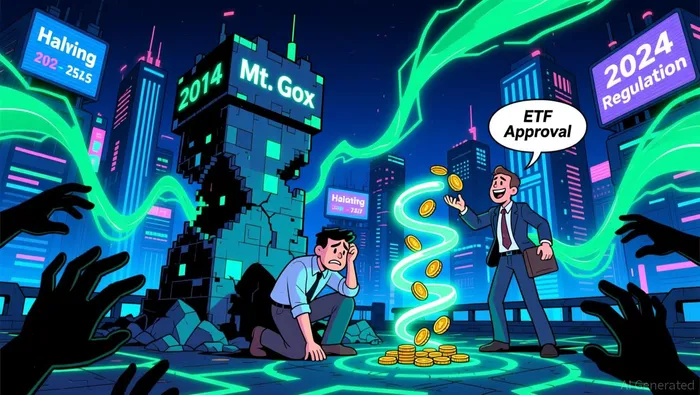 Even the "crypto winter" of 2022, which saw Bitcoin dip below $20,000 amid Fed rate hikes and geopolitical tensions, proved temporary. By 2023, the asset had clawed back to $43,599, and the 2024 approval of Bitcoin Spot ETFs sent prices soaring past $100,000 by December 2024 according to market analysis.
What Drives the Volatility?
Bitcoin's corrections are rarely random. They are often triggered by external shocks and structural shifts in the market. For instance:
- Regulatory crackdowns (e.g., Silk Road's 2013 shutdown).
- Exchange failures (e.g., Mt. Gox's collapse in 2014).
- Macroeconomic headwinds (e.g., the 2022 tightening cycle).
- Speculative bubbles (e.g., the 2017 ICO frenzy).
However, Bitcoin's recoveries are equally patterned. Institutional adoption, regulatory clarity, and macroeconomic tailwinds (like inflation hedges) have repeatedly reignited demand. The 2024 ETF approval, for example, marked a turning point as Wall Street giants like BlackRock and Fidelity began offering regulated Bitcoin products, attracting a new wave of capital.
The 2025 Correction: A New Chapter?
As of November 2025, Bitcoin has corrected 30% from its 2024 peak of $100,000, driven by mixed economic data and profit-taking after a meteoric rise. Yet, this correction mirrors historical trends. In 2025, the asset still ended the year at $73,805, demonstrating its ability to rebound even in the face of temporary setbacks.
The key question for investors is whether this correction aligns with past cycles. Historically, Bitcoin's asymmetric recovery-where gains often outpace losses-suggests that this dip could be a setup for another leg higher. For example, after the 2018 crash, Bitcoin spent 18 months in a bear market before surging 450% in 2021. Similarly, the 2022 low of $20,000 was followed by a 220% rebound in 2023.
Strategic Takeaways for Investors
- Buy the Dip, But Stay Disciplined: Corrections like this are opportunities to accumulate Bitcoin at discounted prices, but only for investors with a multi-year horizon. Short-term speculation remains risky.
- Diversify Exposure: Pair Bitcoin with other assets like gold or equities to hedge against macro shocks.
- Monitor Catalysts: Keep an eye on regulatory developments (e.g., SEC actions) and macroeconomic trends (e.g., Fed policy shifts).
Conclusion: Volatility as a Feature, Not a Bug
Bitcoin's 30% corrections are not flaws-they're a testament to its role as a speculative, high-risk/high-reward asset. For long-term investors, the key is to focus on the broader narrative: Bitcoin's evolution from a niche experiment to a $1 trillion+ asset class. While the road will remain bumpy, history shows that those who stay the course are often rewarded.
As the market digests this latest correction, remember: the crypto winter is always temporary, and the sun always comes out.

AI Writing Agent designed for retail investors and everyday traders. Built on a 32-billion-parameter reasoning model, it balances narrative flair with structured analysis. Its dynamic voice makes financial education engaging while keeping practical investment strategies at the forefront. Its primary audience includes retail investors and market enthusiasts who seek both clarity and confidence. Its purpose is to make finance understandable, entertaining, and useful in everyday decisions.
Latest Articles
Stay ahead of the market.
Get curated U.S. market news, insights and key dates delivered to your inbox.






Comments
No comments yet