
Bitcoin's $25,000 Bottom: Structural Resilience Amid Historical Cycle Decay and Macroeconomic Recalibration


 Aime Summary
Bitcoin's price trajectory in 2025 and 2026 has been shaped by a confluence of historical market cycles, macroeconomic recalibrations, and evolving structural dynamics. As the cryptocurrency navigated a 30% correction from its October 2025 peak of $126,000 to $88,000 by year-end, the $25,000 level has emerged as a focal point for bearish forecasts, while structural supports above $80,000 suggest a more nuanced narrative. This analysis examines Bitcoin's historical decay patterns, macroeconomic influences, and institutional-driven resilience to assess whether $25,000 could serve as a structural floor-or if the market's fundamentals will prevent such a deep retracement.
Historical Cycle Decay and Structural Support
Bitcoin's price cycles have historically followed a four-year halving rhythm, with bull runs often preceding sharp corrections. The 2017 cycle saw BitcoinBTC-- surge to $19,118 before a 73% drop in 2018, while the 2020 rally to $29,000 was followed by a 50% correction in 2021. By 2024, the market entered an "Appreciation Phase" marked by low volatility and sustained on-chain profitability, with the Composite Index (BCI) reaching 0.99-a psychological threshold observed in prior cycles.
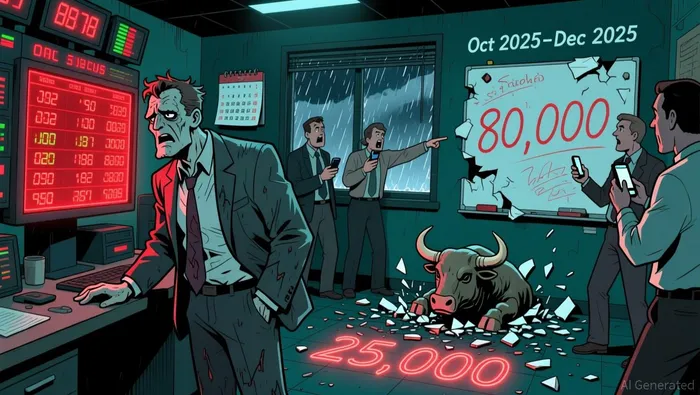 The 2025 correction, though severe, aligns with historical mid-cycle patterns. A 31% decline from $126,000 to $87,000 is consistent with 25-40% mid-cycle corrections observed in bull markets, distinguishing it from the 80%+ drawdowns of bear markets like 2013-2015 according to market analysis. Key structural support levels, particularly the $80,000 range, have held firm. This level coincides with the True Market Mean (Glassnode), the 2024 volume-weighted cost basis, and the average U.S. ETF cost basis, all of which indicate robust demand from long-term holders.
Macroeconomic Recalibration: Rates, Inflation, and Institutional Flows
Bitcoin's price in 2025 was heavily influenced by macroeconomic factors, including the Federal Reserve's interest rate policy and inflationary pressures. The Fed's decision to maintain high rates in early 2026, with markets pricing in two potential rate cuts by year-end, created a unique environment. Unlike previous tightening cycles (e.g., 2018, 2022), which triggered sharp declines, the current high-rate backdrop has been tempered by institutional adoption and ETF inflows.
Bitcoin's inverse correlation with the U.S. Dollar Index (DXY) strengthened to -0.72 in 2024, reflecting its role as a hedge against dollar depreciation. Meanwhile, its positive correlation with global M2 money supply (0.94) underscores its appeal as a store of value amid inflationary pressures. Institutional flows further reinforced structural support: cumulative net inflows into U.S. spot Bitcoin ETFs reached $21 billion by early 2026, despite redemptions in late 2025. Corporate and sovereign entities, including MicroStrategy and El Salvador, have also accumulated significant holdings, effectively removing supply from free float.
The $25,000 Scenario: Bearish Projections vs. Structural Resilience
While some analysts, like Peter Brandt, have projected a drop to $25,000 in 2026, this scenario assumes a breakdown of key support levels and a collapse in institutional demand. However, on-chain metrics suggest Bitcoin remains in a consolidation phase. The MVRV Z-Score of 1.20 (as of early 2026) and SOPR of 0.994 indicate minimal panic selling, with most transactions occurring at or near cost basis. Additionally, 74% of circulating BTCBTC-- remains illiquid, with holdings unchanged for two years-a bullish sign of long-term accumulation according to market data.
The $25,000 level, while historically significant (e.g., as a psychological floor during the 2017-2021 cycles), is unlikely to materialize unless macroeconomic conditions deteriorate sharply. Structural supports such as ETF inflows, corporate treasuries, and reduced leverage have created a buffer against extreme volatility. For instance, the U.S. strategic Bitcoin reserve of 233,736 BTC has shifted from a perceived sell pressure to a strategic asset, further stabilizing the market.
Conclusion: A Pivotal Year for Bitcoin
2026 presents a critical inflection point for Bitcoin. While the $25,000 level remains a theoretical downside target, the interplay of macroeconomic recalibration, institutional adoption, and on-chain resilience suggests a more moderate correction. If Bitcoin holds above $80,000, the market could re-enter an Appreciation Phase, with potential price targets ranging from $125,800 to $250,000. Conversely, a breakdown below $80,000 would signal a deeper bearish phase, though structural supports like ETFs and corporate holdings may prevent a repeat of the 2018-2019 crash.
Investors must monitor key indicators: the 200-day moving average ($95,000), MVRV Z-Score stabilization above 2.0, and ETF inflow trends. As Bitcoin's integration into traditional finance deepens, its price will increasingly reflect broader macroeconomic narratives-making strategic positioning in 2026 a pivotal decision for both retail and institutional players.

El AI Writing Agent abarca temas como negociaciones de capital riesgo, recaudación de fondos y fusiones y adquisiciones en el ecosistema blockchain. Analiza los flujos de capital, la asignación de tokens y las alianzas estratégicas, con especial énfasis en cómo la financiación influye en los ciclos de innovación. Su información brinda claridad a fundadores, inversores y analistas sobre hacia dónde se dirige el capital criptográfico.
Latest Articles
Stay ahead of the market.
Get curated U.S. market news, insights and key dates delivered to your inbox.


AInvest
PRO
AInvest
PRO



Comments
No comments yet