
Bitcoin as a 21st-Century Land Grab: The Strategic Case for Accumulation


 Aime Summary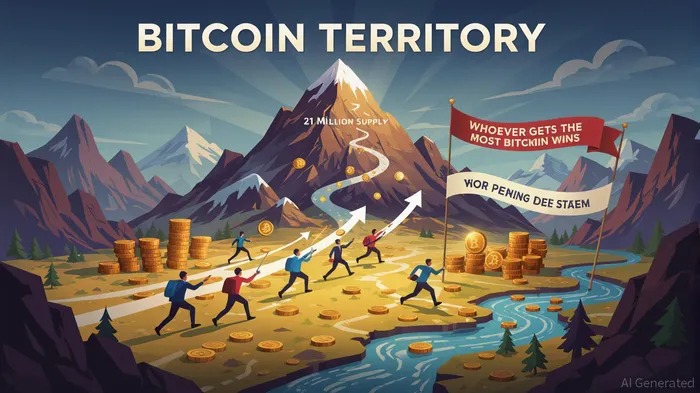
The 21st century has ushered in a new kind of frontier: a finite digital asset with the potential to redefine wealth accumulation. BitcoinBTC--, with its capped supply of 21 million coins, mirrors the speculative frenzies of historical land grabs, where scarcity and demand collide to create exponential value. Today, the race to accumulate Bitcoin is not just a retail phenomenon—it’s a corporate and institutional imperative. As adoption surges and macroeconomic tailwinds align, the strategic case for aggressive Bitcoin ownership has never been clearer.
The Surge in Adoption and Institutional Demand
Bitcoin’s adoption has accelerated at an unprecedented pace. By 2025, 28% of American adults (65 million people) own cryptocurrency, with 66% of those planning to buy more [3]. This surge is driven by mainstream acceptance, regulatory clarity, and the launch of Bitcoin ETFs in the U.S., which have institutionalized access to the asset [4]. Corporate treasuries are now allocating billions to Bitcoin, with public companies holding over $91 billion in the cryptocurrency by mid-2025 [5].
The market capitalization of Bitcoin has ballooned to $2.197 trillion, up 86.53% year-over-year [4]. Experts project further growth, with some predicting a price target of $250,000 by year-end 2025 [5]. This trajectory is fueled by a structural shift: Bitcoin is no longer a speculative asset but a core component of diversified portfolios.
The Saylor Thesis: "Whoever Gets the Most Bitcoin Wins"
Michael Saylor’s bold thesis—“whoever gets the most Bitcoin wins”—has become a rallying cry for institutional investors. Under his leadership, StrategyMSTR-- (formerly MicroStrategy) has transformed into the largest publicly traded Bitcoin holder, acquiring 582,000 BTC at an average cost of $70,086 per coin [2]. This strategy, funded through equity and debt offerings, has turned Strategy into a case study in Bitcoin’s long-term value. The company’s stock has surged over 3,000% since 2020, outperforming traditional assets and indices [5].
Saylor’s approach is rooted in Bitcoin’s fixed supply and its role as a hedge against fiat devaluation. He argues that Bitcoin’s scarcity and growing adoption will drive its price higher over time, making early accumulation a critical advantage [2]. This logic has been echoed by other corporations, including GameStopGME-- and Trump MediaDJT-- & Technology Group, which have allocated billions to Bitcoin treasuries [1].
Market Dynamics and the Maturing Asset Class
Bitcoin’s volatility has historically been a double-edged sword, but 2025 marks a turning point. Institutional participation has tempered price swings, with corrections now averaging 26% instead of the traditional 70-80% drawdowns [1]. This maturation is driven by macro-correlated behavior, as Bitcoin increasingly mirrors the trends of traditional assets like gold and equities.
The approval of Bitcoin ETFs and the launch of new financial products have broadened the investor base, reducing the influence of individual “whales” who once dictated price movements [3]. Meanwhile, stablecoins and altcoins like EthereumETH-- and SolanaSOL-- are gaining traction, but Bitcoin remains the dominant force, holding 59.3% of the crypto market [4].
The Strategic Imperative for Accumulation
The parallels to historical land grabs are striking. Just as early settlers in the 19th century secured claims before prices soared, today’s investors must act swiftly to capture Bitcoin’s appreciating value. The U.S. Strategic Bitcoin Reserve, established in March 2025, and corporate accumulation strategies underscore the asset’s growing legitimacy [6].
For individual investors, the message is clear: Bitcoin’s finite supply and institutional adoption create a compounding effect. Those who accumulate now—whether through ETFs, direct purchases, or corporate treasuries—position themselves to benefit from its long-term appreciation. As Saylor emphasizes, the goal is not to time the market but to own as much of the asset as possible before its supply runs out.
Risks and the Path Forward
Critics argue that Bitcoin’s volatility and the risks of leveraged financing (as seen in MicroStrategy’s debt-heavy strategy) could backfire. A 90% price drop, while unlikely, would test the resilience of even the most bullish investors [4]. However, the growing participation of institutional players and the emergence of macroeconomic correlations suggest that Bitcoin is evolving into a more stable asset class.
For those willing to embrace the long-term vision, the rewards are substantial. As the world transitions to crypto-native capital allocation, Bitcoin’s role as a store of value and inflation hedge will only strengthen. The question is no longer whether Bitcoin is a viable investment—it’s how much of it you can afford to own.
Source:
[1] Bitcoin price cycle might be breaking
https://www.cnbc.com/2025/08/08/bitcoin-btc-price-cycle-might-be-breaking.html
[2] How Michael Saylor's Strategy became the largest Bitcoin holder
https://medium.com/@giannisandreoua/how-michael-saylors-strategy-became-the-largest-bitcoin-holder-0c7d756150ac
[3] GameStop Joins $50 Billion Institutional Surge Into Bitcoin
https://www.pymnts.com/cryptocurrency/2025/strategy-gamestop-lead-50-billion-institutional-surge-into-bitcoin-as-treasury-asset/
[4] Bitcoin's $20 Trillion Aspiration: A Structural Revolution in Global Finance
https://www.ainvest.com/news/bitcoin-20-trillion-aspiration-structural-revolution-global-finance-2508/
[5] Bitcoin is getting boring. That could open more doors for the crypto asset on Wall Street
https://finance.yahoo.com/news/bitcoin-is-getting-boring-that-could-open-more-doors-for-the-crypto-asset-on-wall-street-091231252.html
[6] Bitcoin Price History Chart + Historical Events 2009-2025
https://99bitcoins.com/cryptocurrency/bitcoin/historical-price/

Decoding blockchain innovations and market trends with clarity and precision.
Latest Articles
Stay ahead of the market.
Get curated U.S. market news, insights and key dates delivered to your inbox.




Comments
No comments yet