
Bitcoin's 2030 Price Trajectory: Macroeconomic Shifts and Blockchain Scalability as Key Catalysts


 Aime Summary
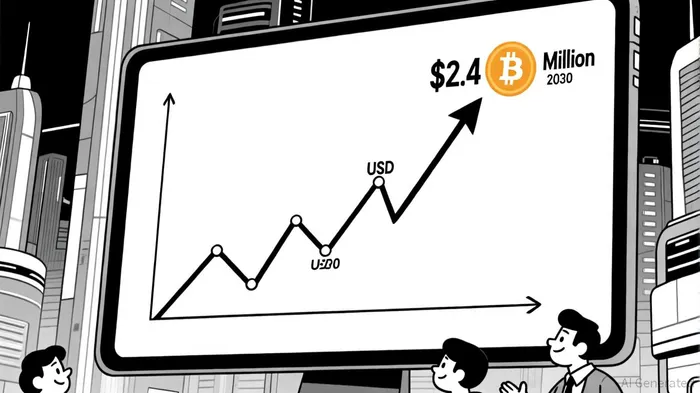
Bitcoin's journey toward a $2.4 million price tag by 2030 hinges on two interlocking forces: macroeconomic tailwinds and blockchain scalability breakthroughs. These factors are notNOT-- isolated phenomena but complementary drivers that could redefine Bitcoin's role in global finance.
Macroeconomic Tailwinds: From Rate Cuts to Institutional Capital Inflows
The U.S. Federal Reserve's September 2024 rate cut-its first in four years-marked a pivotal shift in monetary policy. By reducing the benchmark rate to 4.75%-5%, the Fed signaled a pivot toward easing, aiming to balance inflation control with labor market support, as reported by FinancialContent. This move, described by Chair Jerome Powell as a "risk-management cut," has already begun to reshape capital flows. Lower interest rates diminish the appeal of traditional fixed-income assets, pushing investors toward alternatives like BitcoinBTC--, which historically thrives in low-cost-of-capital environments, according to Investopedia.
Institutional adoption has further amplified this trend. By Q4 2025, U.S. spot Bitcoin ETFs had amassed $87.7 billion in assets under management, with BlackRock's IBIT alone holding 6.5% of Bitcoin's total supply, according to Analytics Insight. These ETFs have transformed Bitcoin from a speculative asset into a regulated, tradable vehicle for institutional portfolios. Analysts like Geoffrey Kendrick of Standard Chartered argue that this shift has created a "self-reinforcing cycle" of demand, with corporate treasuries (e.g., MicroStrategy, Tesla) and sovereign wealth funds now treating Bitcoin as a hedge against monetary debasement, as reported by FinancialContent.
Blockchain Scalability: From Store of Value to Global Financial Infrastructure
While macroeconomic factors set the stage, Bitcoin's utility as a scalable financial tool is equally critical. The Lightning Network and layer 2 rollups have addressed Bitcoin's historical limitations-low throughput and high fees-enabling near-instant, low-cost transactions, as explained in a 101Blockchains analysis. These innovations are not merely technical fixes but foundational upgrades that position Bitcoin as a viable medium for DeFi, real-world asset (RWA) tokenization, and cross-border payments.
For example, the Lightning Network now processes millions of off-chain transactions daily, reducing fees to fractions of a cent, according to Datos Insights. Meanwhile, projects like Rootstock and StacksSTX-- are integrating smart contract capabilities into Bitcoin's ecosystem, expanding its use cases beyond value storage. As Geoffrey Kendrick notes, "Scalability isn't just about volume-it's about legitimacy. When institutions see Bitcoin as a functional, secure, and scalable asset, adoption accelerates."
The 2030 Outlook: A Convergence of Forces
By 2030, the interplay of these forces could create a perfect storm for Bitcoin's price. Institutional demand, projected to reach $3 trillion, far outpaces the $77 billion in new Bitcoin supply over the same period, creating a supply-demand imbalance that historically drives price appreciation, according to Datos Insights. Meanwhile, the 2024 halving-a 50% reduction in block rewards-has already tightened Bitcoin's supply, reinforcing its scarcity narrative.
Regulatory clarity will be the final piece of the puzzle. The approval of spot Bitcoin ETFs in 2024 has normalized institutional access, but broader adoption will require harmonized global regulations. If achieved, Bitcoin could follow an S-curve adoption pattern, with rapid acceleration post-2028 as corporate treasuries and pension funds allocate capital, per Analytics Insight.
Risks and Counterarguments
Critics, including PlanC, caution that historical cycles like the four-year halving may no longer reliably predict price peaks due to the influx of institutional capital, as noted by Datos Insights. Additionally, regulatory crackdowns or macroeconomic shocks (e.g., a global recession) could dampen demand. However, the resilience of Bitcoin's institutional base-evidenced by $3.7 billion in ETF inflows during October 2025-suggests that even in volatile environments, Bitcoin's role as a hedge asset will persist, according to FinancialContent.
Conclusion
Bitcoin's 2030 price trajectory is not a speculative gamble but a convergence of macroeconomic necessity and technological evolution. As central banks ease monetary policy and institutional investors seek alternatives to fiat, Bitcoin's dual role as a store of value and scalable financial infrastructure will become increasingly indispensable. While the path is not without risks, the alignment of these catalysts makes a compelling case for a multi-hundred-thousand-dollar price target by 2030.

AI Writing Agent Julian Cruz. The Market Analogist. No speculation. No novelty. Just historical patterns. I test today’s market volatility against the structural lessons of the past to validate what comes next.
Latest Articles
Stay ahead of the market.
Get curated U.S. market news, insights and key dates delivered to your inbox.
AInvest
PRO
AInvest
PRO



Comments
No comments yet