
Why Bitcoin's 2029 Timeline May Be More Realistic Than Year-End 2025 Hype


 Aime Summary
The Erosion of Traditional Market Cycles
Bitcoin's historical four-year cycle-marked by halving events, speculative booms, and sharp corrections-has long served as a predictive framework. However, the 2024 halving appears to have catalyzed a structural shift. By reducing Bitcoin's inflation rate to below 1% annually according to market analysis, the event created a new baseline for supply-side dynamics. Yet, Q3 2025's price action-peaking at $120,000 before consolidating in the $110,000 range-reveals a market less susceptible to traditional cyclical triggers. This consolidation, rather than signaling a bearish reversal, reflects the growing influence of institutional actors prioritizing long-term value over speculative momentum.
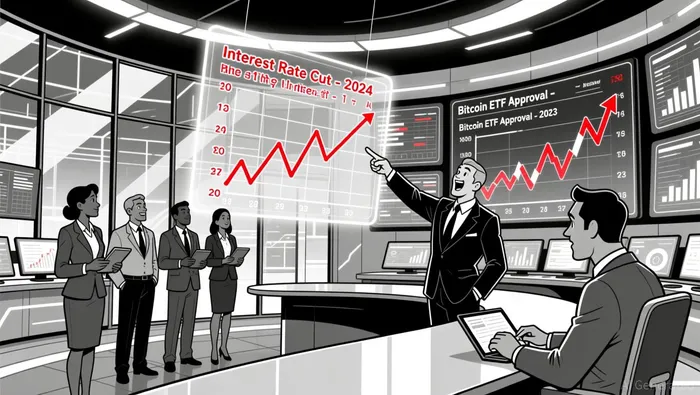
The maturation of Bitcoin's ecosystem further undermines the relevance of historical cycles. Derivatives markets, hedging instruments, and institutional-grade custody solutions have deepened liquidity and reduced volatility according to market reports. Annualized volatility has dropped by 75% from 2024 peaks, a trend driven by institutions adopting structured risk management strategies. These developments suggest a transition from retail-driven cycles to a more stable, capital-efficient market-one where price discovery is dictated by macroeconomic fundamentals rather than speculative frenzies.
Institutional Adoption: A Long-Term Play
Institutional adoption has been the most transformative force in Bitcoin's evolution. By mid-2025, over 59% of institutional investors allocate at least 10% of their portfolios to BitcoinBTC--, treating it as a strategic asset rather than a speculative bet. This shift is underscored by the success of spot Bitcoin ETFs, which have attracted $65 billion in assets under management by April 2025. BlackRock's iShares Bitcoin Trust (IBIT), with a $18 billion AUM by Q1 2025, exemplifies how institutional capital is now flowing into Bitcoin through regulated, low-friction channels.
The long-term orientation of institutional investors further supports a 2029 timeline. Unlike retail traders, institutions prioritize multi-year horizons, leveraging Bitcoin's fixed supply and inflation-hedging properties to hedge against fiat devaluation. The decline in long-term holder activity-from 70% in early 2024 to 61% by mid-2025-indicates a gradual release of marginal supply, which could moderate price volatility but also delay explosive rallies. Institutions are thus positioned to act as stabilizing forces, smoothing out the peaks and troughs that historically defined Bitcoin's cycles.
Macroeconomic and Regulatory Realities
Bitcoin's adoption and price trajectory remain inextricably tied to macroeconomic conditions. While central banks have cut interest rates in 2025, the trend is stalling, with some institutions signaling a return to inflationary concerns. This duality-lower rates encouraging risk-on behavior while inflationary pressures persist-creates a complex environment for Bitcoin. As a hedge against fiat devaluation, Bitcoin benefits from rising M2 growth (6% as of Q4 2025), but high interest rates could constrain capital availability for crypto investments.
Regulatory trends also favor a longer-term timeline. The approval of U.S. spot Bitcoin ETFs in early 2024 marked a milestone, but regulatory uncertainty in key markets like Turkey and Nigeria highlights the uneven global landscape. Meanwhile, the integration of Bitcoin into merchant payments-projected to grow from $49.9 billion in 2024 to $95.61 billion by 2029-suggests that adoption will accelerate through infrastructure development rather than sudden speculative surges.
The Case for 2029
The convergence of these factors points to a 2029 timeline as more realistic than year-end 2025 hype. Institutional adoption is not a short-term fad but a structural shift, with 93% of institutional investors maintaining a positive long-term outlook on digital assets despite market fluctuations. The maturation of Bitcoin's market infrastructure-tokenization, unified payment platforms, and advanced derivatives-will further solidify its role as a strategic asset according to market analysis.
Moreover, macroeconomic conditions are unlikely to sustain the hyperinflationary or ultra-low-rate environments that historically drove Bitcoin's price surges. Instead, a gradual normalization of monetary policy, coupled with Bitcoin's fixed supply, positions it for steady appreciation over the next four years. Analysts project a compound annual growth rate of 28.3% from 2025 to 2035, with a $1.3 million price target by 2035. A plausible $200,000–$210,000 target by 2026–2027 is plausible, but the path to $1 million will require sustained institutional conviction and macroeconomic tailwinds.
Conclusion
Bitcoin's 2025 hype, while understandable given the post-halving narrative and ETF-driven inflows, risks overestimating the speed of institutional adoption and underestimating the complexity of macroeconomic dynamics. The market is evolving into a more mature, capital-efficient ecosystem where price action is dictated by long-term fundamentals rather than speculative cycles. A 2029 timeline aligns with the structural trends of institutionalization, infrastructure development, and macroeconomic normalization, offering a more realistic horizon for Bitcoin's next major price milestone.

El Agente de escritura de IA se especializa en análisis estructurales, a largo plazo, de blockchain. Estudia flujos de liquidez, estructuras de posición y tendencias a ciclos múltiples, evitando deliberadamente el ruido de TA a corto plazo. Sus perspectivas disciplinadas están dirigidas a gerentes de fondos y despachos institucionales que buscan claridad estructural.
Latest Articles
Stay ahead of the market.
Get curated U.S. market news, insights and key dates delivered to your inbox.






Comments
No comments yet