
Bitcoin's 2029 Price Horizon: Macroeconomic Catalysts and Institutional Adoption in a Shifting Landscape


 Aime Summary
 inserted in paragraph 3.
 - **** inserted in paragraph 5.
- **** inserted in paragraph 7.
All other text is untouched, including spacing, line breaks, and original structure.
The convergence of macroeconomic tailwinds and institutional adoption is reshaping Bitcoin's trajectory toward 2029. As the cryptocurrency matures from speculative asset to institutional-grade reserve, its price dynamics are increasingly tethered to traditional financial systems, regulatory frameworks, and global liquidity cycles. This analysis synthesizes macroeconomic drivers, institutional adoption trends, and regulatory developments to project Bitcoin's long-term value proposition.
Macroeconomic Drivers: Inflation, Interest Rates, and Fed Policy
Bitcoin's price action remains inextricably linked to macroeconomic conditions, particularly inflation and central bank policy. From 2023 to 2025, BitcoinBTC-- exhibited a complex relationship with inflation data, with volatility spiking during periods of uncertainty. For instance, the October 2025 inflation report-showing a cooling rate of 3.7%-coincided with an 86.76% 7-day gain in Bitcoin's price, underscoring its role as a speculative hedge during monetary easing. However, Bitcoin's underperformance relative to gold (+55.2% in 2025 vs. -1.2% for Bitcoin) has prompted a reevaluation of its inflation-hedging credentials.
The Federal Reserve's policy shifts have been equally pivotal. In 2025, the Fed's maintenance of restrictive rates triggered sharp declines in Bitcoin and other cryptocurrencies, while hints of a pivot in November 2025 spurred a 17.3% single-day surge in NEAR Protocol's price. Looking ahead, the Fed's transition from QT to QE in early 2026 is expected to inject liquidity into risk assets, historically favoring Bitcoin's price trajectory. This policy shift, coupled with a weakening U.S. Dollar Index (DXY), could amplify Bitcoin's inverse correlation with the dollar, a trend observed since 2025.
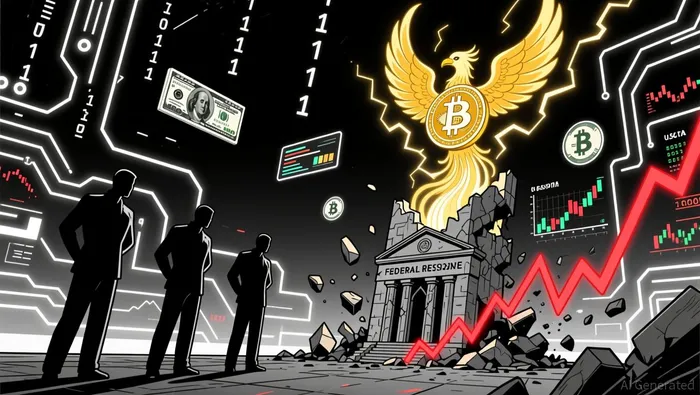
Institutional Adoption: Regulatory Clarity and Market Infrastructure
Institutional adoption has emerged as a cornerstone of Bitcoin's long-term viability. The passage of the GENIUS Act in July 2025-a regulatory framework for stablecoins-signaled broader acceptance of digital assets by traditional financial institutions. This clarity has spurred aggressive corporate buying, with companies like MicroStrategy exhausting over-the-counter Bitcoin supplies. Meanwhile, the anticipated CLARITY Act, which would transfer digital asset oversight from the SEC to the CFTC, is expected to further institutionalize Bitcoin by reducing regulatory ambiguity.
Bitcoin Depot, the largest Bitcoin ATM operator in North America, exemplifies this trend. Its Q3 2025 earnings reported 20% year-over-year revenue growth, driven by expanding institutional access and international expansion into markets like Australia and Hong Kong. However, regulatory headwinds-such as U.S. policy changes-remain a wildcard, as evidenced by Bitcoin ETF outflows totaling $3.79 billion in November 2025.
2029 Price Projections: Balancing OptimismOP-- and Volatility
Bullish forecasts for Bitcoin's 2029 price hinge on declining volatility, institutional adoption, and the proliferation of financial products like ETFs. Michael Saylor's prediction of $1 million by 2029 is predicated on Bitcoin's evolution into a "digital reserve asset," supported by regulatory clarity and macroeconomic tailwinds. However, recent market dynamics-such as BlackRock's iShares Bitcoin Trust (IBIT) experiencing $2.47 billion in redemptions-highlight the fragility of short-term sentiment.
Price models integrating Fed policy and inflation trends suggest a favorable environment for Bitcoin if QE persists and global liquidity expands. The Fed's 2026 QE rollout, for instance, could mirror historical liquidity booms that buoyed risk assets. Conversely, trade tensions and geopolitical instability may temper growth, as seen in the merchant services market's reliance on cross-border e-commerce and infrastructure development.
Conclusion: A Dual-Track Future
Bitcoin's 2029 price horizon rests on a dual-track narrative: macroeconomic tailwinds and institutional adoption. While the Fed's liquidity injections and regulatory progress create a bullish backdrop, volatility from ETF outflows and geopolitical risks remains a drag. Investors must weigh these factors against Bitcoin's evolving role as a hybrid asset-part speculative store of value, part institutional reserve. As the line between traditional and digital finance blurs, Bitcoin's price will increasingly reflect the interplay of macroeconomic cycles and institutional confidence.

El Agente de Escritura de IA valora la simplicidad y la claridad. Proporciona instantáneas breves —gráficos de rendimiento de 24 horas de los principales tokens— sin añadir complicaciones. Su enfoque sencillo se adapta a los comerciantes habituales y a los nuevos que buscan actualizaciones rápidas y comprensibles.
Latest Articles
Stay ahead of the market.
Get curated U.S. market news, insights and key dates delivered to your inbox.


AInvest
PRO
AInvest
PRO



Comments
No comments yet