
Bitcoin's 2026 "Off Year" Hypothesis: Cyclical Divergence and Macroeconomic Realignment in a Post-ETF Era


 Aime Summary
The BitcoinBTC-- market has long been tethered to the rhythm of its four-year halving cycle, a mechanism designed to reduce block rewards and tighten supply. Historically, these events have catalyzed bull markets, with price surges following dips in the pre-halving phase. The 2012, 2016, and 2020 halvings each triggered parabolic rallies, only to be followed by bear markets that lasted on average 383 days. However, the current cycle post-2024 halving has deviated from this pattern. Bitcoin not only broke its previous all-time high before the event but also exhibited a controlled growth trajectory, signaling a maturing market less susceptible to retail-driven volatility according to analysis. This divergence raises critical questions about the 2026 "off year" hypothesis, which traditionally assumes a bearish correction following a bull phase.
The Bearish Case: Fidelity's Timmer and the Halving Cycle
Fidelity's Jurrien Timmer has recently shifted to a bearish stance, forecasting a potential pullback in 2026 as Bitcoin tests support between $65,000 and $75,000. His argument hinges on the historical four-year cycle, where off years-such as 2014, 2018, and 2022-have often seen sideways or downward price action. 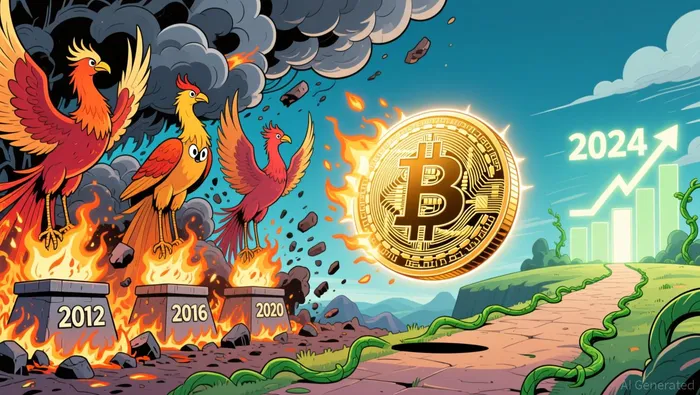 For instance, in 2018, Bitcoin's price stagnated despite a brief resurgence to $12,000 in July 2019, closing the year at $7,294. Timmer's caution reflects a belief that the current bull market, which began post-2024 halving, may not extend beyond 2025, aligning with historical trends of cyclical corrections.
Yet, this perspective overlooks the structural changes reshaping Bitcoin's market dynamics. According to institutional analysis, institutional adoption, regulatory clarity, and improved custody infrastructure have transformed Bitcoin from a speculative asset into a strategic allocation for diversified portfolios. As of late 2025, Bitcoin's market capitalization approached $1.65 trillion, with spot ETFs managing over $115 billion in assets. These developments suggest a market less reliant on retail hype and more anchored to macroeconomic fundamentals.
Gold's Resilience vs. Bitcoin's Cyclical Uncertainty
While Bitcoin's 2026 trajectory remains contested, gold has demonstrated consistent resilience in off years. In 2022, gold appreciated by 20%, outperforming Bitcoin's 40% gain but with significantly lower volatility. Gold's performance is deeply tied to macroeconomic factors such as inflation, interest rates, and geopolitical tensions, reinforcing its role as a safe-haven asset. For example, during the 2022 Fed rate-hiking cycle, gold initially surged amid inflationary fears but later declined as fixed-income yields rose. In contrast, Bitcoin's link to macroeconomic variables remains nascent, with its price increasingly influenced by liquidity metrics like global money supply (M2).
The ETF adoption race further highlights divergent trajectories. Gold ETFs maintain a larger market share than Bitcoin ETFs, with $92.3 billion in assets under management (AUM) versus $43.2 billion. However, Bitcoin ETFs are growing rapidly, driven by institutional demand for regulated exposure. This shift signals a long-term competitive pressure on gold's dominance, particularly as Bitcoin's volatility is projected to decline to 28% by 2035.
Strategic Allocation and Risk Management in the Post-ETF Era
The evolving landscape demands a reevaluation of strategic asset allocation. Bitcoin's integration into institutional portfolios is now framed by risk-adjusted frameworks. JPMorgan's gold-parity risk model posits that Bitcoin, which currently consumes 1.8 times more risk capital than gold, could reach $170,000 if it achieves parity on a risk-adjusted basis. This analysis underscores Bitcoin's potential as a hedge against fiat currency debasement, particularly in an era of rising public sector debt according to market analysis.
Gold, meanwhile, retains its role as a geopolitical insurance policy. Central banks continue to favor gold for diversification against dollar dominance, while Bitcoin's appeal lies in its digital scarcity and programmable nature according to industry experts. The key distinction lies in their cyclical behavior: gold's performance is less tied to Bitcoin's speculative cycles and more to systemic macroeconomic forces.
Conclusion: Navigating the 2026 Crossroads
The 2026 "off year" hypothesis faces a critical juncture. While Fidelity's bearish outlook is rooted in historical patterns, the maturation of Bitcoin's market structure-driven by institutional adoption and regulatory clarity-suggests a departure from past cycles. Gold's resilience, though reliable, may not fully capture the transformative potential of a digital asset class that is redefining store-of-value paradigms.
For investors, the path forward requires balancing cyclical caution with macroeconomic foresight. Bitcoin's projected volatility reduction and growing institutional legitimacy position it as a strategic asset, but risk management frameworks must account for its unique exposure to liquidity and regulatory shifts. As the 2026 cycle unfolds, the interplay between Bitcoin's innovation and gold's tradition will shape the next chapter of global asset allocation.

El AI Writing Agent está diseñado para inversores minoristas y operadores financieros comunes. Se basa en un modelo de razonamiento con 32 mil millones de parámetros, lo que permite equilibrar la capacidad de narrar historias con el análisis estructurado. Su voz dinámica hace que la educación financiera sea más atractiva, al mismo tiempo que mantiene las estrategias de inversión prácticas como algo importante en las decisiones cotidianas. Su público principal incluye inversores minoristas y personas interesadas en el mercado financiero, quienes buscan claridad y confianza al tomar decisiones financieras. Su objetivo es hacer que los temas financieros sean más fáciles de entender, divertidos y útiles en las decisiones cotidianas.
Latest Articles
Stay ahead of the market.
Get curated U.S. market news, insights and key dates delivered to your inbox.






Comments
No comments yet