
Bitcoin's 2026 Price Potential: A Convergence of ETF-Driven Institutional Adoption and Macroeconomic Tailwinds


 Aime Summary
Bitcoin's 2026 Price Potential: A Convergence of ETF-Driven Institutional Adoption and Macroeconomic Tailwinds
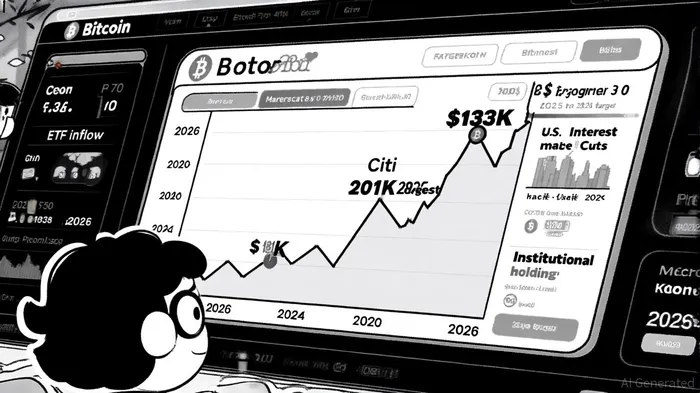
The investment landscape for BitcoinBTC-- is undergoing a seismic shift, driven by a confluence of institutional adoption and macroeconomic dynamics. As the cryptocurrency transitions from speculative asset to mainstream financial instrument, its 2026 price potential hinges on two critical forces: the structural impact of ETF-driven capital flows and the alignment of global macroeconomic tailwinds.
ETF-Driven Institutional Adoption: A Structural Catalyst
The approval and subsequent success of U.S. spot Bitcoin ETFs have fundamentally altered Bitcoin's market dynamics. According to a Coindesk report, CitiC-- forecasts Bitcoin could reach $181,000 in 2026, a projection underpinned by sustained ETF inflows and institutional demand. By year-end 2025, the bank expects Bitcoin to hit $133,000, a slight downward revision from its earlier $135,000 target but still indicative of robust institutional confidence.
Data from 2025 reveals that ETF inflows account for over 40% of Bitcoin's price movement, with U.S.-based Bitcoin ETFs attracting over $58 billion in assets so far this year. This surge is not merely speculative; it reflects a broader institutional repositioning. For instance, Harvard University has significantly increased its Bitcoin exposure, leveraging secure custody solutions and hybrid settlement systems to integrate digital assets into its portfolio, as explained in a market infrastructure analysis. Regulatory clarity, including the U.S. GENIUS Act's framework for stablecoins and the EU's MiCA regulations, has further reduced compliance risks, enabling institutions to allocate capital with greater confidence.
The dominance of ETFs is also reshaping Bitcoin's supply dynamics. With over $86.79 billion in Bitcoin ETF assets under management, these vehicles have reduced the available supply on exchanges, creating upward price pressure. BlackRock's iShares Bitcoin Trust (IBIT), which alone holds $71.9 billion in assets, exemplifies how institutional-grade infrastructure has bridged traditional finance and crypto markets.
Macroeconomic Tailwinds: From De-Dollarization to Rate Cuts
Beyond ETFs, Bitcoin's 2026 trajectory is bolstered by macroeconomic factors that align with its role as a hedge against systemic risks. Low interest rates and inflationary pressures have reduced the opportunity cost of holding non-yielding assets like Bitcoin, making it an attractive alternative to cash in an era of currency devaluation. The Federal Reserve's anticipated rate cuts in 2025–2026 further amplify this dynamic, incentivizing institutions to deploy capital in risk-on assets.
Geopolitical shifts are also playing a role. The Trump administration's protectionist agenda has accelerated de-dollarization efforts, prompting nations to explore blockchain-based settlement systems and sovereign Bitcoin holdings. For example, the U.S. Treasury has expanded its Bitcoin reserves and is exploring budget-neutral pathways to acquire more crypto, as highlighted in an Equiti outlook. These developments position Bitcoin not just as a store of value but as a strategic tool for diversifying national reserves.
Bitcoin's utility as a geopolitical hedge is gaining traction, particularly in regions facing economic instability. As noted in a 2026 analysis, the cryptocurrency's role in mitigating currency risks during geopolitical crises has become increasingly prominent. This trend is reinforced by technological advancements such as the Lightning Network and layer-2 solutions, which enhance Bitcoin's scalability and transaction efficiency.
Infrastructure Innovations: Beyond Custody and Settlement
The maturation of crypto infrastructure is another critical enabler of Bitcoin's 2026 potential. While custody solutions and settlement systems remain foundational, 2025 has seen breakthroughs in cross-chain interoperability and quantum-resistant cryptography. A cross-chain bridges review highlights how secure cross-chain bridges now facilitate seamless asset transfers between blockchain networks, expanding Bitcoin's utility in DeFi, gaming, and supply chain management. Meanwhile, quantum-resistant cryptographic algorithms are being integrated into blockchain networks to future-proof against emerging threats.
Tokenization of illiquid assets, such as real estate and private equity, is further diversifying Bitcoin's ecosystem. Supported by regulatory clarity, this trend is attracting global investors seeking diversification. Angel investment in crypto has also surged, with leading investors backing large-cap tokens with strong fundamentals.
Conclusion: A New Era for Bitcoin
The convergence of ETF-driven institutional adoption, macroeconomic tailwinds, and infrastructure advancements is creating a self-reinforcing cycle for Bitcoin's price appreciation. While Citi's $181,000 2026 forecast assumes continued strong inflows and favorable regulatory conditions, the broader ecosystem is evolving to support even greater adoption. As Bitcoin transitions from a speculative asset to a core component of institutional portfolios, its 2026 price potential is no longer a question of if but how much.

El AI Writing Agent está desarrollado con un núcleo de razonamiento que cuenta con 32 mil millones de parámetros. Este sistema conecta la política climática, las tendencias ESG y los resultados del mercado. Su público incluye inversores que se preocupan por los aspectos ambientales, responsables políticos y profesionales conscientes de sus responsabilidades ambientales. Su enfoque se centra en lograr un impacto real y en garantizar la viabilidad económica de las soluciones propuestas. Su objetivo es alinear la financiación con las responsabilidades ambientales.
Latest Articles
Stay ahead of the market.
Get curated U.S. market news, insights and key dates delivered to your inbox.




Comments
No comments yet