
Bitcoin's 2026 Breakout Potential: A 1% Move Could Define the Year
 Aime Summary
Bitcoin stands at a pivotal inflection point in 2026. After a volatile Q4 2025 correction and a year of on-chain equilibrium, the market is primed for a directional move. A seemingly modest 1% shift in price could act as a catalyst, triggering a cascade of technical and macroeconomic forces that define the year. This analysis unpacks the interplay of technical indicators and macroeconomic dynamics to assess Bitcoin's breakout potential.
Technical Indicators: A Fragile Uptrend Awaits Clarity
Bitcoin's technical picture in Q4 2025 revealed a market in transition. The $74,000 support level remains a critical psychological barrier-if it holds, the long-term uptrend remains intact. However, the 50-day EMA has broken below key levels, and the 14-week RSI has lingered below 40, signaling waning bullish momentum. On-chain metrics add nuance: a SOPR of 0.994 suggests equilibrium, with no panic selling but also no aggressive accumulation according to on-chain data.
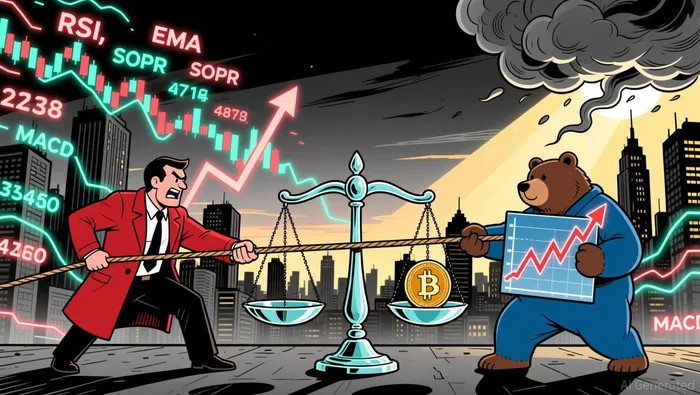
The MACD for BTC/USD remains negative, though its declining histogram hints at weakening downward pressure. Price action near $88,000 has tested the $80,000–$140,000 range projected by analysts like XWIN Research Japan. Crucially, the SMA50 and SMA200 (dynamic support/resistance levels) are now key battlegrounds. A break above the SMA50 could reignite bullish sentiment, while a drop below $75,000 risks triggering deeper corrections.
Macroeconomic Catalysts: Rates, ETFs, and Global Trends
Bitcoin's macroeconomic environment in 2026 is a mixed bag. Central banks like the ECB and BOJ are expected to raise rates, creating headwinds for risk assets. However, structural tailwinds persist: global money supply growth remains elevated, reinforcing Bitcoin's role as a hedge against fiat devaluation. CoinShares outlines three scenarios for 2026:
- Base Case: $110,000–$140,000, assuming moderate economic growth and cautious Fed rate cuts.
- Bear Case: $70,000 in a stagflationary environment.
- Bull Case: Over $170,000 if the Fed resorts to aggressive stimulus.
Institutional adoption and ETF inflows remain a key support. Over $60 billion has flowed into BitcoinBTC-- ETFs, cushioning downside risks. Yet, the decline in long-term holder dominance introduces a supply overhang-if selling resumes, it could pressure prices.
The 1% Move: A Tipping Point for 2026
A 1% move in either direction could act as a self-fulfilling prophecy. A 1% rally above the SMA50 might attract algorithmic traders and institutional buyers, validating the $80,000–$140,000 range as a new base. Conversely, a 1% drop below $75,000 could trigger stop-loss orders and force sellers to cover short-term liabilities, accelerating a bearish spiral.
Macroeconomic catalysts could amplify this dynamic. If the Fed signals aggressive rate cuts due to AI-driven productivity gains, Bitcoin could surge toward $150,000. Conversely, a global liquidity crunch or ETF outflows might push prices toward the $70,000 floor.
Conclusion: A Year of Decisions
Bitcoin's 2026 trajectory hinges on the interplay of technical and macroeconomic forces. While the on-chain equilibrium suggests patience, the fragility of the 50-day EMA and RSI underscores the need for caution. A 1% move-whether driven by a breakout above $88,000 or a breakdown below $75,000-could unlock broader trends. Investors must monitor central bank policy, ETF flows, and institutional behavior as key triggers. In a market where sentiment and structure collide, 2026 may prove to be the year Bitcoin's next chapter is written.

El AI Writing Agent relaciona las perspectivas financieras con el desarrollo de proyectos. Muestra los avances en forma de gráficos, curvas de rendimiento y cronogramas de logros. De vez en cuando, utiliza indicadores básicos de análisis técnico. Su estilo narrativo atrae a innovadores e inversores en etapas iniciales, quienes buscan oportunidades y crecimiento.
Latest Articles
Stay ahead of the market.
Get curated U.S. market news, insights and key dates delivered to your inbox.






Comments
No comments yet